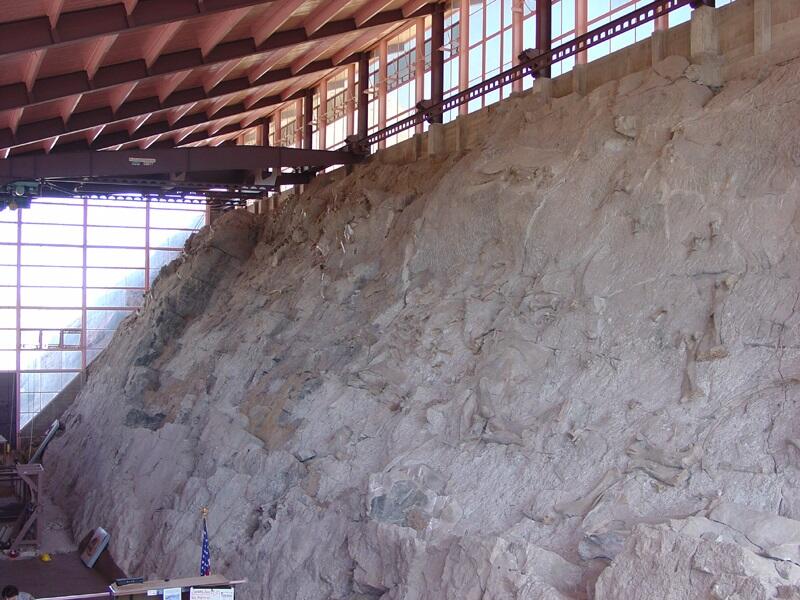
Bonebeds tempt readers into a dramatic mistake. A hillside full of dinosaur bones looks like a frozen disaster, one terrible afternoon sealed in stone. Sometimes that reading is close enough. More often, it is the wrong scale. A bonebed is usually a concentration problem before it is a tragedy story.[1][3][4]
That distinction matters because vertebrate paleontology gets unusual leverage from bonebeds. A single articulated skeleton can reveal anatomy with extraordinary precision. A bonebed can reveal something less clean and sometimes more valuable: how death, decay, transport, burial, weathering, scavenging, and landscape position have been layered together inside one deposit.[1][2] The site is informative precisely because it is messy.
Image context: the lead image shows the remaining in situ bonebed wall at Dinosaur National Monument. It works here because the method starts with the quarry face itself. You do not ask only which dinosaur a bone belonged to; you ask why so many bones are concentrated here, how connected they still are, how they sit in the rock, and what that says about time and transport.[5][6]
1) What a bonebed actually is
At the most practical level, a vertebrate bonebed is a localized concentration of fossil bones, teeth, or other hard parts that is denser than the surrounding rock record.[1] That definition sounds simple, but it already warns against a common shortcut. "Many bones in one place" does not automatically mean "many animals died at exactly one moment."
Bonebeds can form through very different pathways.[1][3][4]
- Some are close to catastrophic events, where deposition happens fast enough that the assemblage approaches a single pulse.
- Some are attritional or time-averaged, where carcasses and isolated elements accumulate across longer windows.
- Some combine both: repeated mortality may feed a low spot or channel, and a later flood or debris flow may reorganize what was already there.[3][4]
The right starting question is therefore not "What killed them?" The right starting question is "What processes were allowed to add bones to this patch of sediment, and for how long?"
2) Time averaging is usually the first hidden variable
Bonebeds become easier to read once time averaging moves to the center. A deposit may look spatially tight while still mixing remains that did not arrive together. This is where taphonomy does the heavy lifting. Weathering stages, cracking, surface flaking, breakage, abrasion, and degrees of articulation can all register how long bones stayed exposed before final burial.[2]
Anna Behrensmeyer's classic work on bone weathering remains foundational because it showed that surface modification can preserve ecological and temporal information rather than just damage.[2] If one bonebed contains elements at sharply different weathering stages, that is a warning that the deposit may represent multiple exposure histories, not one clean death horizon.[2] If weathering is comparatively uniform, the accumulation window may have been tighter. Either way, the deposit has to be read as a time problem.
This is why the romance of the "mass grave" can mislead. Even when mortality concentrated around drought, shrinking water sources, or repeated seasonal stress, the deposit may still have been assembled in installments rather than in a single instant.[3][4] Bonebeds often preserve a blurred clock, not a stopped clock.
3) Transport matters, but not in the cartoon way
Readers often jump between two bad extremes: either every bone stayed exactly where the animal died, or the whole site is a meaningless flood jumble. Real sites sit between those poles.
Experimental work on bone transport under unsteady flows is useful here because it challenges overly confident sorting stories.[4] Bones do move in floods, levee breaches, overbank events, and debris-flow conditions, but they do not all move in the same way. Shape, density, articulation state, and flow regime interact. Some elements roll. Some jam. Some scour into the substrate. Some travel less than their size might suggest.[4]
That is why transport evidence must be read in plural:
- preferred orientation of long bones,
- hydraulic size sorting,
- abrasion intensity,
- articulation frequency,
- association of large and small elements,
- and sedimentary context around the bones themselves.[1][4]
A little transport does not erase ecological meaning. It changes the resolution of the question. The site may still be local and behaviorally informative while no longer functioning as a literal floor plan of where each carcass first fell.
4) Quarry logic: concentration is a landscape clue
The most famous public example in the United States makes the point well. Dinosaur National Monument's quarry wall preserves roughly 1,500 bones from a Late Jurassic assemblage, and the remaining exposed wall still shows both articulated material and many loose elements.[5] That combination alone is instructive. If a bonebed holds some connected skeleton segments but many disconnected bones, the deposit is already telling you that burial, decay, disarticulation, and reworking did not all operate on a single timetable.[5]
The National Park Service's broader Lagerstätten overview describes the quarry concentration as material deposited along an ancient river bend or sandbar, with dinosaurs dying at different times near the river corridor and some bones bearing scavenging marks.[3] Read methodically, that is far more useful than a one-line catastrophe myth.
It tells you to hold several processes together:
- Repeated mortality in a favorable catchment zone.
- Accumulation in a geomorphic trap where bones could gather.
- Partial disarticulation before final burial.
- Scavenger access for at least some carcasses.
- River dynamics capable of concentrating but not completely homogenizing the assemblage.[3][5]
That is quarry logic. The landscape sorts fossils before the paleontologist does.
5) What experienced readers look for first
When paleontologists walk a bonebed, the first task is usually not species identification. It is signal triage. Which features can still constrain process?
High-value cues include:
- Articulation: connected bones imply some parts of the carcass stayed intact through at least part of burial history.[1][5]
- Weathering consistency: similar surface histories can imply a tighter accumulation window; mixed stages imply mixing.[2]
- Element representation: missing small or fragile bones may suggest transport bias, scavenging bias, collection bias, or all three.[1][4]
- Orientation and packing: repeated alignment patterns can indicate current direction or postmortem flow energy.[1][4]
- Bone surface damage: tooth marks, trampling, abrasion, and breakage can separate scavenging, exposure, and transport histories.[3][5]
No single cue is enough. The method works by cross-checking them. A deposit with mixed weathering, scattered articulation, and directional alignment should not be described the same way as a dense nursery herd buried rapidly in one event. Bonebeds become interpretable only when the evidence channels are allowed to disagree before they converge.
6) A better reading rule for the next headline
The next time a headline announces a "dinosaur graveyard," translate it into a stricter checklist.
Ask:
- Is the site being argued as catastrophic, attritional, or mixed?[1][4]
- How much time averaging is visible from weathering and articulation?[2]
- What transport mechanism is being proposed, and what evidence supports it?[4]
- Is the concentration a mortality signal, a landscape trap, or both?[3][5]
- Which claims are about anatomy, and which claims are really about postmortem process?[1]
That last question is the boundary most readers miss. Bonebeds do not merely preserve animals. They preserve what happened to animals after death and before fossilization. In paleontology, that interval often decides how much ecological meaning survives.
So the strongest way to read a bonebed is not as a perfect snapshot and not as meaningless jumble. It is as a structured accumulation with blur. Time, transport, and topography all leave fingerprints there. The quarry becomes legible when those fingerprints are read before the drama script.
Sources
- Raymond R. Rogers, David A. Eberth, and Anthony R. Fiorillo, eds., Bonebeds: Genesis, Analysis, and Paleobiological Significance. University of Chicago Press book page.
- Anna K. Behrensmeyer (1978), Paleobiology: "Taphonomic and ecologic information from bone weathering."
- National Park Service, "Lagerstätten" overview, including discussion of Dinosaur National Monument bone accumulation, drought, river deposition, and scavenging.
- Matthew C. Surprenant et al. (2025), Paleobiology: "When the levee breaks: experimentally testing dinosaur and mammal bone transport in unsteady flows."
- National Park Service, "Quarry Exhibit Hall" at Dinosaur National Monument.
- U.S. Geological Survey, "Dinosaur National Monument - the remaining portion dinosaur bone bed" image page.