
Smithsonian's 2019 webcast on fossil elephants looks, at first glance, like a classroom-friendly survey built around oversized skulls and spectacular teeth.[1][2] It is more useful than that. Paleontologist Advait Jukar uses the program to shift the frame from "mammoths were big" toward a harder paleontological question: how do you recover diversity, diet, body size, and relatedness from fragments of skull and tooth anatomy?[1][3] That is why the video works as an annotated viewing. Its real subject is not extinct-elephant trivia. Its real subject is comparative method.
That method matters because living elephants compress the history of the group into three surviving species. The webcast opens by stating that proboscidean history stretches back roughly 60 million years and once included about 160 species.[3] Read literally, that number is less important than the conceptual correction behind it. "Elephant" is not one stable body plan with a few Ice Age variants attached. It is a long experimental archive of trunks, tusks, jaws, tooth batteries, body sizes, and ecological strategies.[1][2][3]
The best way to watch the video, then, is not as a parade of charismatic giants. Watch it as a lesson in how paleontologists keep extinct elephants from collapsing into one fuzzy category. Around the six-minute mark, measurement turns museum storage into evidence. Around ten minutes, the word "proboscidean" expands beyond the modern elephant silhouette. Around nineteen minutes, teeth become ecological instruments. By the end, resemblance gives way to kinship, and the familiar mammoth-versus-mastodon contrast becomes a phylogenetic problem rather than a branding exercise.[1][3][4][5]
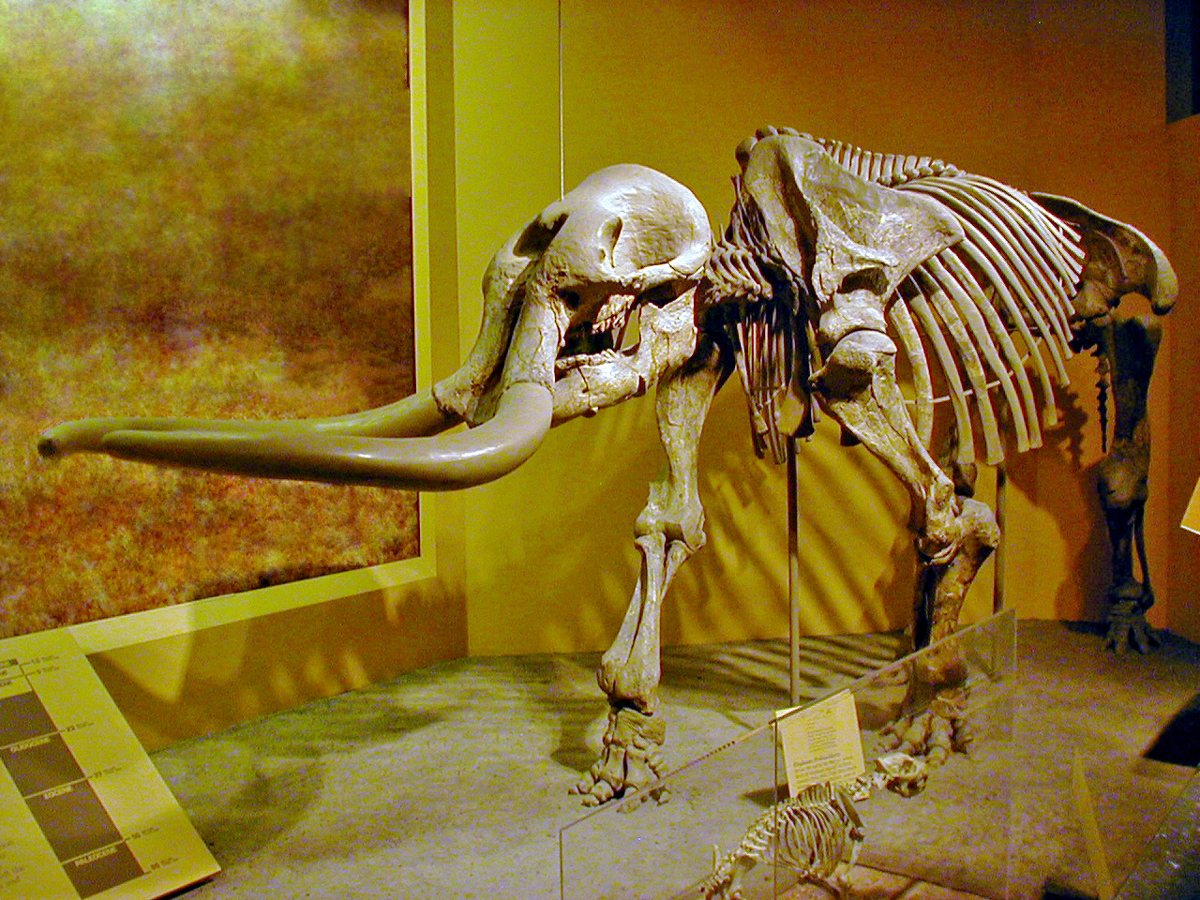
Image context: the lead image uses a real Smithsonian gallery photograph of a Stegomastodon mount from Wikimedia Commons. It fits this article because the piece is about fossil elephants that feel both recognizable and alien at once. The long tusks, heavy skull, and body proportions make the point before the prose does: extinct proboscideans were not just living elephants with colder weather added.[6]
Around 6:00, the video makes measurement the real beginning of the story
The webcast sharpens immediately once Jukar moves behind the gallery and into museum workspaces.[1][3] At about 6:00, he is not telling viewers to admire a giant fossil. He is measuring deinothere teeth with calipers, then describing how those measurements go into a computer for pattern analysis aimed at distinguishing how many kinds of extinct elephants lived in India.[3] That move is easy to miss because the tone stays accessible. Scientifically, though, it is the hinge of the whole video.
This is what the title's word "forgotten" really means. Fossil elephants are not forgotten because museums failed to display them. They are forgotten because public imagination compresses them into a few mascots, while paleontology has to separate them back into analyzable populations, taxa, and anatomical patterns. The Smithsonian resource page frames the video in exactly those terms: it is about using fossils to learn body size, diet, origin, and relatedness, not about repeating a single prehistoric elephant myth.[2]
That framing also improves the way one reads the later giant skull scenes. The oversized storage room is not there to provide awe alone. It shows that skulls are data-rich objects. Length, width, tooth size, and articular landmarks can all be recruited into comparative arguments.[3] The museum collection becomes important not because it houses spectacular bones, but because it stores repeated anatomy at enough scale for patterns to emerge.
Around 10:00, "proboscidean" becomes larger than the modern elephant silhouette
The strongest conceptual correction comes when the hosts pause over the word proboscidean at about 10:00.[1][3] Jukar explains that the name refers to trunk-bearing mammals, then immediately undercuts any neat definition by noting that some early elephant relatives did not yet have trunks in the modern sense.[3] That tension is the point. Taxonomic names often survive earlier assumptions, and fossil evidence makes the group wider, stranger, and more historically layered than the living animals alone would suggest.
The sequence with Palaeomastodon, Moeritherium, gomphotheres, shovel tuskers, deinotheres, mastodons, and mammoths is valuable because it resists the tidy ladder from primitive to modern.[3] Four tusks recur. Lower tusks persist for long stretches. Trunks vary in apparent length and architecture. Body shape remains broadly proboscidean, but the front end of the animal is repeatedly reworked. The video therefore does something paleontology is especially good at: it restores lost morphological diversity without pretending that every extinct form points neatly toward the African or Asian elephant of today.
That matters for readers because modern elephants can make deep time look deceptively settled. Once the group is reduced to three survivors, earlier proboscideans start to seem like rough drafts of a finished design. The webcast pushes the opposite view. The fossil record reads more like a branching design space in which some features stabilize late, some disappear, and some persist far longer than a modern observer would guess.[1][2][3]
Around 18:30 to 24:00, teeth stop being props and become ecology in hard form
The middle tooth section is where the article's main claim becomes clearest. Beginning around 18:30, Jukar uses mammoth, mastodon, and modern-elephant teeth to show how much ecological information is preserved in crown height and cusp shape.[3] By 23:30 to 24:00, the contrast is explicit: mammoth molars are tall and plate-like, suited to abrasive grazing, while mastodon teeth carry sharper, more conical cusps suited to browsing leaves and twigs.[3][4]
The National Park Service's mammoth-versus-mastodon explainer is a useful written partner here because it states the same difference in compact form: mastodons were wood browsers with pointed cones, whereas mammoths were grazers with flatter grinding surfaces.[4] That is not a decorative side note. It means the teeth are registering habitat and feeding behavior directly enough that a viewer can begin to see extinct elephants as occupants of different plant worlds rather than as generic megafauna.
The video gains force because it never isolates teeth from bodies. Tooth form links to wear, wear links to food, food links to landscape, and landscape links back to the history of the lineage.[3][4] A mammoth tooth does not just say "this animal had big molars." It says that grass, grit, and long-term abrasion mattered enough to shape an entire dental strategy. A mastodon tooth says the opposite ecological pressure was at work. That is the kind of evidence chain a good museum video can teach very quickly when the writing around it slows down and makes the logic visible.
Around 26:30, resemblance gives way to kinship
The final section, from roughly 26:30 onward, is the most important correction for a casual viewer.[1][3] The hosts ask whether a mammoth or a mastodon is more closely related to the Asian elephant. Many people would answer from surface impression alone. Jukar pushes viewers toward tooth comparison first, then gives the answer: mammoths are closer to Asian elephants, while mastodons sit further out.[3]
What makes that moment useful is not only that it delivers a surprising fact. It also demonstrates how paleontology reasons from similarity, while later molecular work helps clarify where those similarities point. The genomic analysis published in PLOS Biology states directly that the Asian elephant is the closest living relative of the extinct mammoth in the nuclear genome.[5] The webcast is therefore not using classroom simplification to replace research. It is compressing a real phylogenetic structure into a teachable anatomical comparison.
Seen that way, the video's closing move is larger than mammoths. It shows why fossil elephants should not be organized by fame. Mammoths, mastodons, gomphotheres, deinotheres, and the earlier African forms belong to a lineage history that has to be rebuilt from characters, not vibes.[3][5] Teeth, skulls, and eventually genomes do not simply decorate the story. They are the story.
That is why this is a strong single-video curation piece for paleontology. A reader who never presses play still gets the essential lesson: extinct elephants are most intelligible when treated as a long comparative archive of anatomy and ecology rather than as a sentimental prehistory of the woolly mammoth alone.[1][2][3][4][5] The video earns its place because it makes that archive visible in real objects, handled by someone who knows exactly which differences matter.
Sources
- Smithsonian's National Museum of Natural History, "Fossil Elephants of Deep Time featuring Smithsonian Paleontologist Advait Jukar," YouTube video, published December 12, 2019.
- Smithsonian National Museum of Natural History, "Forgotten Elephants of Deep Time" (teaching resource page for the webcast and classroom activity).
- Smithsonian National Museum of Natural History, "Video Transcript - Forgotten Elephants of Deep Time" (full webcast transcript with timestamps).
- National Park Service, "Mammoth or Mastodon?" (tooth form, diet, and tusk differences).
- Nadin Rohland, David Reich, Svante Paabo, and colleagues, PLOS Biology: "Genomic DNA Sequences from Mastodon and Woolly Mammoth Reveal Deep Speciation of Forest and Savanna Elephants."
- Wikimedia Commons file page for the photographed Smithsonian Stegomastodon mirificus mount used as the lead image.