Ghost Ranch is one of those paleontological places where quantity changes the kind of question you can ask. A single dramatic skeleton can make an extinct animal memorable. A quarry full of them can make it scientifically harder to fake. Coelophysis bauri became famous in part because the Ghost Ranch assemblage near Abiquiu, New Mexico, produced an enormous concentration of Late Triassic skeletons from one small theropod.[1][2] That mattered because the quarry did not just give paleontology a mascot. It turned one dinosaur into a population sample.
That is the cleanest way to read the fossil find now. Coelophysis still looks elegant in the old public-facing way: long neck, narrow head, slim body, long counterbalancing tail. Yet the real scientific value of Ghost Ranch sits less in silhouette than in repetition. When the same animal appears again and again, across different sizes and states of preservation, questions about anatomy, growth, and taphonomy stop depending on one lucky specimen.[1][2][4]
The cannibalism anecdote used to dominate the public afterlife of the quarry. It was vivid and portable, which is why it spread so easily through museum culture and popular dinosaur writing. The better modern reading is narrower and stronger. Ghost Ranch still matters tremendously, but the quarry became more convincing once paleontologists pulled it back from the cannibal headline and returned it to the slower work of specimen context, comparative anatomy, and developmental variation.[2][3]
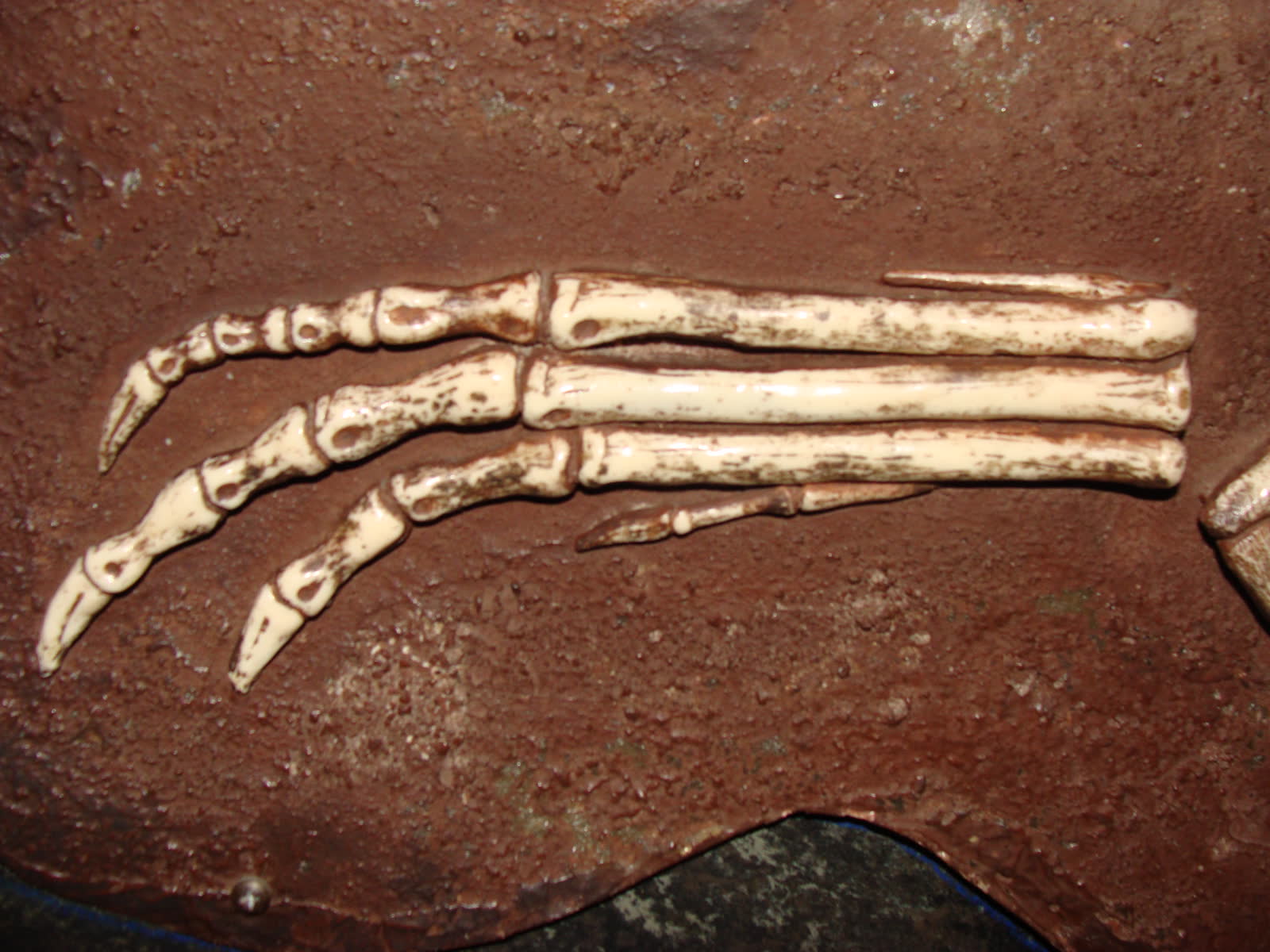
Image context: the lead image is a museum photograph of a mounted Coelophysis from Wikimedia Commons. It belongs here because this article is about reading the Ghost Ranch material as a built body, not just as a famous quarry anecdote. The mount makes the light frame visible at a glance while keeping the fossil basis of the animal in view.[6]
1) The quarry changed one dinosaur into a deep sample
The 2006 Biology Letters paper by Sterling Nesbitt and colleagues opens with the scale of the find because that scale is the premise.[2] In 1947, American Museum of Natural History crews uncovered a bonebed composed of hundreds of Coelophysis skeletons from the Chinle Formation near Ghost Ranch.[2] Schwartz and Gillette's earlier taphonomic study had already stressed what made the quarry unusual among Triassic sites: numerous complete and partial skeletons of a single theropod species in one place.[1]
That is why the Ghost Ranch material keeps returning in the literature. It gives paleontology repeated access to the same animal instead of forcing every argument through a handful of isolated bones. The 2024 paper on immature skulls makes this explicit, describing the quarry as a famous Rhaetian mass-death assemblage and one of the only ontogenetic series available for an early theropod.[3] In other words, Ghost Ranch is useful not because it multiplies spectacle, but because it multiplies comparison.
Once that point is in place, the quarry looks less like a cabinet of curiosities and more like infrastructure. It lets researchers compare robust and delicate skulls, small and large bodies, prepared and incompletely prepared specimens, stomach claims and non-stomach claims, all inside one unusually dense sample.[2][3][4]
2) The animal itself becomes sharper when the light build is taken seriously
The Natural History Museum's overview preserves the core descriptive clue in the name itself: Coelophysis means "hollow form," a reference to the hollow limb bones.[5] That is more than a charming etymology. It tells you what kind of body plan the quarry is repeatedly presenting. Coelophysis was not built like a heavy-headed later giant theropod. It was a lightly built early dinosaur from a Triassic world in which dinosaurs had not yet fully taken over the top predatory roles.[5]
The Digimorph specimen page reinforces the geological anchor. The scanned specimen comes from Ghost Ranch Quarry in the Chinle Formation and dates to the Late Triassic.[4] Together with the mount in the lead image, that makes the basic reading unusually legible. The narrow ribcage, fine limbs, and long tail do not feel like decorative reconstruction choices. They are the body logic of an animal whose name, quarry sample, and later imaging work all point in the same direction.[4][5][6]
This is where the fossil find becomes more interesting than a generic species profile. Ghost Ranch does not just tell us that Coelophysis existed. It keeps returning the same design in enough specimens that the design starts to look constrained rather than theatrical. The quarry makes lightness itself part of the evidence.
3) The famous cannibal story shrank under preparation and re-reading
For years, two Ghost Ranch specimens were treated as classic evidence that Coelophysis ate its own young. Nesbitt and colleagues re-opened that story by asking two simple questions: were the supposed prey bones actually inside the stomach area, and did they really belong to juvenile Coelophysis?[2] That is the kind of reset a famous quarry allows. When many comparative specimens exist, a dramatic old claim can finally be checked against anatomy rather than inherited as folklore.
Their answer sharply reduced the old story. In one specimen, they argued that the material could not be shown unambiguously to sit inside the abdominal cavity at all.[2] In the other, the bones within the stomach area were consistent not with juvenile Coelophysis but with a small crocodylomorph, based on pelvic, vertebral, femoral, and histological evidence.[2] The paper's conclusion was blunt: Ghost Ranch preserved remarkable stomach contents, but no compelling evidence for cannibalism in the famous AMNH "cannibals."[2]
That is the key close-reading lesson of the quarry. The important change was not that paleontology took something exciting away. The change was that Ghost Ranch stopped being forced to carry a story the specimen details could not keep supporting. What remained was better. Instead of a moralizing dinosaur anecdote, the quarry became a case study in how preparation depth, anatomical comparison, and tissue-level evidence can narrow an overfamous claim.[2]
4) New skull work makes the bonebed even more valuable
The 2024 Acta Palaeontologica Polonica paper deepens that correction by shifting attention from sensational behavior to growth.[3] Bugos and McDavid describe two immature Coelophysis skulls from Ghost Ranch and argue that their large orbits, thinner bones, and different tooth proportions reflect skeletal immaturity rather than a separate taxonomic identity.[3] They also emphasize that size alone is not a reliable guide to maturity in this species.[3]
That matters because famous quarries often invite false neatness. Small equals juvenile, large equals adult, robust equals different taxon, delicate equals unusual individual. Ghost Ranch keeps resisting that kind of shortcut. The quarry's strength lies in showing how much intraspecific and developmental variation has to be sorted before broader behavioral or taxonomic claims can be trusted.[3]
So the find grows in value twice over. First it weakens the cannibalism legend by showing that one famous interpretation outran the evidence.[2] Then it strengthens the developmental reading by showing that the same quarry preserves immature skulls capable of clarifying how early theropod heads changed through growth.[3]
5) What this fossil find can really support
High confidence first. Ghost Ranch preserves an unusually rich Coelophysis assemblage from the Late Triassic Chinle Formation.[1][2][4] The quarry lets paleontologists study the animal across many individuals rather than through a single emblematic skeleton.[1][3] Coelophysis itself reads as a lightly built theropod whose hollow limb bones are part of both its name and its anatomical logic.[4][5] And the best-known cannibalism claim tied to the quarry no longer holds up as a strong reading of the evidence.[2]
The boundaries matter too. A mass assemblage does not automatically reveal herd behavior, precise cause of death, or every detail of how Coelophysis hunted. Ghost Ranch is powerful for a different reason. It gives paleontology repetition, and repetition is what lets old stories be tested rather than merely retold. That is why this fossil find still matters. It made one small Triassic theropod famous, then slowly made it harder to simplify.
Sources
- Henri J. Schwartz and David D. Gillette, "Geology and taphonomy of the Coelophysis quarry, Upper Triassic Chinle Formation, Ghost Ranch, New Mexico." Journal of Paleontology 68, no. 5 (1994).
- Sterling J. Nesbitt, Alan H. Turner, Gregory M. Erickson, and Mark A. Norell, "Prey choice and cannibalistic behaviour in the theropod Coelophysis." Biology Letters 2, no. 4 (2006).
- Jeb E. Bugos and Skye N. McDavid, "Immature skulls of the theropod dinosaur Coelophysis bauri from Ghost Ranch, New Mexico." Acta Palaeontologica Polonica 69, no. 4 (2024).
- Digimorph, "Coelophysis bauri" specimen page — Ghost Ranch Quarry, Chinle Formation CT-scanned specimen overview.
- Natural History Museum, "Coelophysis" — overview of the taxon, its hollow limb bones, and its Late Triassic setting.
- Wikimedia Commons file page for the mounted Coelophysis photograph used as the lead image.