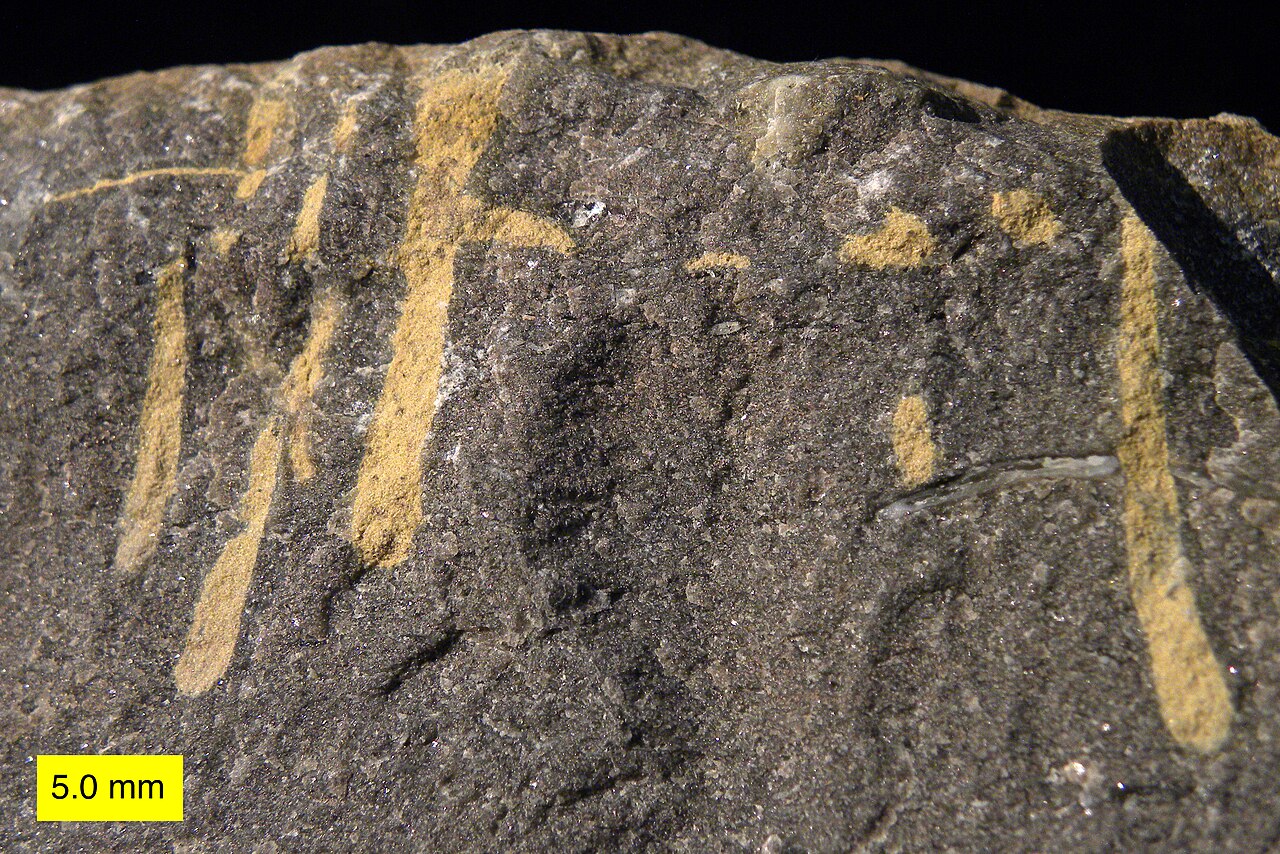
At first, the rock seems streaked with drips. Pale fingers descend through dark limestone from a rough upper edge, each only a few millimeters wide. There is no skull to orient the eye, no shell with an elegant spiral, no leaf retaining its veins. Yet the cut surface exposes a fossil in a particularly expansive sense: a piece of seafloor became solid early enough for animals to live on it and bore into it before younger sediment filled their shafts and covered the floor.[1][6]
Paleontology usually asks us to imagine an organism around an object. A hardground asks us to imagine a place around a plane. The object is limestone; the subject is the interval when that limestone was still the bottom of a living sea.
That change of scale matters. A hardground can preserve no spectacular body and still retain a sequence: soft carbonate sediment stiffened and cemented; net deposition slowed; borers excavated homes; attached animals spread across the exposed surface; some remains were abraded away; another generation arrived; mud finally returned. What looks like one boundary between beds can therefore contain an ecological history.[1][2]
A seafloor must harden before it can become a hardground
A carbonate hardground is not simply any old limestone surface. It forms when carbonate sediment is cemented at or just below the seafloor while that surface is still exposed to seawater. Low net sedimentation, sediment winnowing and early marine cementation can turn loose lime mud or skeletal sand into a substrate firm enough to bore and encrust. The decisive point is timing: lithification happens before normal burial has removed the surface from the benthic world.[1][2]
That distinguishes a hardground from two neighbors. A firmground is cohesive but not fully cemented, so animals can burrow into it as sediment. A rockground is older rock exposed again by erosion. All three may be hard enough to shape a community, but only the hardground is a sedimentary floor that turned to stone during its first stay at the seabed.[1]
How can a geologist know that the cementation was early? The surface carries witnesses. Attached skeletons may remain fixed in life position. Borings open from the exposed face and penetrate the already coherent carbonate. Marine cements, abrasion, mineral coatings and truncated structures can reinforce the case. In complex examples, relief itself records repeated lithification, exhumation and erosion. Paton, Brett and Kampouris showed that Upper Ordovician hardgrounds can progress from simple planes to high-relief surfaces and then to broken, displaced blocks, preserving several rounds of modification rather than one clean pause.[2]
The word pause needs care. A hardground commonly marks an interval of very low net accumulation or erosion—an omission surface—but it is not a universal stopwatch. The missing sediment does not translate directly into a known number of years. Rich boring can be consistent with prolonged exposure, but nutrients, recruitment and local conditions also affect boring intensity; duration still needs independent stratigraphic evidence.[1][2][5]
The holes are occupants, not damage after the fact
The photographed Kentucky section cuts through several Trypanites, an ichnogenus of narrow, unbranched cylindrical borings. An ichnogenus names the form of a trace, not a body fossil producer. Some Ordovician examples contain jaw elements consistent with polychaete worms, but the same simple architecture may have been made by more than one kind of worm-like animal through time. The secure claim is behavioral and material: an organism excavated a dwelling in a hard carbonate substrate.[1]
That is already more informative than calling the holes decay. They establish that the floor was solid, exposed and habitable. Their openings preserve where animals met the surface; their depth and fill can preserve later stages in the substrate's history. If a boring contains sediment unlike the surrounding limestone, the cavity may have remained open until a younger pulse filled it. If an encruster crosses an older boring opening, or a boring cuts an encruster, the intersection establishes relative order.[1][2]
Nor should these holes be confused automatically with predatory drill marks. A round hole in a shell can record an attack, but Trypanites is generally interpreted as a dwelling trace in hard substrate. Shape, position, penetration and context decide the category. The rock does not label violence; paleontologists have to demonstrate it.
Borings are negative fossils—the animal may be absent, but the space it made survives. Encrusters preserve the complementary signal. Bryozoans, brachiopods, oysters, echinoderm holdfasts and tube-building organisms could cement themselves to hard surfaces. Because many stayed attached after death, their positions can retain orientation, crowding and contact with neighbors. A hardground is thus both architecture and guestbook: it preserves the available rooms and some of the bodies that occupied them.[1]
One surface can hold several communities
The Late Ordovician Kirkfield Formation near Kirkfield, Ontario, makes the sequence unusually legible. Carlton Brett and W. David Liddell's 1978 paper used the older "Middle Ordovician Bobcaygeon Formation" assignment; later work now places the relevant interval in the upper Sandbian–lower Katian Kirkfield Formation.[3][7] They described irregular hardgrounds whose hummocky relief partly inherited the shapes of earlier burrow systems. Bryozoans, brachiopods, crinoids, edrioasteroids and paracrinoids settled on those firm surfaces, while small Trypanites borings riddled them.[3]
The assemblage was not a single cast photograph. Some surfaces carried multiple generations. Older encrusters were heavily abraded and nearly erased; fragile, better-preserved echinoderms lay over those remnants. Brett and Liddell inferred that the final inhabitants were buried rapidly by mud, while earlier residents had endured a longer exposed history.[3] The hardground did not stop time. It organized several times on top of one another.
Its relief also created microhabitats. The protected roofs of small crevices held a different balance of bryozoans and echinoderms from the open upper surface.[3] That pattern is ecological evidence because the organisms remained tied to the substrate. A loose shell washed into a bed may have traveled far from where its owner lived; a cemented encruster is much harder to relocate without moving the entire floor.
Contact between encrusters can preserve an even finer interaction. Living colonies on marine hard surfaces compete for finite attachment space, sometimes growing up to one another and sometimes over an opponent's edge. Paul Taylor's review of fossil encruster competition explains why these encounters are unusually recoverable: skeletonized colonies may remain fixed where the contest occurred.[4]
But an overgrowth is not an automatic league table. A colony can spread across a neighbor that was already dead. Burial and erosion can remove the losing edge. Different growth forms preserve unequally. Repeated outcomes across many live-looking contacts make competitive ranking stronger than one dramatic overlap.[4] As elsewhere in paleontology, geometry supplies evidence only after taphonomy tests whether the geometry is original.
Hardgrounds expanded hard-substrate habitat
Hard substrates existed long before the Ordovician, and carbonate hardgrounds are not confined to one interval or depth. Their abundance nevertheless changed through time. During the Ordovician Period, roughly 487 to 443 million years ago, increasingly common hard surfaces accompanied a major expansion of marine ecological variety. More attachment space opened for encrusters, while bioeroders diversified the ways animals could live inside rock and skeleton.[1][2][5]
The Estonian record gives that broad pattern a locality-scale test. Olev Vinn, Mark Wilson and Ursula Toom examined hardgrounds, pebbles and cobbles from Middle and Upper Ordovician strata and measured their borings from calibrated photographs and cut sections. Trypanites dominated the inorganic substrates, with possible Gastrochaenolites also present. Their synthesis placed this regional record within the Ordovician Bioerosion Revolution: the known diversity of macroscopic boring trace types rose sharply from the Cambrian into the Ordovician, although inorganic and skeletal or other organic hard substrates did not diversify in identical ways.[5]
That last qualification prevents a seductive causal shortcut. Hardgrounds did not single-handedly create the Great Ordovician Biodiversification Event. Plankton, food webs, climate, ocean chemistry, biogeography, predation and many other changes also shaped the radiation. The safer claim is reciprocal. More hard substrate created ecological opportunity; organisms colonized and eroded those surfaces; their skeletons and activities in turn altered the substrates available to later organisms.[1][2][5]
This feedback also changes what reaches us. Soft-bottom communities can be exquisitely preserved, but burrowing, transport and burial often scramble their spatial relationships. On a hardground, borers remain inside their chosen substrate and encrusters may remain attached. The record is biased toward organisms that mineralized a skeleton or cut a durable cavity, yet it retains an unusually literal map of where those survivors lived.[1]
Read the floor before rebuilding the sea
A hardground supports claims at several confidence levels. Direct evidence can establish that a carbonate surface lithified early, remained exposed to marine life and was bored or encrusted before final burial. Cross-cutting, abrasion and overgrowth can order some events. Spatial distributions can reveal preference for exposed, hidden, raised or recessed parts of the floor.[1][2][3]
Inference begins when those patterns become duration, water depth, competition or regional evolutionary cause. Each inference may be strong, but each needs another constraint: stratigraphy for time, sedimentology for setting, repeated live contacts for competition, and multiple localities for a macroevolutionary trend.[2][4][5]
That hierarchy is what makes the unshowy Kentucky photograph so compelling. The holes are not decoration on a fossil. They are the fossilized relationship between an animal and a surface. The surface is not merely the top of a bed. It was habitat, then archive, then boundary.
The fossil record has floors because ancient ecosystems needed somewhere to happen. Occasionally, that somewhere hardened soon enough to keep its traffic.
Sources
- Paul D. Taylor and Mark A. Wilson, "Palaeoecology and evolution of marine hard substrate communities," Earth-Science Reviews 62 (2003)—comprehensive review of hardground definitions, borers, encrusters, succession, preservation and long-term change.
- Timothy R. Paton, Carlton E. Brett and George E. Kampouris, "Genesis, modification, and preservation of complex Upper Ordovician hardgrounds," Palaeogeography, Palaeoclimatology, Palaeoecology 526 (2019)—formation, exposure, repeated modification and stratigraphic implications.
- Carlton E. Brett and W. David Liddell, "Preservation and paleoecology of a Middle Ordovician hardground community," Paleobiology 4 (1978)—Kirkfield community succession, abrasion, rapid burial and microhabitat partitioning.
- Paul D. Taylor, "Competition between encrusters on marine hard substrates and its fossil record," Palaeontology 59 (2016)—how overgrowth can preserve spatial competition and where taphonomy complicates it.
- Olev Vinn, Mark A. Wilson and Ursula Toom, "Bioerosion of Inorganic Hard Substrates in the Ordovician of Estonia (Baltica)," PLOS ONE 10 (2015)—open study of measured Ordovician borings and the regional bioerosion record.
- Mark A. Wilson, "Trypanites01.jpg," Wikimedia Commons—source and identification of the photographed Upper Ordovician hardground from northern Kentucky.
- Joseph Moysiuk et al., "A new marrellomorph arthropod from southern Ontario: a rare case of soft-tissue preservation on a Late Ordovician open marine shelf," Journal of Paleontology 96 (2022)—modern Kirkfield Formation assignment and placement of its lower-member Sandbian–Katian boundary.