Lepidodendron is easy to shrink into a nickname. It becomes the "scale tree," the "giant clubmoss," or the standard Carboniferous prop standing behind dragonflies and coal seams. Each phrase is useful for one sentence and misleading by the next. Lepidodendron was tree-sized, but it was not trying to become an oak. It belonged to the arborescent lycopsids, a lineage related to living clubmosses and quillworts, and its most famous feature is not height alone but a whole-body architecture recorded in repeating leaf cushions, shallow rooting systems, and coal-swamp preservation.[1][2]
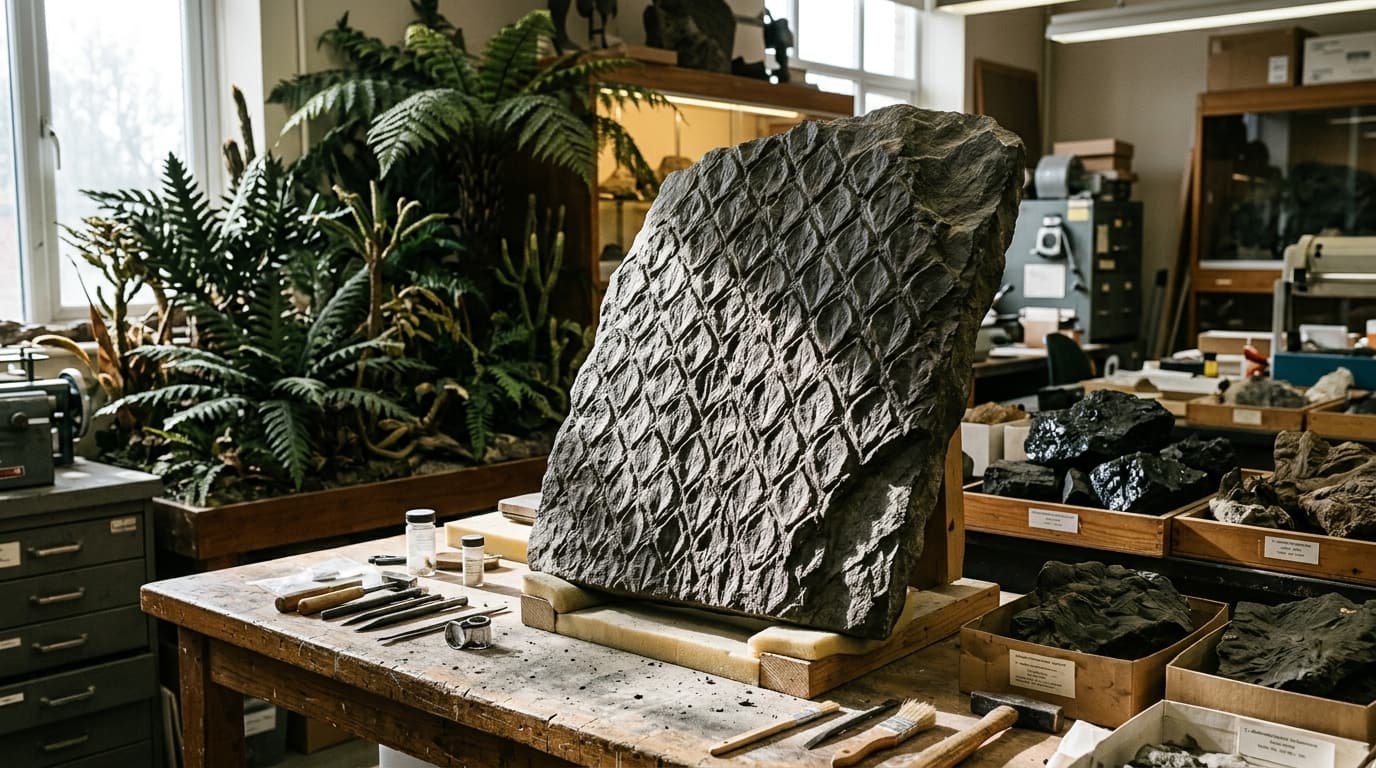
The bark surface is the best place to start because it refuses to behave like a simple label. The diamond pattern is not a reptile scale costume stretched over an ordinary trunk. It is the repeated mark of leaves attached to the stem, a surface record of how a giant lycopsid carried and shed its photosynthetic organs. In many specimens, that outer pattern is what survives most clearly, which means Lepidodendron often enters public imagination through its skin before its growth habit, rooting system, or reproductive strategy is understood.[2]
The Scale Pattern Is A Growth Record
Calling Lepidodendron "scale bark" is convenient, but it can flatten the evidence. The pattern is built from leaf cushions and scars left on the stem as long, narrow leaves were attached and eventually shed. In a modern woody tree, bark often invites comparison with protective outer covering. In Lepidodendron, the surface pattern is more instructive when treated as a map of modular growth: leaf after leaf, cushion after cushion, arranged around a trunk that belonged to a very different plant body plan.[2]
That distinction matters because Lepidodendron is often made primitive in a lazy way. It was not an unfinished version of later seed trees. It was a successful lycopsid solution to a Carboniferous wetland world: rapid vertical growth, a tall unbranched or sparsely branched trunk for much of life, terminal branching late in development, and reproduction through cones rather than flowers or seeds.[1][3] The fossil record does not ask us to grade it against a maple. It asks us to understand why this architecture worked where it did.
The leaf-cushion surface also explains why isolated bark fossils can feel more complete than they really are. A slab of patterned stem can be beautiful and diagnostic, but it is still only one plane through a plant. The animal-fossil habit of imagining a whole body from a single dramatic part can mislead here. A Lepidodendron bark slab is evidence for surface organization and stem anatomy; the full plant also requires roots, branches, leaves, reproductive cones, sedimentary setting, and comparisons across specimens.[1][2]
A Coal-Swamp Tree, Not A Modern Tree
Lepidodendron flourished in Carboniferous coal-swamp ecosystems, especially the wet tropical lowlands that later helped form major coal measures. These forests were not just gloomy backdrops for future fuel. They were plant communities structured by waterlogging, peat accumulation, low-oxygen soils, and repeated disturbance. Arborescent lycopsids were among the dominant vertical elements in many of those settings, sharing the landscape with horsetail relatives, ferns, seed ferns, and other Paleozoic plants.[1]
The usual modern-tree analogy breaks down at several points. Lepidodendron had relatively little secondary wood compared with many seed trees, and much of the trunk's mechanical system depended on tissues and growth patterns unlike those of familiar hardwoods. Its life history is also debated in terms of how quickly it grew, how long it lived, and how much of its biomass was committed to height before reproductive branching. Boyce and DiMichele's work on arborescent lycopsid productivity and lifespan is useful because it treats those questions as constraints rather than as folklore about gigantic mosses.[3]
The result is a stranger and better plant. Lepidodendron could be tall without being a redwood ancestor, woody in part without being a standard wood machine, and tree-like without belonging to the seed-tree tradition. "Tree" describes a form and ecological role. It does not identify a lineage or a construction method. Lepidodendron makes that distinction visible.
Stigmaria Turns The Trunk Into A Wetland System
The roots complete the argument. Fossil rooting systems called Stigmaria are commonly associated with arborescent lycopsids, including Lepidodendron-like plants. They spread through waterlogged substrates with many rootlets, producing a rooting architecture better suited to peat-swamp support than to the deep taproot image many readers bring from modern trees. Work on stigmarian rootlets emphasizes that these systems were highly branched and central to understanding the first giant trees as whole plants, not just trunks with patterned bark.[4]
That rooting system changes the meaning of the stem. A tall Lepidodendron trunk was not simply a pole rising from generic mud. It was part of a shallow, spreading wetland apparatus, tied into peat formation and lowland swamp ecology. The scale-patterned bark, stigmarian rooting network, and reproductive cones belong to the same architecture. Remove any one of them and the plant turns back into a slogan.
It also changes how coal-swamp fossils should be read. Coal preserved enormous plant mass, but it often simplified bodies through compression, fragmentation, and later geological change. Lepidodendron is therefore known through a patchwork: bark impressions and compressions, permineralized anatomy, roots assigned to Stigmaria, cones and spores, and sedimentary context. The plant is reconstructed by matching forms across preservational modes, not by expecting every fossil to be a complete portrait.[1][4]
The Fossil Is A Warning Against Easy Scale
The scale pattern tempts the eye because it looks almost designed. That is why it works as a public image and why it needs careful interpretation. A photographed slab of Lepidodendron bark can honestly introduce the plant, but only if the caption refuses to make the texture stand for everything. The pattern is evidence of leaf attachment and growth. The coal swamp supplies the ecological frame. Stigmaria supplies the belowground frame. Lycopsid biology supplies the evolutionary frame.[1][2][4]
Seen that way, Lepidodendron becomes more than a giant clubmoss. It becomes a case study in how paleontology disciplines analogy. The fossil looks tree-like, but the explanation has to separate height from lineage, bark from leaf cushions, roots from modern root expectations, and coal from a simple swamp cartoon. Its strangeness is not that it was a huge primitive plant. Its strangeness is that it was a highly successful answer to a world where wet peat, rapid growth, spore reproduction, and lycopsid construction could make a forest.
That is the better lesson of the scale tree. Lepidodendron does not ask to be admired as a failed prelude to later forests. It asks to be read as architecture: a repeated surface, a constrained stem, a wetland root system, and a reproductive strategy that made sense in the Carboniferous before seed-tree forests became the default image of wooded land. The diamond marks are not decoration. They are the visible grammar of an extinct way to be tall.
Sources
- Ben Slater, "Fossil Focus: Carboniferous coal swamps," Palaeontology Online.
- University of California Museum of Paleontology, "Lepidodendron - an extinct lycopsid."
- C. Kevin Boyce and William A. DiMichele, "Arborescent lycopsid productivity and lifespan: constraining the possibilities," Review of Palaeobotany and Palynology 227 (2016).
- Alexander J. Hetherington, Christopher M. Berry, and Liam Dolan, "Networks of highly branched stigmarian rootlets developed on the first giant trees," Proceedings of the National Academy of Sciences 113 (2016), via Europe PMC.
- Wikimedia Commons, "File:Lepidodendron aculeatum.jpg" - source page for the real fossil-bark photograph used as the article image.