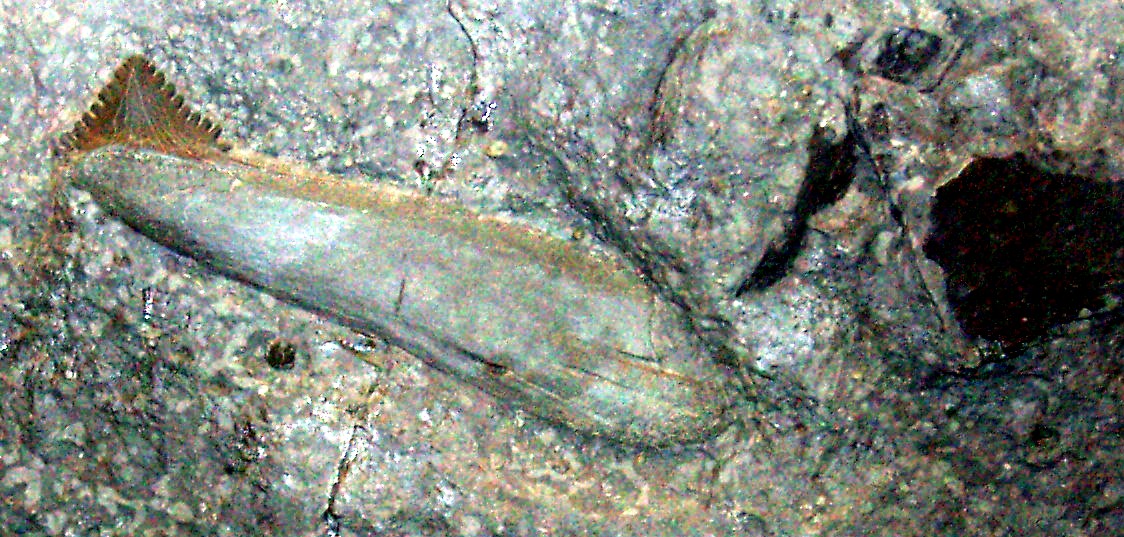
Edestus is usually introduced with the nickname first: the scissor-tooth shark. That name is useful only if it starts a question rather than ending one. The fossil is not a normal shark jaw with bigger teeth. It is a Pennsylvanian chondrichthyan whose most diagnostic remains are curved midline tooth files, or whorls, made from serrated crowns stacked on long roots. In life, those whorls sat in the symphysis of the upper and lower jaws, turning the front of the mouth into something closer to a cutting mechanism than a familiar shark bite.[1][2]
The temptation is to make the animal theatrical: ancient shark, giant blades, Carboniferous sea monster. The better reading is more precise. Edestus matters because it shows how much paleontology can extract from teeth when the rest of the body is mostly absent, and how quickly that extraction becomes risky if the teeth are treated as self-explanatory. The core problem is not whether the teeth were sharp. They were. The problem is how two curved, growing, asymmetric tooth families could work inside a cartilaginous skull that almost never fossilized.[1][2][3]
The photographed E. heinrichi whorl used for this article is a good visual anchor because it keeps the evidence narrow. The fossil shows the blade-like tooth series, not a whole animal. That limitation is the point. In Edestus, the visible object is the beginning of the reconstruction, not the whole reconstruction.[5]
The teeth were files, not loose daggers
The first correction is structural. Edestus tooth whorls were not isolated fangs that happened to curve together. Tapanila and Pruitt describe teeth with long V-shaped roots stacked en echelon, like overlapping roof tiles, with new teeth generated at the posterior end of the whorl and older teeth moving toward the anterior end before being ejected.[2] A single whorl could carry up to about a dozen crowns at a time, and the researchers estimate that more than forty teeth could be produced in each whorl over an animal's life.[2]
That replacement system matters because it makes the blade dynamic. A mammal tooth row is mostly a fixed boundary after eruption. A modern shark tooth row is famous for conveyor-belt replacement across multiple rows. Edestus is stranger: the cutting surface sits in a single midline family in each jaw, continually extending and shedding along a curved file.[1][2] The animal's famous "scissors" therefore were not a pair of metal shears. They were living dental files that had to remain functional while growing, wearing, and ejecting teeth.
That is also why single loose teeth can mislead. A crown that detached from the whorl may preserve size, serrations, and curvature clues, but it has lost its position in the upper or lower file. Tapanila and Pruitt emphasize that almost all historical Edestus species were founded on tooth crowns, often single and incomplete specimens, while upper and lower teeth differ in shape and growth pattern.[2] If the taxonomic unit is built from a tooth whose jaw position is unknown, the category can become too narrow, too confident, or simply wrong.
The skull changed the question
For a long time, Edestus was a tooth problem with a missing skull. That is not unusual for chondrichthyans. Shark and holocephalian skeletons are cartilaginous, so teeth enter the fossil record much more readily than the cranial framework that held them. The shift came when rare specimens with cranial context could be imaged and reconstructed.[1][2][4]
The 2018 anatomical study by Tapanila, Pruitt, Wilga, and Pradel used CT and related digital reconstruction work to put tooth blades back into jaw context.[1] Idaho State University's summary of the project describes the key practical discovery: a skull collected more than fifty years earlier at the Field Museum became the only physical example of an Edestus skull then known, allowing the team to digitize and assemble the feeding apparatus in a way loose teeth could not support by themselves.[4]
That context is the article's hinge. Once the whorls are placed in the mandibular arch, the old question "What are these strange teeth?" becomes "What motion could this jaw produce?"[1][2] Tapanila and colleagues argued for opposing upper and lower cutting surfaces in the mouth, with a distinctive jaw mechanism that could bring the blades down, stop short, and pull back so the teeth sliced across prey tissue rather than simply clamping like ordinary jaws.[1][4]
This is where the "scissor" image becomes both useful and dangerous. It is useful because the animal really did have opposing dental blades in the midline of the jaws.[1][2] It is dangerous because everyday scissors have a hinge, rigid arms, and external handles. Edestus had cartilage, muscle, growing tooth files, and water resistance. The analogy should help readers imagine opposed cutting surfaces, not smuggle in a hardware-store mechanism.
Wear turns function into a test
Microwear is the most disciplined way to keep the feeding story from becoming pure reconstruction. Wayne Itano's 2019 study examined well-preserved E. minor teeth from the Strawn Group of Texas and recorded scratches 50 to 500 micrometers long, oriented predominantly transverse to the basal-apical axis.[3] The result supported the idea that some teeth may have been used to slash prey with vertical motion of the front of the body, rather than only to cut prey trapped between the opposing whorls.[3]
The most important sentence in that paper is not the most dramatic one. Itano also states that substrate interaction cannot be discounted.[3] That caveat keeps the evidence usable. Scratches on fossil teeth can point toward feeding motion only if they were made during life and by prey contact rather than by sediment, preparation, or later abrasion. The transverse pattern is meaningful, but it is not a film clip.
This gives Edestus a productive tension. The CT-backed jaw model strengthens the case for internal slicing between upper and lower blades.[1][4] The microwear study keeps open a slashing component involving teeth contacting prey outside or at the edge of the oral cavity.[3] Those ideas are not mutually exclusive. A real animal might have used different parts of the whorl differently: inner teeth for captured prey, outer projecting teeth for disabling or cutting contact, and jaw motion for drawing tissue across serrated crowns.[1][3]
The method lesson is broader than Edestus. Teeth are not just shapes. They are wear surfaces. A cutting hypothesis should leave some trace on those surfaces, but that trace has to be read through preservation, sample size, and alternative damage pathways. Edestus becomes more interesting when the article resists the cleanest monster-movie version and stays with the evidence stack.
Species names had to be rebuilt around whorl position
The taxonomy also changed because method improved. Tapanila and Pruitt's 2019 PLOS ONE study reevaluated more than 200 ejected teeth and intact spiral tooth whorls, comparing type specimens and measured tooth shapes.[2] Their revision reduced thirteen named species to four morphologically distinct species, clarified upper-versus-lower whorl differences, and placed the genus in coastal marine to estuarine deposits spanning roughly six million years, about 313 to 307 million years ago.[2]
That is not housekeeping. It changes how the animal can be discussed. If too many species are named from partial loose teeth, then apparent diversity may partly reflect tooth position, growth stage, or incomplete preservation. If the upper and lower whorls differ, then a taxonomist who treats them as interchangeable risks splitting one animal into several artificial categories.[2]
The revision also makes size talk less vague. The same study estimated, from tooth-whorl length, that E. heinrichi could conservatively exceed 6.7 meters.[2] That number should be handled carefully. No complete postcranial skeleton of Edestus is available, and body-length extrapolation from skull or dental elements always carries assumptions. Still, the estimate has force because it is attached to a measured whorl framework rather than to an inflated silhouette.[2]
So the species story reinforces the anatomy story. Edestus is not an animal one can responsibly reconstruct by drawing the biggest possible shark around a blade. It has to be rebuilt from whorl geometry, upper-lower differentiation, rare cranial context, tooth replacement, wear, and stratigraphic occurrence.[1][2][3]
Why the scissor-tooth shark still matters
The secure version of Edestus is strange enough without exaggeration. It was a late Carboniferous eugeneodontiform chondrichthyan with upper and lower symphyseal tooth whorls, serrated crowns, long stacked roots, rare cranial preservation, and a jaw mechanism unlike that of living sharks.[1][2][4] Its teeth were not decorative spikes and not a simple buzzsaw. They were a growing midline cutting system.
The uncertainty is just as important. We do not have the whole body. We do not have abundant skulls. We do not know exactly how often it struck, what prey dominated its diet, or how much of the cutting happened inside the mouth versus at the projecting tooth edge.[1][3] The best reconstruction therefore remains mechanical, not cinematic: two curved dental files, cartilage preserving just enough context to orient them, wear patterns that test motion, and species revision that prevents loose teeth from multiplying the animal beyond the evidence.
That is why Edestus earns a method deep dive. It shows paleontology working at the boundary between spectacular form and disciplined inference. The fossil looks like a weapon. The science begins when the weapon becomes a mechanism.
Sources
- Leif Tapanila, Jesse Pruitt, Cheryl D. Wilga, and Alan Pradel, "Saws, Scissors, and Sharks: Late Paleozoic Experimentation with Symphyseal Dentition," The Anatomical Record (2020), PubMed record - CT-backed jaw reconstruction and feeding-mechanics interpretation.
- Leif Tapanila and Jesse Pruitt, "Redefining species concepts for the Pennsylvanian scissor tooth shark, Edestus," PLOS ONE 14, no. 9 (2019) - species revision, tooth-whorl morphology, age range, and body-size estimate.
- Wayne M. Itano, "Oriented microwear on a tooth of Edestus minor (Chondrichthyes, Eugeneodontiformes): Implications for dental function," Palaeontologia Electronica 22.2.39A (2019) - microwear evidence and limits of the slashing hypothesis.
- Idaho State University, "Idaho State University researchers help create skull of ancient scissor-toothed shark, Edestus" (2018) - institutional report on the Field Museum skull reconstruction project and public explanation of the jaw model.
- Wikimedia Commons, "File:Edestus heinrichi.JPG" - source page for the real fossil photograph used as the article image.