

The public story of paleontology still likes the first dramatic moment too much. A bone appears in the field, jackets are made, trucks go home, and the specimen seems to have been discovered already. That is good museum theater, but it is a weak way to understand how fossils become evidence. Smithsonian's field-to-museum teaching guide lays out a longer chain on purpose: transport, opening, cleaning, stabilization, interpretation, and storage all belong to preparation rather than to some secondary aftercare phase.[4] Florida Museum's conservation guidance sharpens the same point from the opposite side, insisting that minimal intervention is often best because every treatment changes the specimen's future.[5]
That is why these three videos belong together. The first is about a plaster jacket that has remained unopened for decades in a university collection.[1] The second is about CT scanning blocks that would yield less information if preparators simply attacked them with tools until bone was exposed.[2][6] The third returns to a museum lab and shows that the actual identification of a find often happens only after preparation, stabilization, and scanning have already changed what researchers can see.[3] Watched in sequence, the clips argue that fossil preparation is not a race toward naked bone. It is a decision structure about order.
That order matters because matrix is doing more than hiding anatomy. It preserves spatial relationships, supports fragile pieces, and sometimes contains anatomy that can be read only through imaging before the block is opened further.[2][3][6] The best preparators therefore do something less glamorous than "freeing the fossil." They decide when a jacket should stay closed a little longer, when a scan should come before another pass with tools, and when the remaining rock is still doing scientific work.[1][4][5]
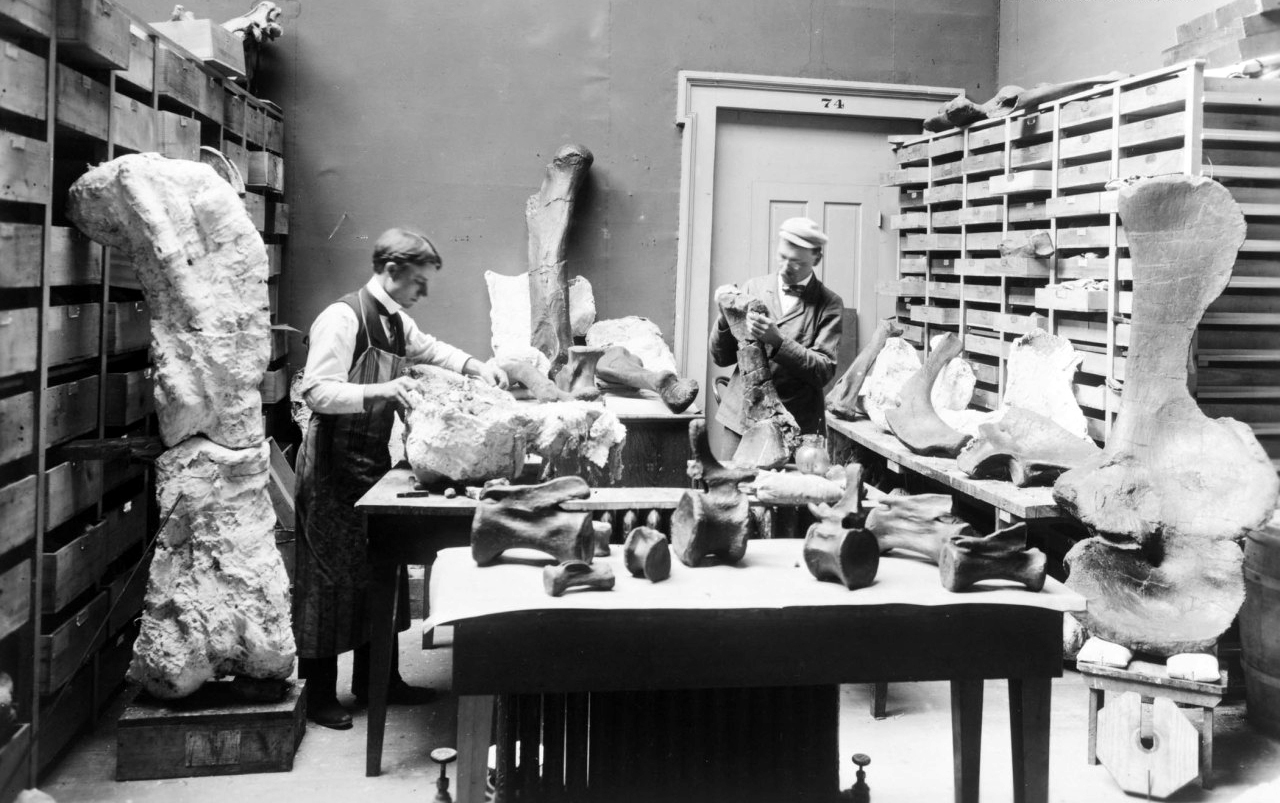
Image context: the lead image uses an archival Field Museum laboratory photograph showing Elmer Riggs and an assistant preparing Grand Junction material while a Brachiosaurus altithorax femur still rests in plaster at the left edge of the room.[7] It belongs here because the article's argument is old as well as modern. Even in 1894, the lab was already a place where jackets, rock, and specimen identity had to be negotiated together rather than stripped apart in one heroic gesture.
Video 1: the unopened jacket is already a scientific record
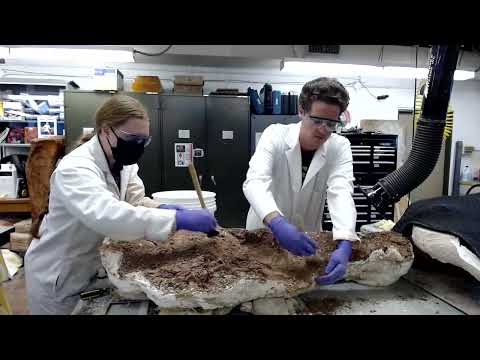
The University of Texas Jackson School video is the right opening because it begins with a specimen that has not yet become a specimen in the full descriptive sense.[1] Fossil preparator Kenneth Bader introduces a jacket collected in 1939 under a Works Progress Administration fossil program, reads its field number aloud, and makes clear that the lab still does not know exactly what is inside.[1] The uncertainty is the point. A jacket is not dead time between excavation and science. It is suspended information: locality, collection history, orientation, and a guess about anatomy that may or may not survive first contact with the lab.
What the video captures well is the discipline of opening rather than the excitement of revealing.[1] Bader does not smash the jacket apart. He cuts the plaster into a lid, runs dust collection, trims the burlap, and explicitly worries about the jacket locking around fossil before lifting the top away.[1] That behavior lines up with Smithsonian's description of preparation as a chain that includes unpacking, removing fossils from loose sediment and rock, and conserving them for later research or display.[4] The jacket is being converted from field protection into laboratory access, but that conversion has to preserve context rather than erase it.
The historical layer makes the point sharper. Jackson School's write-up on the event notes that many of these Texas jackets remained closed for decades after their Depression-era collection, even as related material from the same broader program helped reconstruct whole ancient communities.[6] That delay is not just backlog; it is also a reminder that paleontological collections can hold unopened problems for generations. A jacket is a promise of evidence, not evidence fully realized.
So the first lesson in the collection is modest and fundamental. Preparation starts with restraint. Before anyone can argue about taxon, function, or environment, somebody has to turn packaging into access without destroying the field record that packaging was designed to carry.[1][4][5]
Video 2: CT scanning is what you do when rock is carrying anatomy, not merely covering it
The University of Chicago video shifts the argument from opening to seeing.[2] In the clearest sequence, researchers describe a block from the Canadian Arctic that looked unpromising on the surface, then explain how CT data exposed the fin bones of Qikiqtania wakei inside the rock and allowed those elements to be enlarged, printed, and tested as structure rather than guessed at as rumor.[2][6] The logic here is different from ordinary cleaning. The block becomes more informative when it is scanned before it is fully dismantled.
That is the step where fossil preparation stops looking like a one-way path from rock to object. In the video, Neil Shubin and colleagues explain that once a CT scan exists, the fossil becomes a software model as well as a physical thing.[2] Tiny bones can be enlarged into handheld prints; joints can be modeled; muscles and motions can be hypothesized and compared across living and extinct animals.[2] UChicago's news account of the Qikiqtania project adds the procedural detail that matters most: an initial scan showed a pectoral fin deep inside the block, then researchers later trimmed the rock strategically so the scanner could get closer and produce a better image.[6] They did not choose between rock and data. They used the rock's remaining thickness to decide the next move.
This is exactly where Florida Museum's conservation rule becomes more than a museum slogan. "Minimal intervention is best" does not mean doing nothing.[5] It means every intervention has to justify itself against the information still trapped in the specimen. Some fossils can be exposed safely with picks and air tools. Some should stay partially encased because the matrix is supporting delicate structures. Some become legible only when the best first preparator is the scanner.[2][5][6]
The second lesson, then, is that preparation has a digital branch. Rock can be obstacle, but it can also be the condition that lets anatomy survive in place long enough to be read non-destructively.[2][6] The smartest lab work sometimes begins by refusing the old instinct to remove more material immediately.
Video 3: the lab is where uncertain field finds get their identities
The American Museum of Natural History video is the strongest closer because it brings the earlier lessons back into a working museum pipeline.[3] Roger Benson says the usual gut reaction is to think that discovery happens when something is found in the field, but he then argues that the more exciting moment often arrives only after long preparation and stabilization in the lab, when the fossil finally gains a face, a name, and a place in the larger research picture.[3] That line belongs at the center of any serious account of preparation.
What makes the video more than a general lab tour is its sequencing. Benson explains that some Morrison Formation jackets are CT-scanned before preparation because the matrix is dry, crumbly, and prone to shrinking and splitting fossils as it dries further.[3] The scan records the material in a more pristine state and can reveal bones around a visible vertebra that field crews did not know were there.[3] The payoff is not abstract. One jacket can yield a cluster of small-animal material, including bones that are not yet identified to a taxon or even to a skeletal element.[3] In the lab, a vague field block becomes a more precise ecological sample.
That emphasis matters for paleontology because large, obvious fossils distort the public picture of discovery. AMNH stresses that small mammals, reptiles, amphibians, plants, and small dinosaurs are often historically under-collected or under-recognized even though they may represent much of the ecosystem's true diversity.[3] Smithsonian's FossiLab description fits neatly beside that point: preparation in a real public lab includes unpacking new shipments, removing fossils from sediment, repairing material from exhibit, photographing, illustrating, and conserving specimens across many scales.[4] The lab is not a finishing shop. It is where collections become more specific than they were in the field.
The final lesson in the collection is therefore institutional. Preparation is not only about one bone or one block. It is about how a museum or university turns uncertain field material into durable, searchable, re-readable evidence.[3][4]
What the sequence reveals together
Watched in order, the three videos correct a common but expensive misunderstanding. The first shows that a jacket carries field identity long before it yields anatomical identity.[1][6] The second shows that rock can preserve information best when it is scanned before further exposure, and that digital enlargement can make tiny structures newly usable.[2][6] The third shows that the lab, not the quarry edge alone, is often where the real discovery becomes legible and where under-noticed ecosystem members finally enter the record.[3]
That is why the phrase "fossil preparation" is too easily underestimated. It sounds like cleanup after the serious work. These videos show something stricter. Preparation is the serious work of sequencing access: opening without scrambling context, imaging before overexposure, stabilizing before interpretation, and stopping before intervention becomes loss.[1][2][3][4][5][6] Paleontology does not get stronger by removing every trace of rock as fast as possible. It gets stronger when preparators can tell which boundary is still carrying evidence, and when to cross it.
Sources
- The University of Texas Jackson School of Geosciences, "Mystery Fossil Unwrapping at the Vertebrate Paleontology Laboratory," YouTube video.
- University of Chicago Biological Sciences Division, "Discovering a new side of fossils with CT scanning," YouTube video.
- American Museum of Natural History, "Behind the Scenes in a Dinosaur Fossil Laboratory," YouTube video.
- Smithsonian National Museum of Natural History, "Fossil Preparation from Field to Museum."
- Florida Museum of Natural History, "Preparation and Conservation."
- University of Chicago News, "New fossil shows four-legged fishapod that returned to the water while Tiktaalik ventured onto land."
- Wikimedia Commons, "File:Altithorax.jpg" - archival Field Museum laboratory photograph used as the lead image.