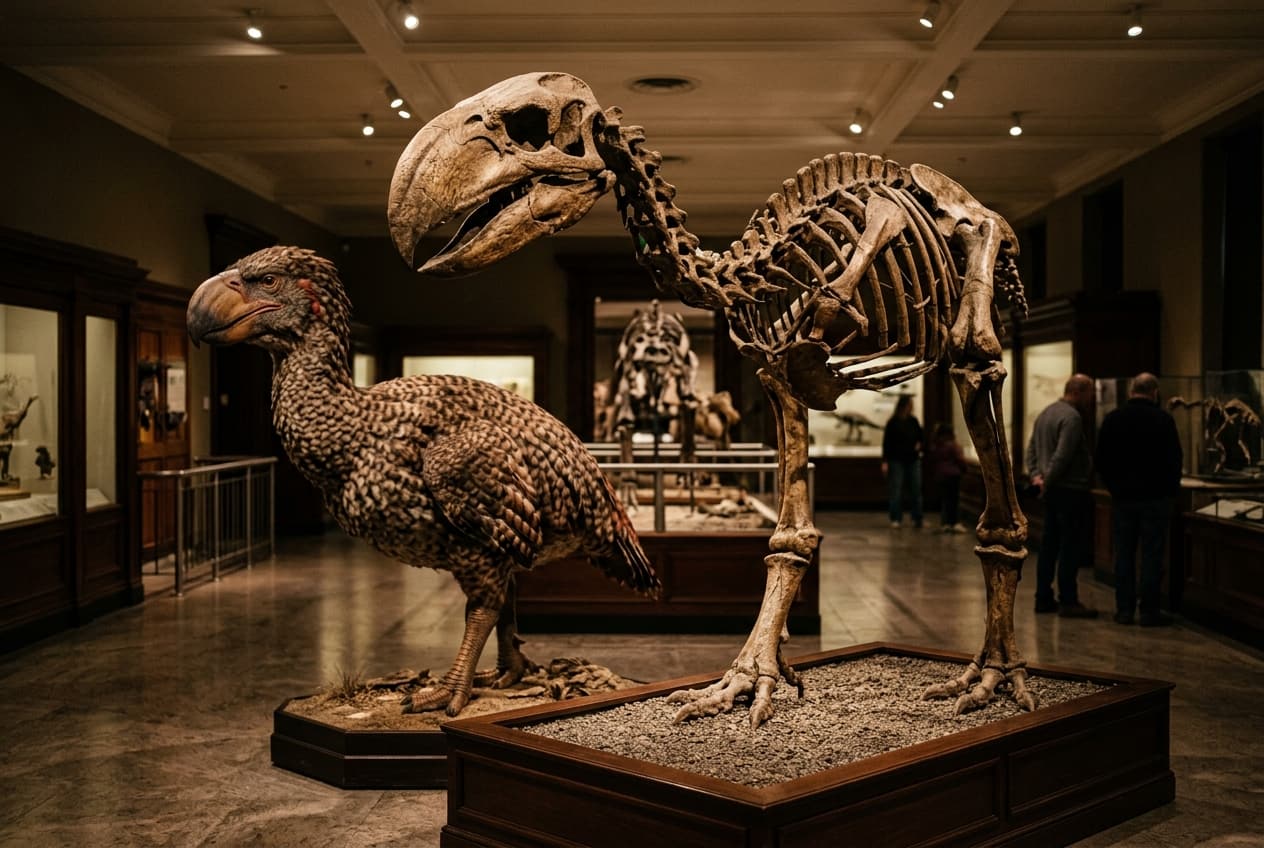
Gastornis used to be one of those fossils that popular paleontology could not resist pushing in the wrong direction. Giant, flightless, big-headed, and equipped with a formidable beak, it was easy to cast as an early Cenozoic answer to the later South American terror birds. The evidence now points elsewhere. The most useful modern profile is narrower and stronger: this was a large terrestrial gastornithiform whose ecology is best read through herbivory, graviportal walking, and a head built for heavy beak work rather than for raptorial killing.[1][2][3][4][5]
That reset matters because the old predator image did not come from nowhere. A bird more than six feet tall, living around 50 million years ago and known from striking skull material, almost asks to be turned into a mammal-hunting mascot.[1] But when isotopes, jaw reconstruction, beak surface anatomy, and eggshell data are put in the same frame, the result stops looking like a fake terror bird and starts looking like one of the early Cenozoic's most distinctive large plant-eaters.[2][4][5]
Image context: the lead image has been replaced during post-publish QA with an immersive museum-gallery scene rather than an analytical or archival-documentation visual. That fit is deliberate. This article depends on slowing down at the head, legs, and body mass before turning the animal into a predator by silhouette alone.
1) The strongest correction is dietary: the isotope signal does not back the old apex-predator story
The 2014 study by Angst and colleagues remains the cleanest single reset because it attacked the problem from two directions at once.[2] The authors analyzed carbon isotope values from Gastornis bone apatite across four Paleocene and Eocene French localities and compared those values with the enrichment patterns of modern carnivorous and herbivorous birds.[2] Their conclusion was direct: the isotopic signal indicates that Gastornis fed on plants, not on a diet centered on vertebrate prey.[2]
That result would already be important on its own. What makes the paper harder to dismiss is that the isotope case is paired with morphology. The same study reports that reconstructed jaw musculature was closer to that of living herbivorous birds than to carnivorous forms.[2] In other words, chemistry and mechanics pull the same way.
The 2015 eggshell paper from southern France pushes the same profile into a second archive.[5] Those authors treated large Paleocene and early Eocene eggshell fragments as gastornithid, and in the Sparnacian material as most likely laid by Gastornis.[5] Their carbon isotope values were again read as evidence for herbivory.[5] This matters because it is not merely one specimen type repeating the same story. Bone and eggshell are different routes into diet, and both move away from the predator legend.
2) The beak was powerful, but powerful does not automatically mean predatory
The beak is exactly where older reconstructions took a wrong turn. Large beak plus large body is visually suggestive, and visual suggestion has a long half-life. But the more recent anatomical literature makes the beak harder to read lazily.
The 2021 Frontiers paper on putative tooth alveoli in the gastornithid Omorhamphus is not a diet paper first, but it contains one of the most useful observations for Gastornis itself.[4] The authors note that adult beaks of Gastornis show deep vascular grooves over much of the dorsal surface and interpret these grooves as related to maintaining a thick rhamphotheca, the keratin sheath of the beak.[4] They further suggest that thickening of the rhamphotheca after growth may have been related to a diet incorporating hard or abrasive food items.[4]
That is a bounded inference, and it should stay bounded. It does not prove a single menu or turn Gastornis into a seed-cracker by decree. What it does do is make the head look more like a heavy-duty processing structure than like a hooked flesh-rending apparatus. The skull becomes easier to place beside tough plant matter than beside a chase-and-tear predatory script.[2][4]
This is one reason the museum-gallery lead works better than a diagram or specimen-documentation plate for the published page. The beak is massive, but it is massive in a way that demands function rather than fantasy. Once the diet evidence is added, the head stops reading as menace and starts reading as leverage.
3) The body plan fits a ground bird that walked heavily rather than a cursorial killer
The 2024 review of gastornithiforms by Mayr and colleagues is useful not because it gives one perfect popular summary, but because it returns the whole group to specimen-level discipline.[3] The review emphasizes that much of what we know anatomically comes from a few good skeletons, especially the nearly complete North American material long known under Diatryma.[3] It also describes gastornithiforms as graviportal and probably rather slow walkers.[3]
That matters because it changes the tone of the whole animal. A graviportal, low-speed giant bird can still be imposing, but its ecology begins in body support and terrestrial movement rather than in pursuit. The limbs and stance fit a heavy ground bird better than an agile mammal hunter.
AMNH's public-facing account compresses this in a simple way: a giant flightless bird, taller than a person, once imagined as carnivorous, now better understood as vegetarian.[1] The museum framing is basic, but it lines up cleanly with the technical literature. By now the best-supported Gastornis is not a predator whose beak merely happened to test positive for plants. It is a herbivore whose size and beak once encouraged the wrong narrative.
4) Taxonomy is still moving, which is exactly why the profile should stay evidence-first
One reason Gastornis remains worth writing about is that not every part of the classification has settled into one permanent label. The 2024 review explicitly resurrects Diatryma for some material traditionally folded into Gastornis, including North American forms and the Geisel Valley species, on the basis of anatomical differences in the scapulocoracoid and tarsometatarsus.[3] That means the exact naming map is still under revision.
This is not a weakness in the article's main claim. It is a useful reminder about how paleontology works. Taxonomy can keep moving while ecology becomes clearer. The naming dispute asks whether all these giant early Cenozoic gastornithiforms belong in one genus. The dietary evidence asks what sort of animal the classic giant form actually was. Those are related questions, but they are not the same question.
That separation improves the species profile. If you learned the animal as Gastornis, the safest modern update is not to pretend the revision does not exist, and not to turn the revision into total uncertainty either.[3] The stable part of the picture is ecological: large, flightless, terrestrial, heavy-built, and strongly supported as herbivorous.[2][3][5] The unstable part is how broadly the name Gastornis should be stretched across the Northern Hemisphere sample.[3]
5) Why the animal still matters
The best final sentence about Gastornis is no longer "it was an early terror bird." A better sentence is that early Cenozoic terrestrial ecosystems could support a giant bird whose skull looked intimidating enough to mislead generations of readers, yet whose isotopes, musculature, beak anatomy, and eggshell chemistry now fit a plant-eating life.[2][4][5]
That shift is more than a correction of one popular misconception. It is a reminder that spectacular anatomy does not carry its own ecological meaning. Sometimes the most dramatic head in the room belongs not to the hunter, but to the herbivore that solved a different mechanical problem. Gastornis stays memorable precisely because the evidence had to work against the silhouette.
Sources
- American Museum of Natural History, "Get to Know a Dino: Gastornis gigantea."
- Delphine Angst, Christophe Lecuyer, Romain Amiot, et al., "Isotopic and anatomical evidence of an herbivorous diet in the Early Tertiary giant bird Gastornis. Implications for the structure of Paleocene terrestrial ecosystems" (2014), University of Bristol publication page with abstract and DOI.
- Gerald Mayr, Cecile Mourer-Chauvire, Estelle Bourdon, and Michael Stache, "Resurrecting the taxon Diatryma: A review of the giant flightless Eocene Gastornithiformes, with a report of the first skull of Diatryma geiselensis" (2024), Palaeontologia Electronica.
- Antoine Louchart, Bhart-Anjan Bhullar, Segolene Riamon, and Daniel J. Field, "The True Identity of Putative Tooth Alveoli in a Cenozoic Crown Bird, the Gastornithid Omorhamphus" (2021), Frontiers in Earth Science.
- Delphine Angst, Christophe Lecuyer, Romain Amiot, et al., "Diet and climatic context of giant birds inferred from d13Cc and d18Oc values of Late Palaeocene and Early Eocene eggshells from southern France" (2015), Palaeogeography, Palaeoclimatology, Palaeoecology.