Dreadnoughtus entered public memory with the kind of headline giant sauropods almost always attract: biggest, heaviest, and more secure in those titles than anything that had come before.[1][3] The excitement in 2014 was understandable. Kenneth Lacovara and colleagues were not announcing another colossal dinosaur from a handful of vertebrae. They had a giant Patagonian titanosaur represented by all major skeletal regions, by a humerus and femur suitable for a formal limb-circumference mass estimate, and by completeness values far above the other enormous titanosaurs that usually dominate size talk.[1][3] That combination yielded the famous numbers: a reconstructed body length of about 26 meters and a body-mass estimate of roughly 59.3 metric tons for the holotype individual MPM-PV 1156.[1]
The more durable lesson is narrower and stronger. Dreadnoughtus is most useful when completeness and mass are kept on separate shelves.[1][2][6] The fossil genuinely changed what paleontologists can say about giant titanosaurs because so much of the body is preserved and comparable across regions.[1][3] At the same time, the specimen also shows why a better skeleton does not automatically produce a final answer about absolute body weight. The neck had to be partly restored, the individual was still growing at death, and later volumetric modeling pushed hard against the largest published mass number.[1][2][6]
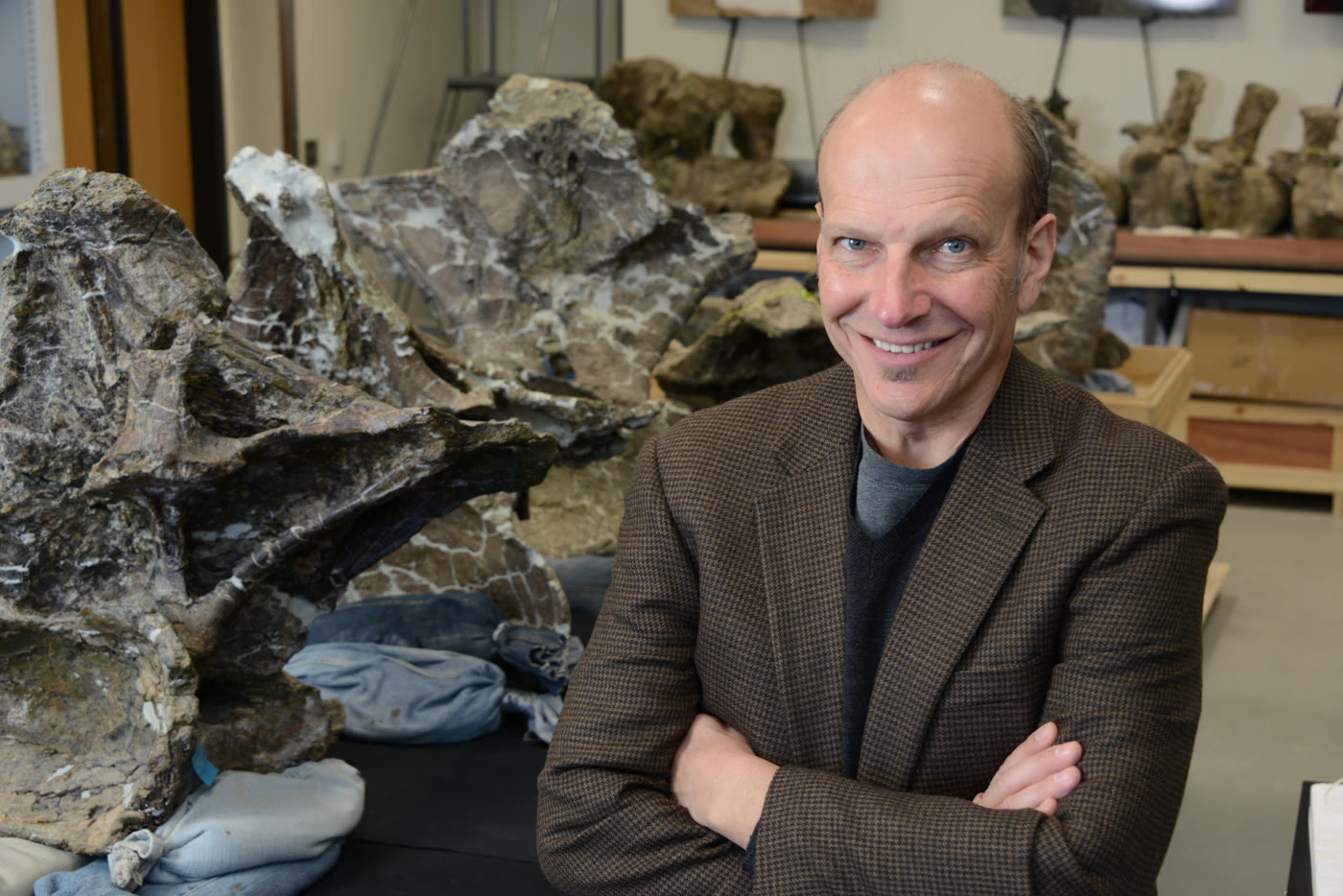
Image context: the cover uses a real laboratory photograph from Wikimedia Commons showing Kenneth Lacovara standing beside the skeleton.[5] It fits this article because the point is not abstract gigantism by itself. The value lies in seeing how many of the relevant regions are actually present in one specimen.
1) The fossil changed the argument first by being unusually complete for a giant titanosaur
The original paper is explicit about what made Dreadnoughtus different.[1] Between the two known specimens, the authors counted 116 non-duplicated elements. For the holotype and referred material together, that translated into about 45.3% of the bones expected in a complete titanosaurian skeleton and, depending on counting method, up to 70.4% of the postcranial element types.[1] The comparison with other giant titanosaurs is the crucial part. The same paper gives far lower values for the animals that normally appear in "largest dinosaur" discussions: 15.2% / 26.8% for Futalognkosaurus, 7.8% / 12.7% for Paralititan, 5.1% / 9.2% for Argentinosaurus, and even less for some other famous giants.[1]
That difference matters more than the headline. Fragmentary giants can still be historically important, but they leave huge parts of the body plan unavailable for close comparison. Dreadnoughtus instead preserves a long tail represented by many vertebrae, substantial limb material, girdle elements, ribs, parts of the jaw, and enough of the rest of the skeleton to make anatomical judgments travel across the body instead of hanging on isolated bones.[1][3] Drexel's release captured this practical advantage well: the skeleton included most of the vertebrae from the roughly 30-foot tail, numerous ribs, toes, a claw, jaw material, and nearly all bones from both forelimbs and hindlimbs, including the femur and humerus most relevant to size estimation.[3]
That is why the specimen still matters even if one ignores the publicity around record claims. Giant titanosaurs are often famous as silhouettes. Dreadnoughtus became valuable as a document.
2) The famous 59.3-ton estimate was real, but it was only one kind of answer
The original mass estimate was not hype improvised after the fact.[1] Lacovara and colleagues used the minimum shaft circumferences of the humerus (785 mm) and femur (910 mm) and applied the then-recent Campione and Evans scaling equation for quadrupedal tetrapods.[1] On that method, the holotype came out to 59,291 kilograms.[1] That result had force because many giant titanosaurs cannot even be entered into the same calculation. Their upper limb bones are missing, too incomplete, or too poorly associated to make a similar estimate defensible. In that narrow sense, Dreadnoughtus really did become a landmark specimen: it let researchers calculate a mass for a giant sauropod using bones that are often absent in its rivals.[1][3]
But even the same paper shows why "calculable" is not the same as "settled."[1] The authors state plainly that total body length could not be established definitively because the cervical series was too incomplete. The preserved neck material implied a long neck, yet much of that region had to be restored after Futalognkosaurus; the skull length also had to be scaled indirectly from Tapuiasaurus using radius proportions.[1] The famous 26-meter body length therefore already depended on a blend of preserved bone and informed restoration rather than on a complete articulated animal.[1]
That does not weaken the paper. It clarifies the kind of claim being made. The skeleton allowed a stronger estimate than most giant titanosaurs, but the estimate still sat inside reconstruction choices. Dreadnoughtus was never a frozen certainty delivered whole from the rock.
3) The holotype was enormous before it had finished growing
One of the most important boundaries in the 2014 paper is ontogenetic, not geometric.[1] Lacovara and colleagues argue that MPM-PV 1156 was not osteologically mature at death. The scapula remained unfused to the coracoid, the humerus retained a thick outer layer of vascularized fibrolamellar bone, and the histology lacked both lines of arrested growth and an external fundamental system.[1] Their conclusion is precise: multiple lines of evidence suggest that this giant individual was still growing when it died.[1]
That point changes the meaning of the size headline. Readers often hear "still growing" and turn it instantly into a simple escalation narrative, as though the only conclusion were that the adult would have been even more spectacular. The actual scientific consequence is more disciplined. If the holotype had not yet reached maximum size, then the published specimen is both more astonishing and less final than the headline suggests.[1][6] It shows that titanosaurs could reach extraordinary scale before skeletal maturity, but it also means that one should be careful about treating the holotype's published number as the definitive endpoint for the species.
In other words, Dreadnoughtus sharpened the giant-sauropod problem instead of ending it. The fossil showed that a still-growing animal could already rival or exceed the calculable masses of many other giant sauropods.[1] Yet the same growth evidence keeps the specimen from becoming a perfect measuring stick for adult maximum mass.
4) Later volumetric work did not erase the fossil; it exposed the method boundary
The strongest challenge came quickly. In 2015, Karl Bates and colleagues revisited Dreadnoughtus using a three-dimensional skeletal model and volumetric reconstructions rather than relying only on limb-circumference scaling.[2][6] Their conclusion was blunt: 59,300 kg was highly implausible, and masses above 40,000 kg required body densities and soft-tissue expansion beyond what is typical for living quadrupedal mammals.[2] The University of Liverpool's summary of the same work translated that into a simpler public range, arguing that the animal was more likely around 30 to 40 tonnes.[6]
This disagreement is exactly why the fossil remains so useful. The later study did not make Dreadnoughtus less informative. It made the limits of competing methods visible on one unusually good specimen.[2][6] If a giant sauropod is known from scraps, debates about mass can turn speculative very quickly because almost every major body region has to be guessed. Dreadnoughtus narrows that zone of ignorance. Researchers can argue over limb scaling versus volumetric modeling while sharing much more of the same underlying skeleton than is possible for most other giant titanosaurs.[1][2]
That is a better outcome than a single winner-take-all number. Paleontology rarely grows stronger by pretending uncertainty has disappeared. It grows stronger when uncertainty is forced into sharper forms. Dreadnoughtus did that for sauropod mass estimation.
5) The afterlife of the specimen is archival as much as anatomical
The final reason to keep returning to Dreadnoughtus is that the specimen was built into a digital archive from the start.[3][4] Drexel emphasized that all bones from both specimens were digitally scanned, and Lacovara's team made a virtual mount publicly available.[3] The figshare dataset preserves those 3D PDF images as a citable research object rather than as a private lab file.[4] That matters because giant dinosaurs are difficult to move, difficult to mount, and difficult to compare in person across continents. A public digital skeleton does not solve every anatomical question, but it changes who can test them.
That is the scale at which Dreadnoughtus deserves to be remembered. The fossil mattered because it moved the discussion of giant titanosaurs away from silhouette mythology and toward documented anatomy.[1][3][4] It also mattered because it demonstrated that even a remarkably complete giant can leave body mass under live negotiation.[1][2][6] The specimen did not hand paleontology one final number. It handed the field something better: a large, unusually transparent boundary between what the bones secure, what reconstructions infer, and what future methods still have to argue out.
Sources
- Kenneth J. Lacovara, Matthew C. Lamanna, Lucio M. Ibiricu, Jason C. Poole, Nestor E. Schroeter, Paul V. Ullmann, Leandro Salgado, Rubén D. Martínez, Fernando E. Novas et al., "A Gigantic, Exceptionally Complete Titanosaurian Sauropod Dinosaur from Southern Patagonia, Argentina" (2014), Scientific Reports.
- Karl T. Bates, Peter L. Falkingham, Sophie Macaulay, Charlotte Brassey, and Susannah C. R. Maidment, "Downsizing a giant: re-evaluating Dreadnoughtus body mass" (2015), Biology Letters record via the University of Liverpool repository.
- Drexel University, "Drexel Team Unveils Dreadnoughtus: A Gigantic, Exceptionally Complete Sauropod Dinosaur" (2014).
- Kenneth Lacovara, "Dreadnoughtus schrani 3D PDF images - Lacovara et al., 2014" (figshare dataset).
- Wikimedia Commons, "File: Kenneth J. Lacovara with the skeleton of Dreadnoughtus schrani.jpg".
- University of Liverpool, "Scientists downsize the giant 'Dreadnoughtus' dinosaur" (2015).