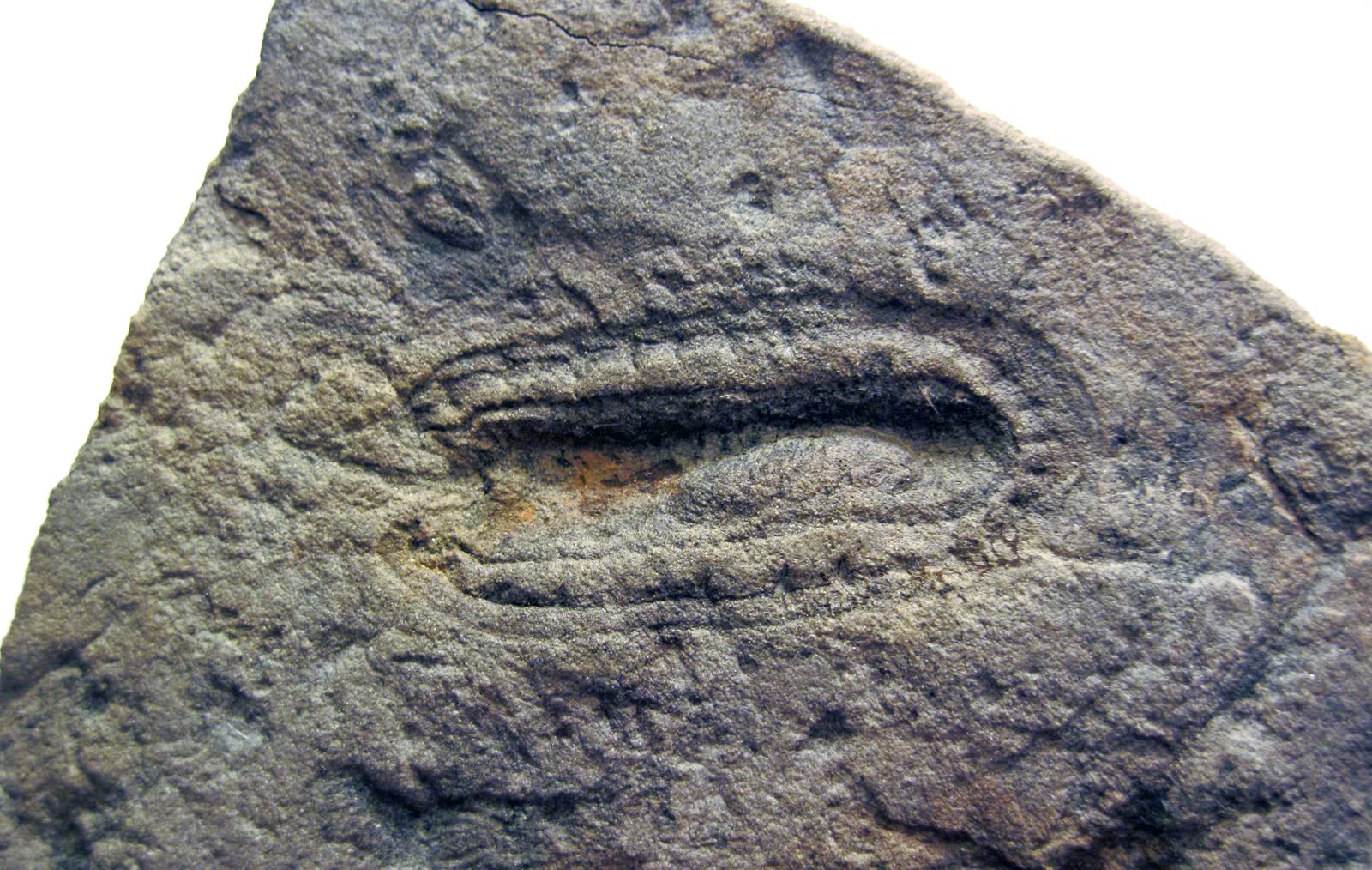
Kimberella quadrata is easy to overuse as a headline about the first animal with a familiar body plan. That shortcut misses the reason the fossil matters. Kimberella is valuable because it makes several fragile kinds of evidence touch without letting any one of them carry the whole argument: a soft-bodied impression, bilateral organization, a possible creeping or feeding apparatus, fan-shaped scratch marks, and a late Ediacaran age just before the Cambrian animal record becomes louder.[1][2][3]
The best way to read Kimberella is therefore not as a little proto-snail waiting for the Cambrian curtain to rise. It is better read as a boundary fossil. It sits where body fossils and trace fossils begin to reinforce one another, but also where the terms "mollusc-like," "bilaterian," and "trace maker" still need careful handling. The fossil's strength comes from the bundle. Its limits come from the same bundle.[1][2][4]
Image context: the lead image uses a real photograph of a Kimberella quadrata specimen in sandstone from the Ust-Pinega Formation, White Sea region, Russia, sourced through Wikimedia Commons. It belongs here because this article depends on fossil evidence rather than a life reconstruction. The body impression is quiet, compressed, and ambiguous in exactly the way the argument requires.[5]
1) The old jellyfish reading had to fail first
The modern importance of Kimberella is partly a story about interpretation leaving an older visual habit behind. Fedonkin and Waggoner's 1997 Nature paper notes that the fossil was originally described from late Precambrian rocks of South Australia and had been reconstructed as a jellyfish or linked to cnidarians before the White Sea material changed the case.[1] Their Russian specimens supported a different reading: a bilaterally symmetrical, benthic animal with a non-mineralized, univalved shell-like structure, resembling a mollusc in several respects.[1]
That was a serious shift. It moved Kimberella out of the old "Ediacaran jellyfish" frame and into a more active, bottom-dwelling animal problem. The claim mattered because it placed a relatively large, triploblastic-looking metazoan in the Precambrian record, pushing the roots of major protostome-grade organization deeper than a simple Cambrian explosion story allows.[1]
But the useful word in that reading is "mollusc-like," not "mollusc" as a finished label. A modern snail or chiton should not be projected backward onto the slab. The fossil preserves an impression and a body organization, not a radula, shell mineralogy, or enough internal anatomy to close the case in the way a younger fossil mollusc might. The analogy is powerful because it gives the body a functional grammar. It becomes weaker when the analogy is treated as identity.[1][4]
2) The scratches make the body harder to ignore
The trace-fossil evidence is what gives Kimberella much of its force. Gehling, Runnegar, and Droser described fan-shaped sets of paired scratches, named Kimberichnus teruzzii, from South Australia and the White Sea region of Russia. They interpreted these as feeding traces associated with large Ediacaran bilaterians and identified Kimberella quadrata as the trace maker because body fossils co-occur with the scratch marks in both regions.[2]
That co-occurrence changes the scale of the argument. A body impression by itself can be anatomically suggestive, but still mute about behavior. A trace by itself can suggest movement or feeding, but leave the maker uncertain. Together, they create a stronger pattern: an organism with a coherent body outline appears in the same Ediacaran settings as systematic mat-excavation marks.[2] The claim is not that every scratch beside every body is a perfect signature. The claim is that body and trace evidence begin to lock into the same ecological story.
The microbial mat setting matters. Gehling and colleagues argue that the paired scratches record systematic excavation of seafloor microbial mats by large bilaterian animals of molluscan grade.[2] That is why the traces are more than decorative lines. They point toward directed interaction with a food surface: scraping, raking, or excavating mat material in repeated passes. For an Ediacaran fossil, that behavioral signal is precious because it turns a static impression into part of a living surface economy.[2]
3) Age control gives the fossil evolutionary weight
The timing is part of the evidence. Martin and colleagues reported a uranium-lead zircon age from volcanic ash interbedded with fossil-bearing shallow marine rocks at the White Sea's Zimnie Gory section. Their PubMed abstract gives an age of before 555.3 +/- 0.3 million years ago for a diverse assemblage of body and trace fossils, describing this as a minimum age for the oldest well-documented triploblastic bilaterian Kimberella.[3]
That date does not make Kimberella the ancestor of later molluscs, and it does not turn one fossil into a complete map of early animal evolution. It does something narrower and more durable. It places a body-and-trace evidence package in the late Ediacaran, before the major Cambrian expansion of biomineralized skeletons and more abundant burrows makes animal activity easier to see.[3]
This is why Kimberella is so often pulled into molecular clock and Cambrian explosion arguments. The fossil is not simply old. It is old in a way that constrains the conversation: if the body and traces are read as bilaterian-grade evidence, then some complex animal organization was already present before 555 million years ago.[1][2][3]
4) The caution is part of the value
The stronger the fossil becomes in public retelling, the more important the caution becomes. Runnegar's 2021 review of Ediacaran interpretations in Geological Magazine keeps that boundary visible. It emphasizes the long history of changing Ediacaran hypotheses and notes that, although Kimberella shows clear bilateral symmetry, the evidence for a precise molluscan identity remains limited. The same review also flags complications in attributing the scratch traces to Kimberella, including questions about timing, bed surfaces, and how the marks formed.[4]
That does not erase the body-trace case. It improves it. A fossil this old should not be made stronger by hiding its weak joints. The better reading says: Kimberella is one of the best Ediacaran candidates for a large, bilaterian-grade animal; the feeding-trace association is a major reason; the mollusc comparison is informative; the exact affinity and trace-production mechanics still carry uncertainty.[1][2][4]
That layered position is more interesting than certainty. It shows how paleontology handles a fossil that is too informative to dismiss and too incomplete to simplify. The body has enough organization to escape the old jellyfish frame. The scratches have enough pattern to suggest active feeding. The age is tight enough to matter for animal origins. The remaining ambiguity keeps all three lines honest.[1][2][3][4]
5) A boundary fossil should be read as a boundary
The temptation with Kimberella is to ask for a single answer: mollusc or not, bilaterian or not, trace maker or not. The fossil rewards a better question. What combination of evidence makes a late Ediacaran organism animal-like enough to matter, and where does that combination stop?
Read this way, Kimberella becomes a compact lesson in early-animal evidence. Its body impression gives morphology. Its associated scratches give behavior. Its White Sea age gives evolutionary placement. Its contested affinity gives discipline.[1][2][3][4] None of those lines is sufficient alone. Together, they make a fossil that can bear real evolutionary weight without being turned into a mascot.
That is the value of keeping the scratches with the body. Kimberella matters because the fossil record briefly lets anatomy, behavior, and time meet on the same Ediacaran surface. The meeting is partial. It is also enough to make the pre-Cambrian animal world feel less like a blank prelude and more like a working seafloor, crossed by soft bodies that left marks before skeletons took over the public story.[1][2][3]
Sources
- Mikhail A. Fedonkin and Benjamin M. Waggoner, "The Late Precambrian fossil Kimberella is a mollusc-like bilaterian organism," Nature 388 (1997).
- James G. Gehling, Bruce N. Runnegar, and Mary L. Droser, "Scratch Traces of Large Ediacara Bilaterian Animals," Journal of Paleontology 88, no. 2 (2014), Cambridge Core page.
- M. W. Martin and others, "Age of Neoproterozoic bilatarian body and trace fossils, White Sea, Russia: implications for metazoan evolution," Science 288 (2000), PubMed record.
- Bruce Runnegar, "Following the logic behind biological interpretations of the Ediacaran biotas," Geological Magazine 158, no. 11 (2021), Cambridge Core open-access article.
- Wikimedia Commons file page for the Kimberella quadrata fossil photograph used as the article image.