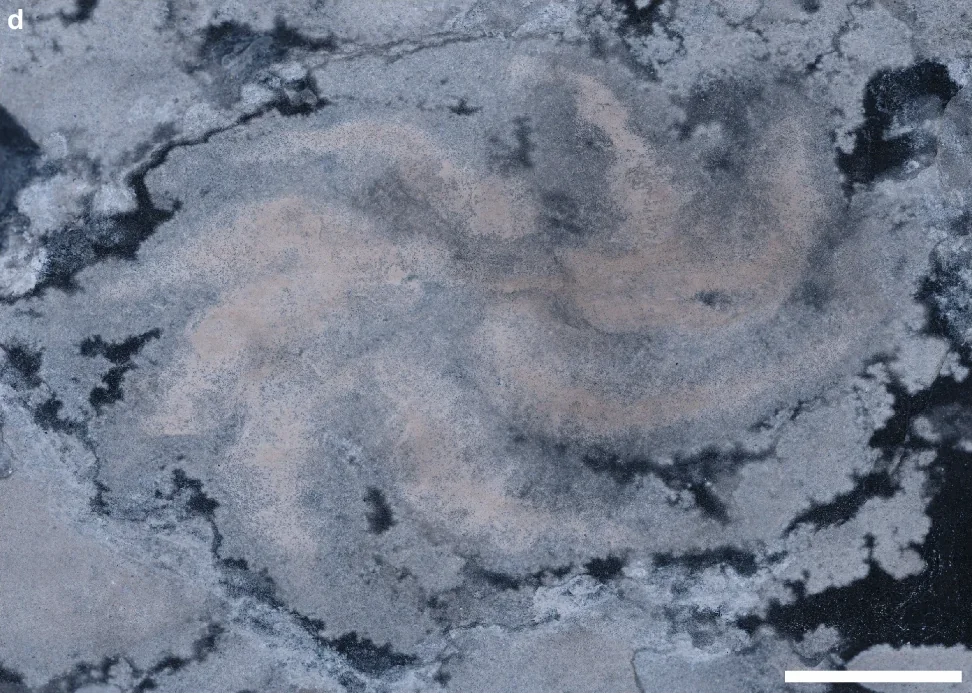
The cover fossil looks like a whirl pressed into slate. Eight pale bands curl around a small central point; outside them, the carbon film fades into the dark shale. This is ESEN 0015, collected from the Tongshan Lagerstätte in Hubei, China, in rocks bracketed between roughly 551 million years ago and 543.74 ± 0.87 million years ago. The specimen extends Eoandromeda octobrachiata into the terminal Ediacaran, later than its previously recognized range.[5][6]
The obvious reading is also the dangerous one: a flat, eight-armed organism lay on the seafloor exactly as the photograph shows. Yet a fossil is the combined product of a body, a burial event and the chemistry that made some parts visible. Eoandromeda is unusually useful because versions of the same form occur in two very different preservational windows. In South China it survives as a carbonaceous compression in shale. In South Australia it is an external mould on the underside of sandstone beds.[1][4]
Those records agree on the eight-part spiral while disagreeing in the ways a soft body should disagree after being flattened by different sediments. A recent shape analysis turns that distortion from nuisance into evidence. Its strongest reconstruction is not a living pinwheel, but a soft, probably sessile body that rose from the microbial mat as a low cone. The spiral may record how that cone gave way.
One body, two kinds of absence
When Chinese and Australian material were compared in 2008, the match mattered for more than taxonomy. The Chinese fossils retained organic carbon; the Australian fossils retained relief after the body itself had disappeared. Finding the same eight tapering arms in both made it harder to dismiss the form as a local sedimentary structure or an agglutinated mass assembled from grains. The authors treated the contrasting preservation as evidence for a relatively resistant organic outer layer, while leaving the organism's deeper affinity open.[1]
The two windows do not make identical pictures. Chinese compressions can show the spiral in either handedness because the original top and bottom of a loose shale piece may be uncertain. Australian impressions consistently spiral anticlockwise when viewed as negative relief on the bed underside—equivalent to a clockwise spiral on the body in life. Some Chinese specimens also preserve transverse bands along the arms. Comparable bands are absent from the Australian sample, where apparent examples may instead be sandstone texture.[2][4]
That difference is an important restraint. A character visible in one preservational regime and missing in another might be real tissue selectively retained by carbon film. It might also be a crease, mineral stain or repeated artefact. Preservation can corroborate an organism without making every detail interchangeable.
The Tongshan specimen adds a third Chinese locality and a younger time slice, but not a finished anatomical answer. Hou and colleagues identified its eight arms and central pole in Burgess Shale-type carbonaceous preservation; they described a possible ctenophore affinity rather than claiming that the specimen resolves it.[5] The photograph expands the record. It does not turn resemblance into homology.
How eight arms became eight comb rows
The ctenophore proposal is easy to understand. Living comb jellies move with eight rows of fused cilia called ctenes. In 2011, Feng Tang and colleagues read Eoandromeda's eight spiral arms as comb rows, the transverse bands as ctenes, tubular-looking interiors as meridional canals, and the central structure as an aboral organ. They placed it on the ctenophore stem: outside the living crown because it lacked such features as tentacles, statoliths, polar fields and biradial symmetry, but inside the broader lineage because of its eightfold construction.[2]
A later study of Chinese compressions gave that body a life history. Ye Wang and colleagues interpreted circular and oval specimens as views of an umbrella-shaped organism, with a few bell-shaped compressions representing side views. They proposed an actively swimming juvenile followed by mostly benthic adult and senescent stages, drawing on arm proportions and features described as feather-like lamellae and marginal skirts.[3]
Both interpretations make testable predictions. A swimmer caught from the water column should not always land in the same orientation. Features used to diagnose comb rows should recur independently of one rock's texture. A claimed change in lifestyle should appear as a coherent change in shape across body sizes. The South Australian bedding planes preserve enough individuals to test those expectations as a population rather than as a sequence of especially persuasive specimens.[4]
The burial current becomes an experiment
Tory Botha and colleagues surveyed about 230 South Australian specimens from three beds at Nilpena Ediacara National Park and museum collections. Ninety-five complete enough for landmark analysis became the core dataset. Because an eightfold spiral has no obvious first arm, the researchers made eight rotated, relabelled versions of each landmark configuration before calculating a consensus shape. That procedure prevented arbitrary orientation from masquerading as anatomical variation.[4]
The three bedding planes then acted like imperfect natural flumes. The WS-Parv bed records a strong unidirectional current through tool marks and aligned fallen fronds. Its Eoandromeda specimens are strongly distorted and offset in the same direction. WS-Sub records a weaker current and a similar, weaker alignment. On the LV-Eo bed, where the sediment offers no comparable current signal, specimens point in many directions and preserve a larger share of symmetrical shape variation.[4]
Size does not explain the asymmetry. If one side naturally grew larger as an individual matured, distortion should change systematically with body size. It did not. Instead, asymmetry tracks an external variable—the direction and strength of flow at burial. Other organisms on the same surfaces do not deform as strongly, suggesting that Eoandromeda was especially flexible, perhaps because its tissues were soft or partly fluid-filled.[4]
This pattern also bears on lifestyle. The Australian fossils occur in a consistent face-down relationship to the bed; none in the study was completely on its side or upside down. Their edges often fade into the texture of the microbial mat. A pelagic body dragged out of the water column by repeated burial events should produce a less disciplined set of landing angles. Consistent orientation and current-aligned slumping fit a body already living on the bottom more comfortably than an active swimmer.[4]
That is not a video of behavior preserved in stone. It is a comparative inference: three beds, different flow signatures, one deformable anatomy.
The cone survives in two unfinished collapses
Flattening can show that a body was flexible without revealing its original height. The conical reconstruction rests on two rare South Australian specimens, SAMA P49301 and P49302, whose centers retain high relief. Their arms run comparatively straight down the raised middle, then begin to spiral near its base. In one, a side has folded farther inward than the rest. Both were found ex situ on an isolated piece, so their exact position within a mapped bed is lost.[4]
Read cautiously, they preserve stages between standing body and flat impression. A supported cone—whether stiffened by tissue, internal fluid or both—could shorten under sediment loading. Its eight longitudinal arms would have to accommodate that compression. Coiling lets length move sideways as height is lost, rather as a twisted paper shade turns into a tighter spiral when pushed down. Larger specimens in the dataset tend to show tighter coils, a pattern compatible with more collapse in a taller body, though growth itself may also have changed arm length and curvature.[4]
Only two specimens retain this partly collapsed geometry. They cannot prove a universal cone, much less its precise height or internal material. “Possibly cone-shaped” is the right claim. What makes it strong is not the visual appeal of either fossil alone, but its fit with the broader evidence: radial consensus shape, current-sensitive deformation, consistent bedding orientation and arms joined around a body margin.[4]
A better body does not guarantee a family
Reconstructing Eoandromeda as a flexible benthic cone weakens the swimming comb-jelly scenario, but it does not identify a replacement lineage. The Australian specimens lack the proposed transverse ctenes and marginal skirts. Their fully benthic distribution and inferred construction differ from the pelagic body plan of living comb jellies, while comparisons with debated Cambrian ctenophore-like fossils add no simple anatomical bridge. Botha and colleagues therefore left class, order and family unassigned and judged a stem-ctenophore placement unlikely.[4]
That conclusion does not erase the eightfold resemblance that motivated the hypothesis. It changes its weight. Eight repeated structures are direct fossil evidence. Calling them comb rows is an evolutionary interpretation that requires independent anatomical support. A central spot is direct evidence. Calling it an aboral sensory organ requires the same caution. The fossil can be animal-like—and perhaps genuinely animal—without belonging to the modern group it most quickly evokes.[1][2][4]
Return to the cover image and the spiral now reads differently. The carbon film records an organism, but it also records the last mechanical act performed on that organism. Its asymmetry may be current direction. Its flatness may be lost height. Its coil may be the route by which a soft cone accommodated burial.
Eoandromeda remains taxonomically homeless, yet it is no longer shapeless. That is the sharper achievement: not forcing an Ediacaran body into a familiar phylum, but recovering how it stood, bent and collapsed while leaving the family name blank.
Sources
- Maoyan Zhu et al., “Eight-armed Ediacara fossil preserved in contrasting taphonomic windows from China and Australia,” Geology 36 (2008)—carbonaceous compressions, sandstone moulds and the original cross-window comparison.
- Feng Tang et al., “Eoandromeda and the origin of Ctenophora,” Evolution & Development 13 (2011), PubMed record—stem-ctenophore interpretation and its proposed anatomical homologies.
- Ye Wang et al., “Lifestyle of the Octoradiate Eoandromeda in the Ediacaran,” Paleontological Research 24 (2020)—Chinese compression anatomy and the proposed pelagic-to-benthic life history.
- Tory L. Botha et al., “Elucidating the morphology and ecology of Eoandromeda octobrachiata from the Ediacaran of South Australia,” Papers in Palaeontology 9 (2023), NASA Technical Reports Server record—rotational morphometrics, current-aligned deformation and the benthic-cone reconstruction.
- Jin-bo Hou et al., “The terminal Ediacaran Tongshan Lagerstätte from South China,” Nature Communications 16 (2025)—the younger Tongshan occurrence, age control and specimen ESEN 0015.
- Hou et al., “Eoandromeda octobrachiata from the Tongshan Lagerstätte,” Wikimedia Commons—source page for the CC BY 4.0 specimen photograph used as the article image.