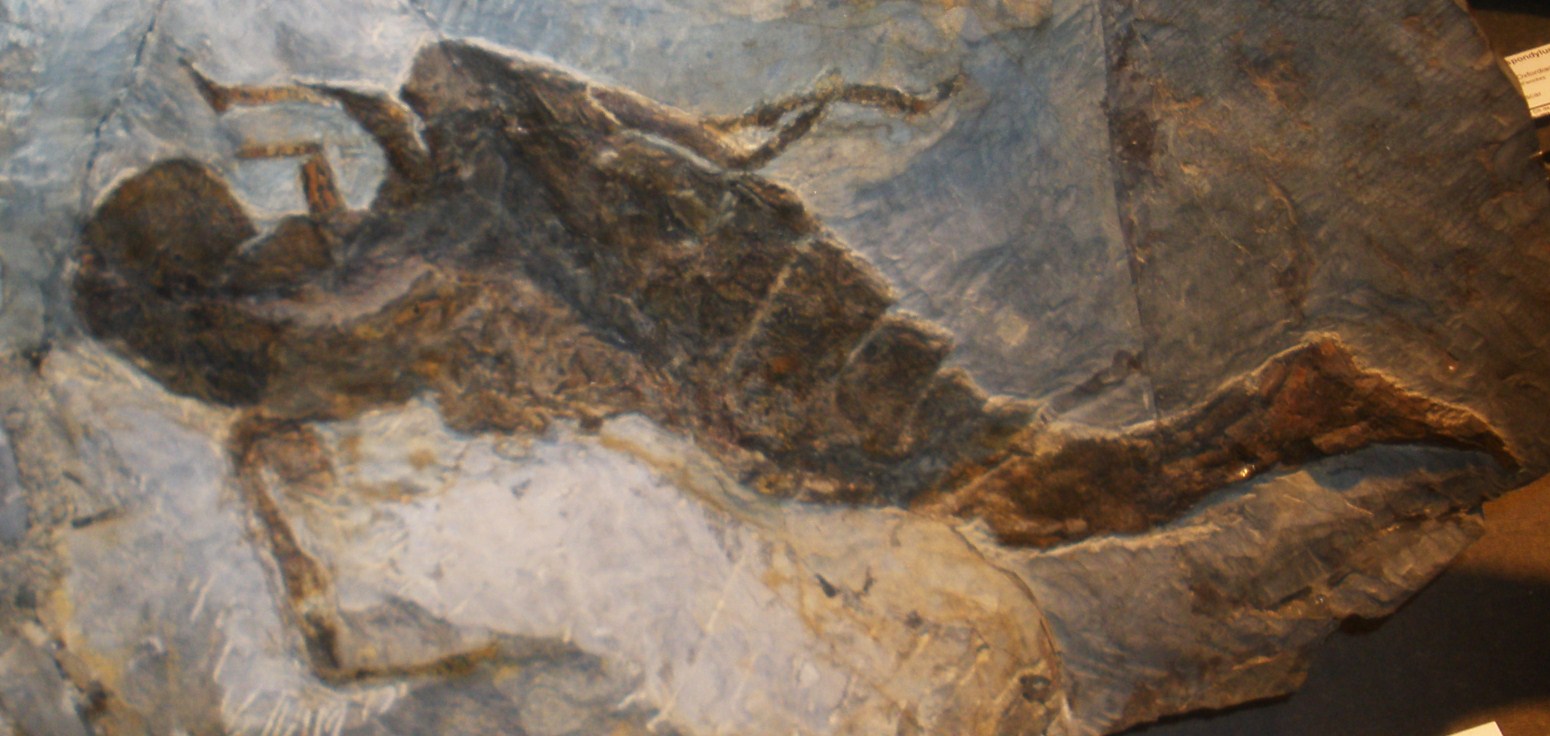
The easy version of Jaekelopterus rhenaniae is almost too efficient: a "sea scorpion" as long as a person, armed with a claw big enough to make the Paleozoic feel cinematic. The better version begins more slowly. The size claim rests on a fossil chelicera, a claw-bearing mouth appendage, from the Early Devonian Willwerath Lagerstatte of Germany. Braddy, Poschmann, and Tetlie described the find as a 46-centimeter chelicera and used comparison with other pterygotid eurypterids to estimate a body length of roughly 2.5 meters, making Jaekelopterus the largest arthropod then known from the fossil record.[1]
That is an extraordinary claim, but it is not a loose one. It is a scaling argument built from a partial body part. The fossil does not hand us a complete animal stretched on a slab. It gives a large predatory appendage, then asks whether the ratios seen in better-known pterygotids can carry that appendage back to body length. That is why Jaekelopterus deserves a fossil-find close reading. The scientific drama is not that an ancient creature was big. It is that a single preserved structure can be strong enough to alter the upper size limit of arthropods, while still requiring the reader to keep every inference visible.[1]
Image context: the lead image is a real photograph of a displayed Jaekelopterus rhenaniae fossil from Wikimedia Commons. It is used here because the article is concerned with fossil evidence and not with a life reconstruction. The slab format keeps the animal's preserved reality in view before any body-size imagination begins.[5]
1) The claw is the evidence center
The key fossil is not a generic claw. In eurypterids, the chelicera is part of the feeding apparatus, and in pterygotids it became one of the most distinctive predatory structures in the group.[2] Yale Peabody summarizes pterygotids as the largest eurypterids, with formidable claws and binocular vision that would have supported active attacks on prey such as primitive fish or cephalopod relatives.[2] That background matters because the Willwerath chelicera is not just a size proxy. It is a functional organ from a predatory system.
Still, function does not erase uncertainty. A claw can be measured directly; a whole animal has to be reconstructed by comparison. The original body-length estimate depends on the relationship between cheliceral size and body size in related pterygotids.[1] This is a disciplined kind of inference, not a guess. It also has a boundary: if the proportions of Jaekelopterus differed substantially from the comparator taxa, the estimate would move. The fossil's power lies in that tension. It is specific enough to make an enormous size plausible, and incomplete enough to make proportional reasoning unavoidable.[1]
That is also why the phrase "largest arthropod" should be handled with care. It is a claim about known fossil evidence, not a declaration that no larger arthropod ever lived. Paleontology speaks from recovered material. Jaekelopterus expands the known record by forcing a larger upper bound from an unusually large pterygotid appendage.[1][4]
2) "Sea scorpion" is a useful nickname until it starts misleading
Eurypterids are often called sea scorpions, but the nickname can smuggle in the wrong picture. Yale Peabody places them within Chelicerata, related to horseshoe crabs, scorpions, spiders, mites, and ticks.[2] The BMC Evolutionary Biology work by Lamsdell and Selden likewise frames eurypterids as an extinct chelicerate group, probably close to arachnids, ranging from the mid-Ordovician to the end-Permian and often preserved in Silurian and Devonian Lagerstatten because of their unmineralized cuticle.[3]
Those details matter for Jaekelopterus. Calling it a scorpion with paddles is too blunt. The animal belongs to an aquatic chelicerate radiation with its own long history, its own preservation biases, and its own ecological experiments.[2][3] The pterygotid body plan combined enlarged grasping chelicerae, swimming structures, and visual predation. It was not a modern scorpion moved into water. It was a Devonian predator built inside a chelicerate design space that later vanished.[2][3]
The habitat label needs the same care. Eurypterids as a whole occupied a range of aquatic settings, and Lamsdell and Selden note a long-term trend toward freshwater habitats through the Carboniferous and Permian.[3] Jaekelopterus rhenaniae itself comes from Devonian deposits in Germany rather than from an open-ocean skeleton lying in wait for a movie poster. The record points toward brackish to freshwater or nearshore aquatic systems in which large pterygotids could hunt, molt, and leave fragmentary remains.[1][3]
3) Giant size was a pattern, not a one-off stunt
The claw becomes more interesting once Jaekelopterus is placed in the broader Paleozoic arthropod story. The Natural History Museum of Los Angeles County's "Giants of the Paleozoic" page treats Jaekelopterus alongside other large arthropods such as griffenflies, Arthropleura, giant trilobites, and anomalocaridids.[4] That grouping is useful because it prevents a single-animal myth. Paleozoic gigantism appeared in several arthropod lineages, and its causes were not uniform.
The 2009 Bristol summary of Lamsdell and Braddy's work makes the same point more analytically. Earlier explanations had leaned either on ecological competition, especially Romer's old "arms race" idea involving early vertebrates, or on environmental factors such as past oxygen levels. Their reading split eurypterids into two main patterns: giant predatory swimming forms that appear to have grown under competition with placoderms, and other forms that reached large size later under different environmental pressures.[4]
This matters for Jaekelopterus because it turns giant size from a monster trait into an ecological result. A large claw makes sense inside a predator's life, but the predator's body size also sits within a world of armored fishes, shifting salinity regimes, prey capture, locomotion, and clade history.[2][4] The fossil appendage is therefore not simply a trophy. It is a data point in a larger question about why some arthropods could become huge, why different eurypterid lineages did so in different ways, and why those experiments eventually ended.[3][4]
4) The best reading keeps scale and fragment together
The public appeal of Jaekelopterus comes from scale. The scientific value comes from keeping that scale attached to the fragment that produced it. If the chelicera is treated only as a monster prop, the fossil becomes less informative. If it is treated as a measured anatomical part from a particular pterygotid animal in a particular Devonian setting, it becomes richer.[1][2]
That close reading also improves the "largest arthropod" claim. The phrase is exciting, but the actual argument is more precise: a 46-centimeter pterygotid chelicera from Willwerath, scaled against related forms, indicates a body length near 2.5 meters.[1] The estimate is not magic. It is comparative anatomy under fossil-record conditions. The preserved part is directly measured; the whole animal is inferred; the ecological meaning is then tested against what is known about eurypterid vision, claws, habitats, diversity, and decline.[1][2][3][4]
Seen this way, Jaekelopterus is not diminished by caution. It gets better. The animal remains enormous, but the real fascination shifts from size alone to evidentiary method. A fossil claw can change the record of arthropod maximum size, but only if paleontology can explain exactly how the leap from claw to body is made. Jaekelopterus is memorable because it lets that leap be watched in public: a fragment, a comparison set, a Devonian ecosystem, and a giant body reconstructed within limits.[1][2][4]
Sources
- Simon J. Braddy, Markus Poschmann, and O. Erik Tetlie, "Giant claw reveals the largest ever arthropod," Biology Letters 4 (2008), PubMed record with DOI and abstract.
- Yale Peabody Museum, "Eurypterids, Giant Ancient Sea Scorpions" - overview of eurypterid relationships, pterygotid size, claws, and visual predation.
- James C. Lamsdell and Paul A. Selden, "Babes in the wood - a unique window into sea scorpion ontogeny," BMC Evolutionary Biology 13 (2013).
- University of Bristol, "Why giant sea scorpions got so big" (2009 research summary of Lamsdell and Braddy on eurypterid gigantism).
- Wikimedia Commons file page for the Jaekelopterus rhenaniae fossil photograph used as the lead image.