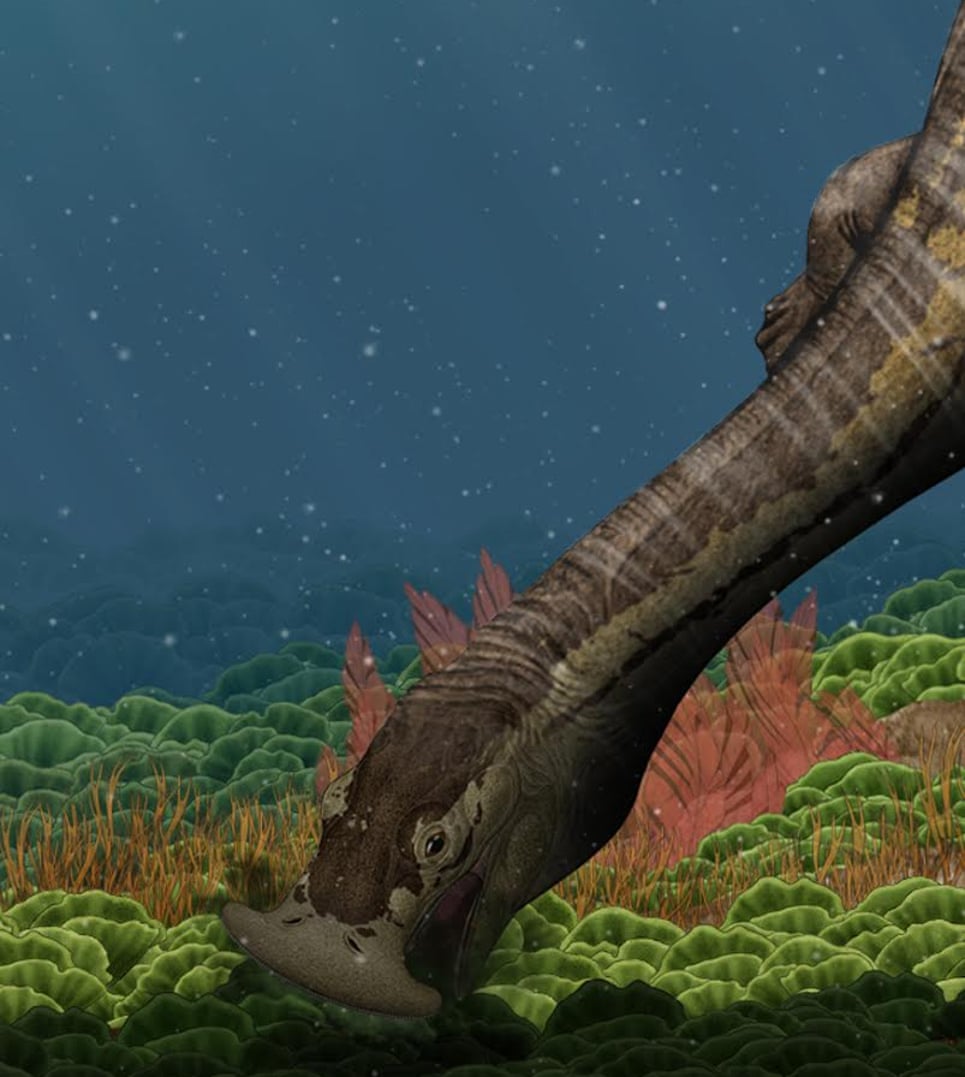
Atopodentatus unicus looks at first like a joke the fossil record played on tidy categories. It was a Middle Triassic marine reptile from Luoping County in Yunnan, China, roughly three meters long, with a compact neck, sturdy limbs, and a jaw apparatus so unfamiliar that its first interpretation did not survive the next round of better skull evidence.[1][2]
The useful way to read the animal is not as a one-off oddity. It is a species profile about correction. In 2014, the original description presented a marine reptile with a strange downturned rostrum and dense, comb-like teeth, interpreted as a specialized bottom filter feeder.[2] Two years later, new specimens changed the head. The living animal was not best understood as a reptile with a vertical zipper of teeth. It had a broad, hammer-shaped front to the jaws, with chisel-shaped teeth along the leading edge and needle-like teeth forming a filtering mesh along the sides.[1][3]
That is why Atopodentatus matters. The fossil is not merely bizarre; it is an example of how a damaged specimen can produce a plausible but wrong functional story, and how additional material can turn the same animal into a sharper ecological signal.
The first version was already strange
The 2014 paper had good reason to take the animal seriously. Atopodentatus was not known from a single isolated tooth or a few vertebrae. The described material included a near-complete skeleton with skull material from the Guanling Formation, and the dentition was extraordinary enough to define the name: unusual teeth, uniquely arranged.[2] The authors saw many small teeth on the jaws and a head shape that seemed to point toward bottom feeding in water.[2]
That first model fit a broader Triassic context. After the end-Permian mass extinction, marine ecosystems did not simply refill with the same old players. The Luoping biota is one of the key windows into that rebuilding, preserving fishes, arthropods, mollusks, echinoderms, marine reptiles, and other organisms in an early Middle Triassic ecosystem that was already far from empty.[5] A reptile experimenting with an odd feeding mode did not seem out of place there.
But the first skull was damaged. That is the hinge. Paleontology often has to reason from flattened, sheared, incomplete, or compressed material. A shape that looks anatomical can be partly taphonomic. In Atopodentatus, the correction was not cosmetic. It changed the food, the motion of the mouth, and the ecological role of the animal.
The hammerhead is a feeding tool
The 2016 Science Advances paper reframed the animal around two better-preserved skulls. Those specimens showed a pronounced hammerhead-like jaw apparatus: the front edges of the upper and lower jaws were widened, and the teeth were not all doing the same job.[1] The straight front edge carried chisel-like teeth, while the side and rear portions of the jaws held dense, needle-like teeth.[1]
That division of labor makes the animal legible. The front of the mouth could scrape plant matter or algae from hard surfaces. The mouth could then take in suspended material and water. The needle-like side teeth acted as a sieve, keeping food in while water exited.[1][3] The comparison is sometimes made to baleen, but the more precise point is mechanical rather than genealogical: Atopodentatus had a mouth in which scraping and filtering were integrated into one feeding cycle.
This is not how marine reptiles are usually introduced. Popular accounts of Mesozoic seas are crowded with pursuit predators: ichthyosaurs chasing fish, plesiosaurs using flippers and reach, mosasaurs bringing late-Cretaceous lizard power to open water. Atopodentatus points in another direction. It was not a top predator. It was a specialized herbivorous filter feeder, and the 2016 authors treated it as the earliest known herbivorous marine reptile.[1][3]
The word "herbivorous" needs care. Nobody watched it eat. The claim comes from the jaw architecture, tooth shapes, wear expectations, and comparison with feeding mechanics in living and fossil animals.[1] The skull does not prove a menu with modern precision, but it does strongly change the range of plausible diets. A narrow invertebrate-sifting story became less convincing once the hammer-shaped scraping edge appeared.
A recovery ecosystem with room for specialists
The animal's age is part of the argument. The Field Museum account places the animal about 242 million years ago, in the aftermath of the end-Permian crisis that had removed a huge fraction of marine life.[3] The Luoping biota paper frames the same broader interval as a window into recovery and radiation, not just survival: new trophic levels and diverse marine reptiles were already present in Middle Triassic seas.[5]
That matters because Atopodentatus is specialized. A scraping-and-filtering herbivore is not a bare-minimum survivor design. It implies that hard substrates, plant or algal resources, and enough ecological structure existed to reward a narrow feeding machine. The animal's weirdness therefore cuts against a lazy picture of post-extinction seas as simple, slow, and predator-poor for a long time. By the time Atopodentatus appears, some marine reptile lineages were already exploring highly particular jobs.
It also sharpens the meaning of "marine reptile." The phrase can sound like a single lifestyle, but it names a repeated invasion of water by different reptile groups under different constraints. Atopodentatus was probably near the sauropterygian side of that story, not an ichthyosaur or a mosasaur.[1][2] Its body says aquatic or semi-aquatic animal. Its mouth says plant-processing apparatus. Together they make a profile that does not fit the default sea-monster lane.
The lesson is specimen discipline
The best reason to keep returning to Atopodentatus is methodological. The first reconstruction was not foolish; it was provisional. The 2014 authors had a real animal with a real, highly unusual skull and dentition.[2] The 2016 specimens added missing structure and exposed the earlier skull as misleading in a key region.[1] That sequence is paleontology working as it should: not by protecting the first dramatic interpretation, but by letting better-preserved material reorganize the story.
The result is more interesting than the original mystery. A strange-toothed reptile became a hammer-jawed herbivore. A damaged skull became a caution about deformation. A local fossil from the Luoping biota became evidence that Middle Triassic marine ecosystems could support not only predators and generalists, but also a specialized plant-feeding marine reptile with a mouth unlike anything else in the standard cast.
Read that way, Atopodentatus is not valuable because it is weird. It is valuable because its weirdness became testable. The fossil record first handed researchers a puzzle, then supplied enough new anatomy to change the answer.
Sources
- Chun Li, Olivier Rieppel, Long Cheng, and Nicholas C. Fraser, "The earliest herbivorous marine reptile and its remarkable jaw apparatus," Science Advances 2, no. 5 (2016), PubMed record.
- Long Cheng, Xiahong Chen, Qiang Shang, and Xiaochun Wu, "A new marine reptile from the Triassic of China, with a highly specialized feeding adaptation," Naturwissenschaften 101 (2014), DOI record.
- Field Museum, "'Hammerhead' creature was world's first plant-eating marine reptile" (May 6, 2016).
- Nicola Davis, "Atopodentatus was a hammerheaded herbivore, new fossil find shows," The Guardian (May 6, 2016), including the fossil photograph credited to Y. Chen / IVPP.
- Shi-Xue Hu and colleagues, "The Luoping biota: exceptional preservation, and new evidence on the Triassic recovery from end-Permian mass extinction," Proceedings of the Royal Society B 278 (2011), PubMed record.