Kayentatherium wellesi is famous for a number that sounds almost too tidy for deep time: at least 38 young found with an adult in Early Jurassic rock. The discovery is usually summarized as a mammal relative with a reptile-like brood, and that is broadly right. But the stronger reading is more specific. This fossil does not simply show a strange prehistoric family. It catches the mammal line before a major reproductive bargain had fully changed: fewer offspring, more investment per offspring, slower growth, and larger brains.[1][2]
That makes the specimen unusually intimate without being sentimental. The adult and the perinates were not preserved as a modern mammal litter. They were preserved as evidence from a tritylodontid cynodont, a close mammal relative outside Mammalia proper, in the Lower Jurassic Kayenta Formation of Arizona.[1][4] The animal sits near enough to mammals to make the comparison meaningful, but far enough outside the crown to prevent an easy projection of modern mammal life back onto it. The whole point is the mismatch.
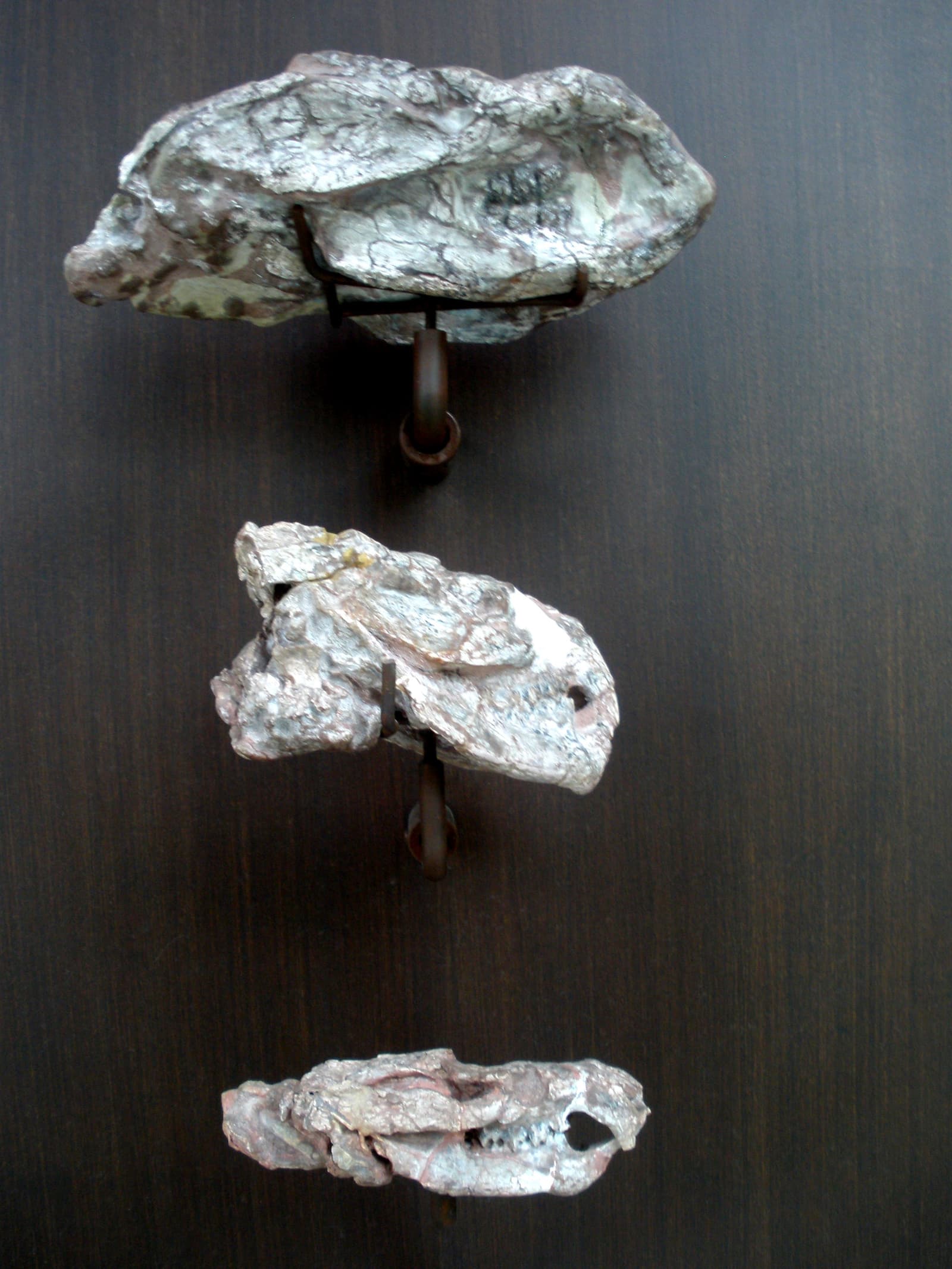
The skulls in the lead photograph are not the 38 tiny individuals from the Nature study; they are museum-displayed Kayentatherium skulls. That distinction matters. The image is there to anchor the animal in real fossil material, not to illustrate the nursery directly. The close reading belongs to the published specimen complex and its CT-based analysis, while the photograph reminds us what kind of animal is being discussed: a robust-jawed tritylodontid whose mammal-like nearness should not be confused with fully mammalian reproduction.[1][6]
The number is only the doorway
The headline fact is the clutch size. Hoffman and Rowe reported a presumed maternal skeleton associated with at least 38 perinates, described as pre- or near-hatching young.[1] That count is not just high by mammal standards; the Nature paper argued that it falls outside documented litter sizes for living mammals.[1] In a public account of the work, Hoffman described the young as more than twice the average litter size of any living mammal.[3]
The number matters because reproduction usually fossilizes poorly. Teeth, jaws, limb bones, and tracks are much more common than a direct association between an adult and numerous near-hatching young. Without such a specimen, paleontologists can infer reproductive strategy indirectly from body size, growth, histology, pelvis shape, or comparisons with living animals. Here the evidence is unusually direct: many small individuals were preserved with the adult in one fossil context.[1]
But the number alone would be too blunt. A large brood could be treated as a novelty fact and then abandoned. The deeper point is what those 38 young imply when they are placed next to skull growth and brain evolution. The perinates were tiny, but their skulls were not proportionally baby-faced in the way modern mammal young often are. Hoffman and Rowe found largely isometric cranial growth: the perinate skull shape was broadly similar to the adult condition, rather than showing the kind of face-lengthening pattern tied to later mammalian developmental change.[1]
That is where the fossil stops being a family tableau and becomes an evolutionary argument. Kayentatherium combines many offspring with young that already look developmentally unlike helpless, big-brained mammal infants. The specimen therefore preserves a reproductive mode closer to the ancestral amniote pattern than to the high-investment mammalian pattern familiar from many living species.[1][3]
The animal was close, but not modern
The taxonomic position keeps the interpretation disciplined. The Paleobiology Database records Kayentatherium wellesi as a species-level fossil taxon, while the Nature study and postcranial work place the animal among tritylodontid cynodonts: close mammal relatives with mammal-like features but not mammals in the crown-group sense.[1][4][5] Later postcranial work on K. wellesi from the Lower Jurassic Kayenta Formation emphasized how useful the animal is for assessing both functional anatomy and phylogenetic signals in tritylodontid cynodonts.[4]
That context prevents a common mistake. It is tempting to say the fossil shows "early mammals had 38 babies." The safer and better claim is that a close mammal relative, branching just outside a later mammaliaform condition, still retained a large-clutch reproductive strategy.[1][5] The difference is not cosmetic. If the fossil is forced inside a modern-mammal frame, the result sounds like an odd exception. If it is read at the correct stemward position, it becomes a timing marker for when mammalian reproduction had not yet crossed into its later small-litter, high-investment pattern.
The body also matters because tritylodontids were not crude halfway animals. The Smithsonian repository record for Sues and Jenkins' postcranial study describes Kayentatherium wellesi material from the Lower Jurassic Kayenta Formation and frames the work around the phylogenetic significance of postcranial features in tritylodontid cynodonts.[4] In other words, this is not a creature useful only because it sits near mammals on a tree. It is a real anatomical package: skull, jaws, limbs, vertebrae, and ecological possibilities, all of which complicate any simple ladder-of-progress story.
The babies sharpen the brain question
The strongest claim in the 2018 study is not just that Kayentatherium had many young. It is that the combination of clutch size and cranial development fits a scenario in which later mammalian brain expansion helped drive reproductive change.[1] Large brains are expensive. So are pregnancy, lactation, prolonged care, and slow juvenile development. A lineage cannot increase every cost at once without tradeoffs showing up somewhere.
The UT Austin release on the discovery stated the tradeoff plainly: the fossil suggests an important step in mammal evolution involved moving from large litters toward bigger brains, and that this step occurred later in the mammalian story.[2] That should not be reduced to a slogan that brains "caused" small litters in one mechanical instant. The better interpretation is historical sequencing. Kayentatherium sits before the fully mammalian package had converged: small brain, many young, and largely adult-like cranial proportions in the perinates appear together.[1][2]
That combination lets the fossil test an idea that otherwise risks staying abstract. Many living mammals invest heavily in relatively few young. Many reptiles and other amniotes can produce larger clutches with less per-offspring investment. Kayentatherium shows that, near the mammal line, the older high-number pattern persisted even after many mammal-like anatomical traits had already evolved.[1][3] The reduction in offspring number was therefore not simply automatic once a synapsid became superficially mammal-like.
The perinates are important because they expose development, not just reproduction. Their skulls were tiny, but the study found their overall skull shape similar to adults, with the main positive allometries associated with bones supporting chewing muscles.[1] A modern mammal comparison pushes the other way: juvenile cranial proportions often reflect the enlarged brain and developmental timing of the mammalian head. Kayentatherium therefore gives paleontologists a rare pre-modern snapshot of how the head could grow before later mammalian developmental shifts dominated the face-brain relationship.
The fossil is direct evidence, but not a full behavior film
The adult-and-perinate association is powerful, but it should not be asked to answer everything. The study described the young as pre- or near-hatching perinates, and the large clutch is consistent with egg laying or a reproductive strategy more like that of some non-mammalian amniotes than living placental or marsupial mammals.[1][3] It does not let us watch nest construction, hatching, parental behavior, lactation, or death. The fossil records association and anatomy, not a complete domestic scene.
That limit is useful. It keeps the specimen from becoming a sentimental image of Jurassic motherhood. The adult may be presumed maternal in the analysis, and the association is remarkable, but the scientific force lies in count, size, skull shape, and phylogenetic placement.[1] Those pieces are enough. They show that a near-mammalian animal could still produce a brood far larger than living mammals normally do, and that its young did not yet display the cranial developmental pattern expected from later big-brained mammalian investment.[1][2]
The preservation pathway also matters. The specimen was studied through microCT, a method that can separate tiny bones hidden in a field jacket without physically destroying the association.[1][3] That technology is part of the story because the young are not dramatic museum mounts. They are small, nested pieces of evidence that became legible through scanning and digital segmentation. The fossil's intimacy is therefore modern as well as Jurassic: a 190-million-year-old association read by twenty-first-century imaging.
What Kayentatherium can carry
The secure claim is narrow and strong. Kayentatherium wellesi was a tritylodontid cynodont from the Early Jurassic Kayenta Formation, close to mammals but outside the living mammal condition.[1][4][5] One specimen preserves an adult associated with at least 38 perinates. Those young had skull proportions broadly similar to adult skulls, and the clutch size lies far beyond living mammal litter norms.[1] Together, those facts support the view that a large-clutch reproductive strategy persisted near the mammalian stem before later shifts toward fewer offspring, greater parental investment, altered cranial development, and larger brains.[1][2][3]
The boundary is just as important. This is not proof that "mammals used to be reptiles" in a loose popular sense. It is not a direct portrait of the first mammal mother. It is not a complete behavioral scene. It is a fossil-find close reading of a stemward mammal relative that preserves the wrong-looking combination: mammal-near jaws and body, a very large brood, and young whose heads had not yet entered the later mammalian developmental pattern.[1][4]
That is why the specimen remains unusually good evidence. It does not make mammal origins simpler. It makes them less smooth. The mammalian condition was assembled across anatomy, growth, physiology, and reproduction at different speeds. Kayentatherium matters because, for once, the reproductive side of that assembly is not only inferred from theory. It is counted in tiny skulls.
Sources
- Eva A. Hoffman and Timothy B. Rowe, "Jurassic stem-mammal perinates and the origin of mammalian reproduction and growth," Nature 561 (2018) - original study of the adult-and-perinate Kayentatherium specimen.
- The University of Texas at Austin, "Mammal Forerunner that Reproduced Like a Reptile Sheds Light on Brain Evolution" (2018) - public research release on the 38-young discovery and brain/litter-size tradeoff.
- Eva Hoffman, "An Early Jurassic mammaliamorph with three dozen perinatal young," Springer Nature Research Communities (2018) - author account of the CT work and offspring count.
- Smithsonian Research Online, record for Hans-Dieter Sues and F. A. Jenkins, "The postcranial skeleton of Kayentatherium wellesi from the Lower Jurassic Kayenta Formation of Arizona..." (2006) - postcranial and phylogenetic context.
- Paleobiology Database, taxon record for Kayentatherium wellesi - accessible species-level taxonomy record.
- Wikimedia Commons, "File:Kayentatherium.JPG" - source page for the public-domain fossil-skull photograph used as the article image.