Burgessomedusa phasmiformis sounds like the kind of fossil that should be easy to oversell: a Cambrian jellyfish, more than 500 million years old, preserved from an animal type that is mostly water. The stronger version of the story is more disciplined. The fossil matters because it gives paleontologists enough repeated anatomy to test the free-swimming medusa body plan in stone, rather than simply naming every soft circular impression a jellyfish.[1][2]
That distinction is the whole article. Cnidarians are old; medusozoans include animals with a free-swimming medusa stage; but the fossil record has been much better at preserving tubes, polyps, larval traces, and ambiguous soft-bodied shapes than adult jellyfish. Moon, Caron, and Moysiuk described Burgessomedusa from 182 exceptionally preserved body fossils from Raymond Quarry in the Burgess Shale, and argued that it is the oldest unequivocal macroscopic free-swimming medusa yet known.[1] The word "unequivocal" is doing real work. It is not a mood. It means the animal preserves a package of features that can be compared, counted, and bounded.
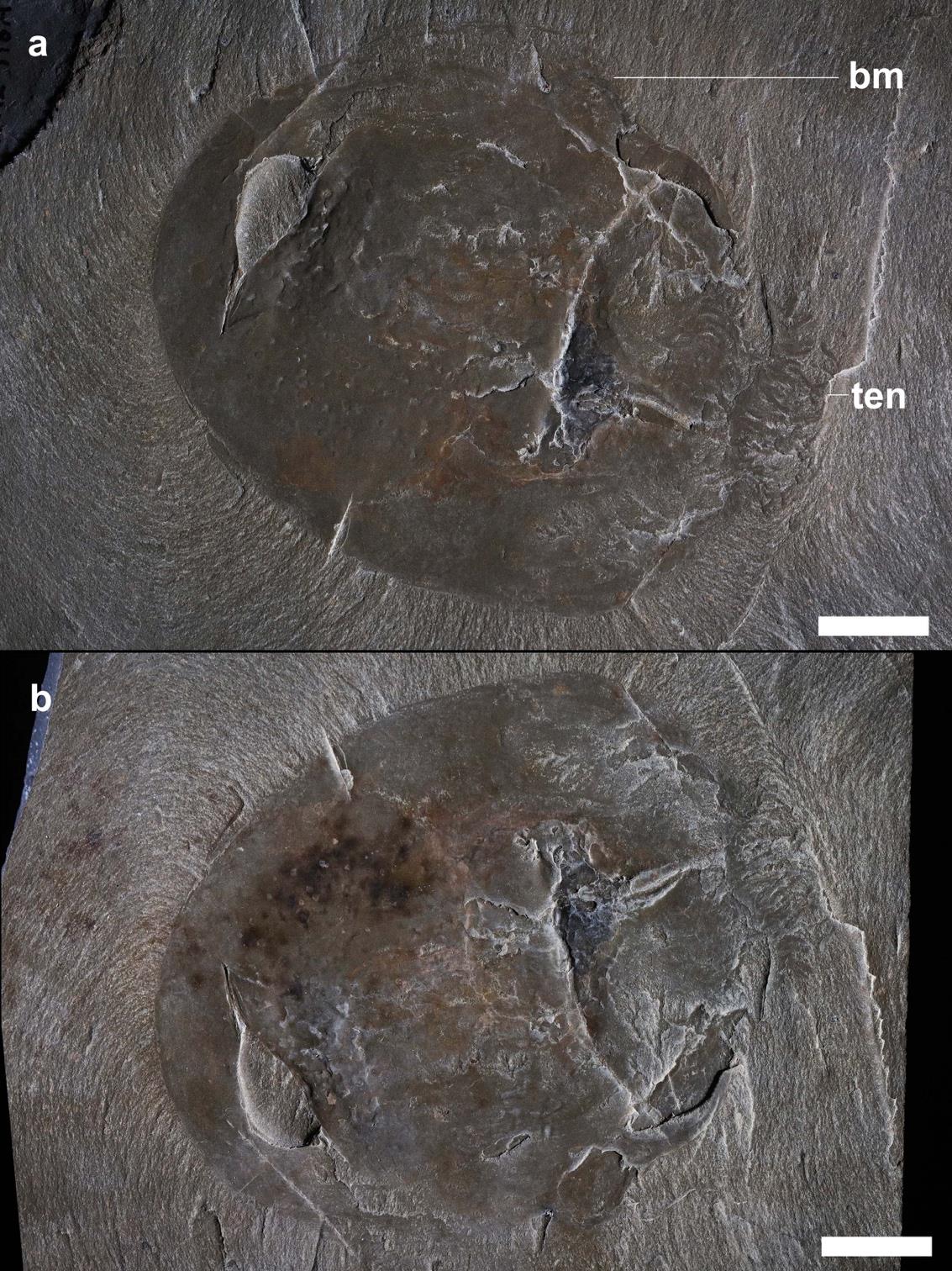
The cover image uses a real fossil photograph from the supplementary material to the 2023 paper, showing specimen ROMIP65787 under cross-polarized light.[5] It is not the most theatrical way to picture an ancient jellyfish. That is why it is useful. The slab keeps the reader with the evidence: a flattened umbrella, part and counterpart, scale bars, and the problem of extracting a living body from a delicate compression fossil.
The first test is whether the outline is enough
The outline alone is not enough. That is the first methodological safeguard. Old jellyfish claims often began with a tempting shape: a disk, bell, pouch, or circular mark that looks medusa-like if the viewer already expects a jellyfish. Burgessomedusa becomes more secure because the authors did not stop at outline. They described a cuboidal umbrella up to 20 centimetres high, a large internal stomach cavity, a long manubrium, paired or corner-positioned internal structures interpreted as gonads, and more than 90 short finger-like tentacles around the oral margin.[1][2]
Each feature narrows the interpretation. A bell-shaped body suggests a medusa, but bell shape by itself can mislead. Tentacles at the margin help, but tentacles alone do not settle the whole animal. Internal organization matters because it ties the fossil to a body plan rather than to a vague gelatinous silhouette. The 2023 paper's phylogenetic analysis placed Burgessomedusa within Medusozoa, probably near stem Cubozoa or Acraspeda, the larger group including stalked jellyfish, box jellyfish, and true jellyfish.[1]
That result should be read as a constrained anatomical claim, not as a cartoon translation into a modern box jelly. The fossil is not valuable because it lets us pretend the Cambrian sea already had a familiar beach warning sign drifting through it. It is valuable because the medusa stage had already become a macroscopic, swimming, tentacle-bearing animal by the middle Cambrian, while still belonging to a body-plan experiment older and broader than living jellyfish categories make obvious.[1][2]
The second test is why this fossil is not just another Burgess oddity
The Burgess Shale makes soft animals visible with unusual force. ROM's Burgess Shale introduction describes the deposit as preserving soft-bodied Cambrian animals and algae in exceptional detail for roughly the last half-billion years, with many fossils representing old members or relatives of groups still alive today.[3] That context is important because Burgessomedusa depends on the same preservational privilege. A jellyfish fossil is not impossible, but it requires the right burial, chemistry, compression, and collection history.
ROM's release makes the preservation problem plain: jellyfish are roughly 95 percent water, yet the museum holds close to two hundred Burgessomedusa specimens with details of internal anatomy and tentacles visible.[2] That sample size changes the evidentiary situation. One ghostly slab would invite caution. A collection large enough to compare shape, tentacle preservation, internal features, and deformation patterns makes a stronger argument possible.[1][2]
Raymond Quarry also keeps the animal from floating in isolation. The fossils were mostly found during the late 1980s and 1990s under former ROM curator Desmond Collins, then studied later as part of the museum's Burgess Shale collections.[2] In other words, this was not just a spectacular new field moment. It was also a collections-afterlife story: old slabs became newly legible when researchers asked a sharper question about medusozoan body plans and had enough specimens to test it.
That is one reason Burgessomedusa is a good anatomy-and-method case. It shows how paleontology can move from "delicate animal preserved" to "body plan constrained" only when field context, collection volume, imaging, and comparative anatomy line up. The fossil is fragile, but the argument is not fragile in the same way.
The third test is separating cnidarians from lookalikes
The harder comparison is not with modern jellyfish. It is with other ancient soft-bodied animals that can look jellyfish-like in a flat fossil. The 2023 paper is explicit that some previously described Cambrian macrofossils once treated as possible crown-group medusozoan medusae are better reinterpreted as ctenophore-grade organisms.[1] That matters because comb jellies and jellyfish are not the same animal group, even if both can be gelatinous, marine, and superficially similar to a non-specialist eye.[2]
This is where the fossil becomes more than a headline about age. Burgessomedusa is useful because it raises the standard for calling a Cambrian soft-bodied fossil a free-swimming medusa. The better question is not "Does it look like a jellyfish?" The better question is "Which anatomical features are present together, and do they make more sense as a cnidarian medusa than as a ctenophore-grade animal, a polyp, a tube, a decay artifact, or an unrelated gelatinous body?"[1][2]
The distinction also helps place older cnidarian evidence. The Ediacaran fossil Auroralumina attenboroughii, described from Charnwood Forest, has been interpreted as an early crown-group cnidarian and stem-group medusozoan, showing that cnidarian-grade body plans reach back before the Cambrian.[4] But Auroralumina is not a free-swimming adult jellyfish. It is a polyp-like, skeleton-bearing fossil with a different ecological and anatomical signal.[4] Set beside it, Burgessomedusa does not invent cnidarian history from scratch. It fills a different gap: the macroscopic swimming medusa stage itself.[1][4]
That difference is the cleanest way to avoid overclaiming. Cnidarians were not born with Burgessomedusa. The medusa stage did not become visible just because researchers wanted a record-breaker. The fossil matters because it ties a particular life-cycle form to a particular Cambrian body, while leaving older polyp and crown-group cnidarian evidence in its own category.[1][4]
The fourth test is behavior without fantasy
Once the anatomy is accepted, behavior becomes tempting. A bell-shaped swimming animal with many tentacles invites a predator story, and ROM's release reasonably frames Burgessomedusa as an efficient swimming predator in the Cambrian ecosystem.[2] The 2023 paper also argues that the umbrella shape and tentacles support active swimming and prey capture.[1]
The boundary is that fossil anatomy does not give a full life film. The animal probably swam by rowing-like umbrella motion rather than by a tightly restricted jet-propulsion mechanism, because the preserved anatomy lacks the structures that would narrow the bell opening in the way needed for strong jetting.[1] The tentacles support prey capture, but they do not identify every prey item. Its association with other Raymond Quarry organisms places it within a benthic community context, but it does not prove that every individual lived only near the bottom.[1][2]
That cautious behavioral reading is stronger than a monster version. The Cambrian food web already had famous large swimmers such as Anomalocaris, but Burgessomedusa adds a different kind of predator: gelatinous, tentaculate, macroscopic, and anatomically cnidarian rather than arthropod.[2] The importance is not that it was the biggest threat in the water. The importance is that predation and swimming were being explored through more than one body architecture.
This is why the fossil changes the feel of the Cambrian ecosystem. It inserts a recognizable but still ancient kind of animal into the water column. Not everything mobile and predatory had to be armored, segmented, or appendage-heavy. Some predators were already solving the problem with an umbrella, a mouth stalk, internal cavities, and a fringe of tentacles.[1][2]
The useful conclusion is narrow and durable
The safest summary is also the most interesting one. Burgessomedusa phasmiformis is not merely "a very old jellyfish." It is a method case for how a jellyfish claim becomes defensible in deep time. The argument depends on a specimen set, not a single suggestive shape; on internal and marginal anatomy, not just a bell outline; on comparison with ctenophore-grade lookalikes, not just modern visual resemblance; and on Burgess Shale preservation, not ordinary fossil luck.[1][2][3]
That is why the fossil deserves to be read as anatomy before spectacle. It makes the free-swimming medusa stage visible in the middle Cambrian, while keeping the category disciplined. The animal is ghostly in preservation, but the claim is concrete: by the time Raymond Quarry captured these slabs, the cnidarian experiment had already produced a macroscopic swimming form with tentacles, internal organization, and a place in a complex food web.[1][2]
Sources
- Justin Moon, Jean-Bernard Caron, and Joseph Moysiuk, "A macroscopic free-swimming medusa from the middle Cambrian Burgess Shale," Proceedings of the Royal Society B 290 (2023), PubMed record and abstract.
- Royal Ontario Museum, "Royal Ontario Museum Researchers Identify Oldest Known Species of Swimming Jellyfish" (August 2, 2023).
- Royal Ontario Museum and Parks Canada, "Introduction - The Burgess Shale" (site context, preservation significance, and World Heritage framing).
- Frances S. Dunn et al., "A crown-group cnidarian from the Ediacaran of Charnwood Forest, UK," Nature Ecology & Evolution 6 (2022).
- Wikimedia Commons file page, "File:Rspb20222490 si 0011-009.jpg" - cross-polarized fossil photograph of Burgessomedusa phasmiformis specimen ROMIP65787 from the 2023 supplementary material.