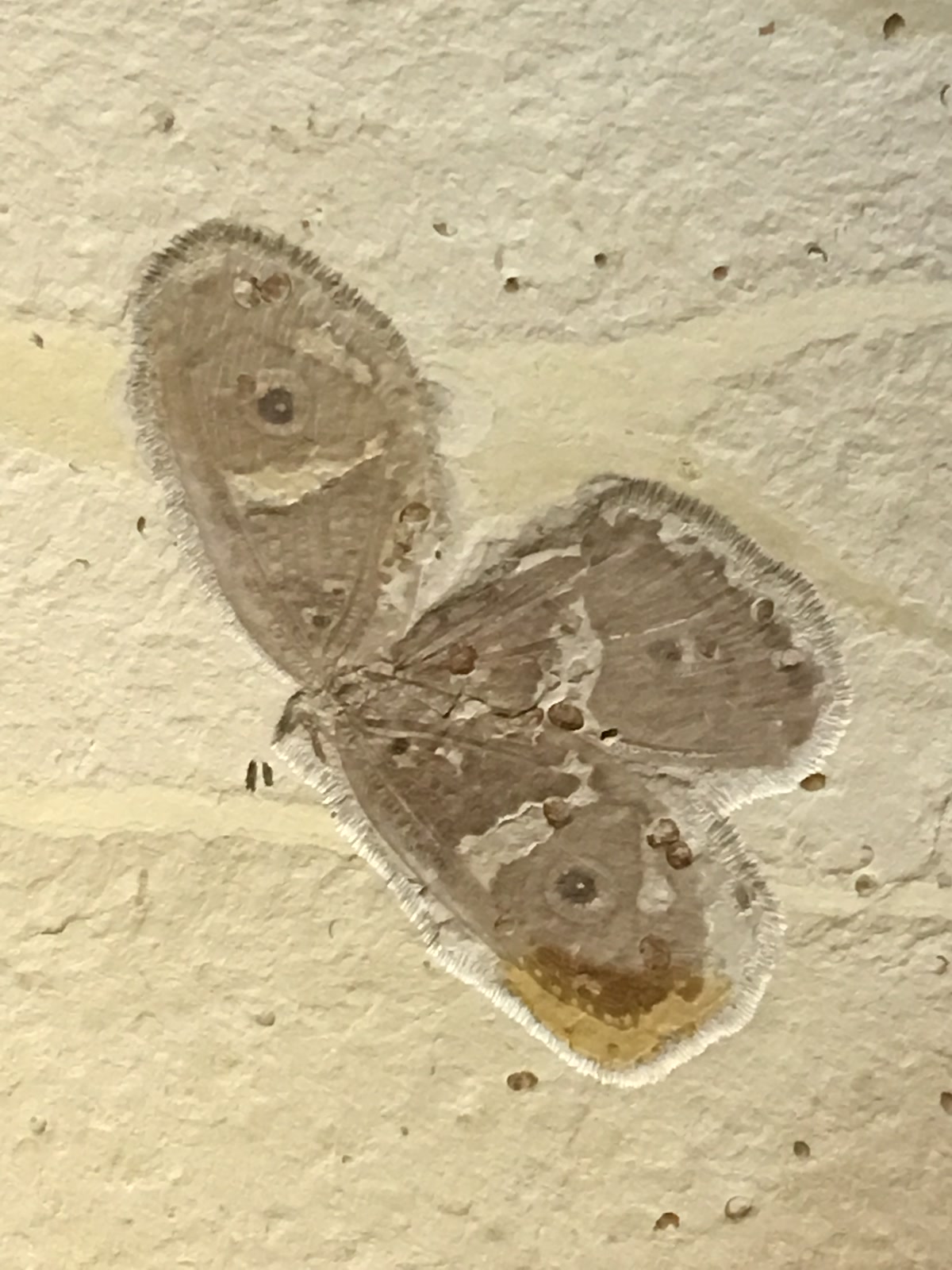
The fossil looks almost too familiar. Four broad wings lie open on pale stone. Dark rings sit inside them like the warning marks on an owl butterfly. A faint body occupies the crossing point, small beside all that patterned surface. Yet the specimen is not a butterfly, not a moth, and not an ancestor of either. It is Kalligramma albifasciatum, a member of an extinct family of lacewings called Kalligrammatidae.[6]
That distinction turns resemblance into a better story. Kalligrammatids and butterflies arrived at a similar visual and ecological package from distant branches of the insect tree. Both evolved large patterned wings, scale-like coverings, eye-shaped markings, and elongated mouthparts suited to drinking exposed plant fluids. But they did not do so in the same forests, from the same anatomy, or on the same schedule.[2][3]
The old shorthand calls kalligrammatids “butterflies of the Jurassic.” It is memorable and slightly misleading. Their currently described record begins in the Early Jurassic, about 182 million years ago, and reaches at least to 99-million-year-old amber in the Cretaceous.[1][4] A large 2023 phylogenomic study places the origin of butterflies near 101 million years ago, so the youngest known kalligrammatids may even have overlapped the earliest butterfly lineage in time.[5] The important point is not that one vanished neatly before the other appeared. It is that evolution assembled a recognizably butterfly-like solution twice.
A family assembled the look in stages
The lineage begins earlier than the classic Chinese fossils that made kalligrammatids famous. Jörg Ansorge and Vladimir Makarkin redescribed lower Toarcian material from Germany as two distantly related kalligrammatid subfamilies. Their presence around 182 million years ago led the authors to infer that the family itself probably originated in the Late Triassic or earliest Jurassic.[1] One of those early wings already carried a developed central eyespot. The visual trick was not a late flourish on an otherwise settled body plan.
Nor was there one unchanging “kalligrammatid design.” A 2014 phylogenetic study of Chinese material separated the family into five principal clades and documented a range of wing shapes, markings, and mouthparts across fossils from the Middle Jurassic and Early Cretaceous.[2] The basal sophogrammatine branch retained chewing mouthparts and lacked the full eyespot-and-scale combination. Character mapping in the later convergence study placed siphoning mouthparts, scales, and elaborate wing markings in more derived branches.[2][3]
That sequence matters. If every kalligrammatid is imagined as a ready-made butterfly copy, evolution disappears behind the costume. The family instead records experimentation: chewing and sipping mouths, unmarked and marked wings, simple spots and concentric eyespots. Similarity to butterflies was an outcome assembled within part of the lineage, not an ancestral instruction waiting to be expressed.
The eyes survived; the stare is inferred
The wing patterns are unusually direct evidence. Fine lake sediments in northeastern China preserved dense venation, outlines of scales and their sockets, and rings of differently dark material. The 2016 study used light microscopy, scanning electron microscopy, elemental analysis, and mass spectrometry to investigate those surfaces.[3] What remains in the rock is not merely a modern artist’s decision to make an extinct insect dramatic.
The limits are just as important. Chemical signals were consistent with melanin in the dark centers of some eyespots, but the authors could not exclude every alternative source of carbon.[3] It is therefore reasonable to say the wings were patterned and probably pigmented; it is not reasonable to paint every species in saturated orange and black as though the original palette had been photographed.
Function also survives indirectly. In living butterflies and moths, large eyespots can startle a predator or pull an attack away from the vulnerable body toward the wing. Kalligrammatid markings have been interpreted in the same way, and the 2018 amber study found that strong eyespots were concentrated in larger forms while small species carried weak marks or none.[4] That size pattern supports a defensive reading because an eye-like display can help a large target yet simply make a small one easier to detect. Still, no fossil preserves a bird veering away or a lizard striking the wrong spot. The pattern is evidence; the startled predator is a comparative inference.
A drinking tube before the flower economy
The mouthparts deepen the convergence. Derived kalligrammatids carried long, non-piercing structures built from extended parts of the maxillae and labium. Compression fossils show the gross outline; amber preserves joints, palps, bands of cuticle, and other details in three dimensions. Across the specimens analyzed in 2018, mouthpart lengths ranged from roughly 0.6 to 18 millimeters.[4] The longest versions were not miniature jaws. They were equipment for reaching liquid rewards.
Here, too, evidence and inference need separate shelves. The fossils directly preserve tubular mouthparts. Pollen occurs beside or on some specimens, and one food canal contained carbon-rich material compatible with plant fluid rather than blood. Contemporary seed plants, especially bennettitaleans, produced exposed pollination drops inside channels and funnels that could accommodate such a proboscis.[3] Together, anatomy, residues, pollen association, and plant geometry make feeding on gymnosperm reproductive fluids a strong interpretation.
Pollination is one step beyond feeding. An insect becomes a pollinator only if it carries pollen between reproductive structures, and that journey is not preserved in a single compression fossil. The best formulation is therefore probable pollination, not witnessed pollination. Kalligrammatids likely received sugary drops and pollen as food while moving pollen among gymnosperm structures, but the particular host attached to any one fossil usually remains unknown.[3][4]
Variation among the mouthparts adds an ecological clue. Different proboscis lengths would have reached different depths, much as flower-visiting insects partition liquid rewards today. Liu and colleagues interpreted the broad range in kalligrammatids and other long-proboscid Mesozoic insects as evidence for diverse feeding niches before flowering plants dominated terrestrial pollination systems.[4] It is a persuasive match, not a recovered menu. The fossils preserve the tools more often than the exact plants on which those tools were used.
Amber moved the last page forward
Kalligrammatid history is also a useful lesson in how a fossil range changes. The influential 2016 convergence paper worked with a record running from about 165 to 120 million years ago and described a long temporal gap between the last kalligrammatids and the first butterflies then inferred.[3] Two later results altered both ends of that comparison.
First, the German lower Toarcian specimens pushed the secure family record back to roughly 182 million years ago.[1] Second, the 2018 study placed small kalligrammatids in earliest Cenomanian amber from northern Myanmar, about 99 million years old.[4] Those amber insects were not simply late survivors of the large Jurassic form. They included species with varied body sizes, proboscides, antennae, and reduced or absent eyespots. The family entered its last known chapter still diversifying its equipment.
Meanwhile, the 2023 butterfly tree—built from 391 genes across nearly 2,300 species—estimated that butterflies originated around 101.4 million years ago.[5] Fossil ranges and molecular-clock estimates are different kinds of evidence, each with uncertainty, but together they remove the tidy claim that every kalligrammatid was gone tens of millions of years before butterflies began. Possible overlap does not weaken convergence. It sharpens it: two unrelated lineages could occupy similar design space at nearly the same time without one turning into the other.
The extinction boundary remains open. Ninety-nine million years is the youngest secure occurrence discussed in the amber study, not a dated final individual. The same study proposed that close dependence on gymnosperm hosts may have made kalligrammatids vulnerable as flowering plants expanded and gymnosperm diversity declined later in the Cretaceous.[4] That is a plausible ecological mechanism, not a proven cause. A sparse insect fossil record can make the last known fossil look more final than it was.
Similar result, different machine
Convergence does not mean identity. Butterfly mouthparts form a coiling proboscis with their own musculature and operating history. The amber kalligrammatid apparatus was a more complex assembly of paired elements that could bend but apparently did not coil in the same way.[4] Butterfly scales, development, larval host use, and wing patterning belong to Lepidoptera. Kalligrammatid venation, head anatomy, and relationships belong to Neuroptera. The finished silhouettes rhyme; the machinery and ancestry do not.
That is why the stone specimen is more useful than a glamorous life reconstruction. It preserves enough to make the resemblance undeniable and enough damage to keep certainty disciplined. The eyespots are there. The wing outlines are there. Much of the color is gone, behavior is absent, and the host plant is out of frame.[3][6]
Kalligrammatids were not an evolutionary rehearsal for butterflies. They were a successful lineage solving recurring ecological problems on its own terms: how to advertise or misdirect with a large wing, how to reach a liquid reward inside a seed plant, and how to specialize without becoming permanent. Butterflies later combined comparable answers with different anatomy and a flowering-plant world. Deep time did not repeat the animal. It repeated the pressure—and produced a second, astonishingly familiar result.
Sources
- Jörg Ansorge and Vladimir N. Makarkin, “The oldest giant lacewings (Neuroptera: Kalligrammatidae) from the Lower Jurassic of Germany,” Palaeoworld 30 (2021) — lower Toarcian records and inferred family origin.
- Qiang Yang et al., “Mesozoic lacewings from China provide phylogenetic insight into evolution of the Kalligrammatidae (Neuroptera),” BMC Evolutionary Biology 14, 126 (2014) — five-clade framework and morphological diversity.
- Conrad C. Labandeira et al., “The evolutionary convergence of mid-Mesozoic lacewings and Cenozoic butterflies,” Proceedings of the Royal Society B 283 (2016) — wing, scale, mouthpart, chemical, and plant-association evidence.
- Qing Liu et al., “High niche diversity in Mesozoic pollinating lacewings,” Nature Communications 9, 3793 (2018) — 99-million-year-old amber specimens, mouthpart variation, and revised ecological range.
- Akito Y. Kawahara et al., “A global phylogeny of butterflies reveals their evolutionary history, ancestral hosts and biogeographic origins,” Nature Ecology & Evolution 7 (2023) — approximately 101-million-year butterfly origin estimate.
- Wikimedia Commons, “File:BMNH IMG 5551 Kalligramma albifasciatum.jpg” — real museum-specimen photograph by Bjoertvedt used as the article image.