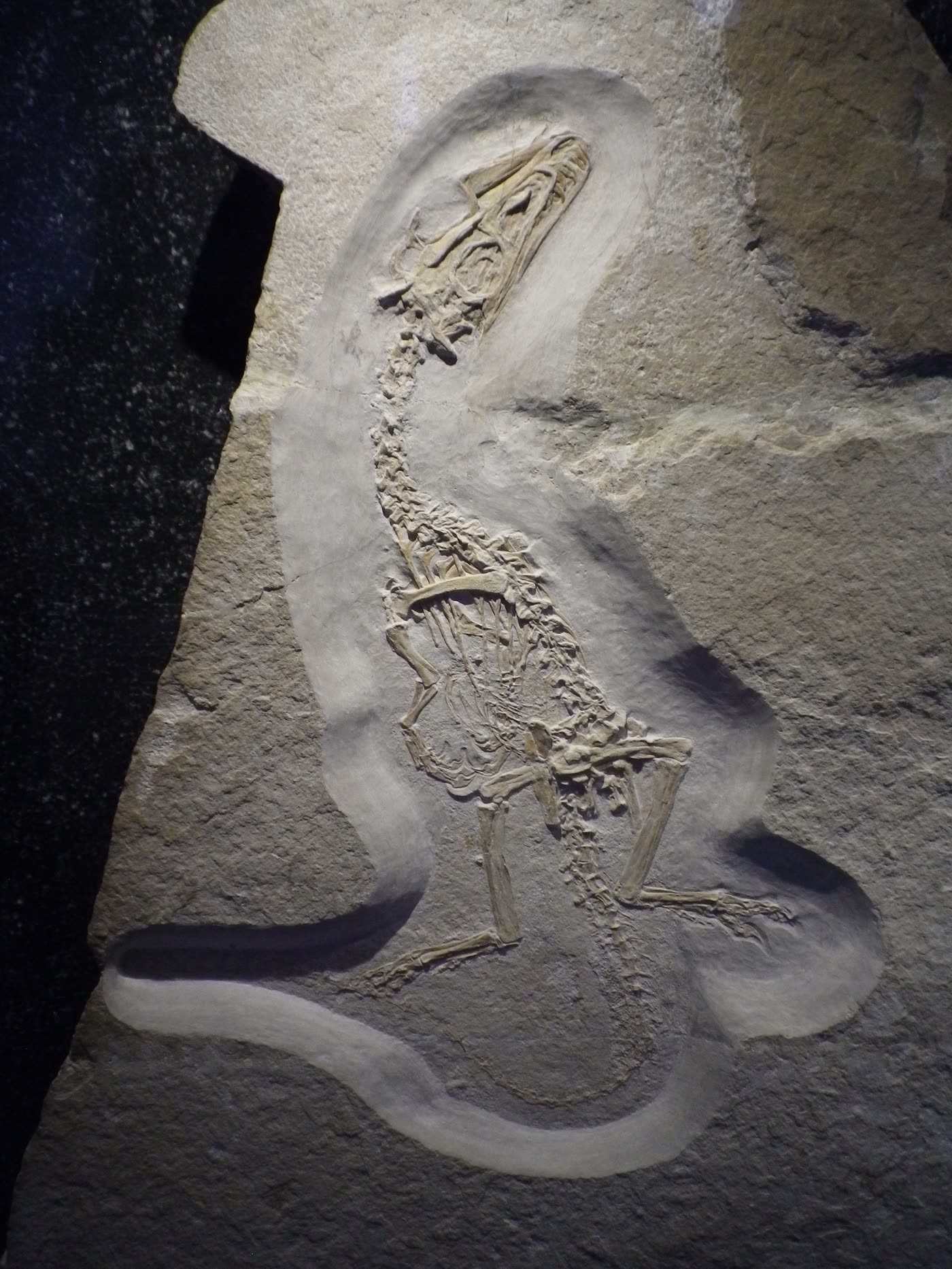
Juravenator starki is often pulled into paleontology as if one juvenile skeleton from Bavaria were supposed to settle a large and public argument: were small theropod dinosaurs scaly, feathered, or some transitional blend of the two?[1][3] That is a bad demand to place on the fossil, and it is also what makes the specimen worth reading carefully. Juravenator matters because it preserves an unusually tight knot of anatomy, integument, preparation history, and depositional context.[1][2] It is less a mascot for one side of a debate than a warning against asking the debate in a lazy way.
The original 2006 description made the fossil famous by combining two facts that seemed to pull against one another. The animal was a juvenile basal coelurosaur, a part of theropod history that sits inside a wider feather-rich branch, yet large preserved areas of the tail showed scales rather than an obvious fuzzy coat.[1] Later work did not erase that tension. It made it more specific. UV-based re-reading and subsequent analysis added short monofilaments, multiple scale types, and even crocodile-like sensory nodes on the tail.[3][4] The specimen therefore became stronger evidence and less convenient shorthand at the same time.
Image context: the cover uses a real Wikimedia Commons photograph of the Schamhaupten specimen rather than a life reconstruction.[7] That choice matters because this article is about evidence boundaries. The slab keeps attention on the single body that exists, not on the many complete animals people can imagine around it.
1) Start with the slab itself: one juvenile, one locality, one unusually complete body
Göhlich and Chiappe's 2006 Nature paper still gives the cleanest starting frame.[1] The fossil came from Schamhaupten in southern Germany and was described as exquisitely preserved, complete from the snout to the distal third of the tail, and the best-preserved predatory non-avian dinosaur then known from Europe.[1] That is already enough to explain why the specimen acquired outsized weight in feather discussions. Late Jurassic small theropods are rare, and a near-complete articulated juvenile arrives carrying information that isolated teeth or scattered limb bones cannot.
But the preparation history matters just as much as the skeleton. The 2012 Fossil Record paper on the fish found in the same block notes that the Juravenator specimen had been recovered in many pieces, then prepared painstakingly enough that a second fossil, a small fish, was discovered among discarded rock fragments during the process.[2] That detail is more than workshop trivia. It shows how much of the final scientific object depended on preparation discipline and on a matrix that preserved fine information while making extraction difficult.[2]
The museum context pushes the same point in another direction. The Jura-Museum describes Juravenator as both the world's only specimen of the genus and the best-preserved predatory dinosaur in Germany.[6] That is impressive, but it should also make the reader conservative. Every strong statement about the animal's integument, ecology, or growth stage is being made from one individual, not from a population sample.
2) Why the original feather headline was never as simple as it sounded
The 2006 paper became memorable because it seemed to pose a sharp contrast.[1] Here was a small coelurosaur preserved with extensive tail integument, yet the preserved areas did not show feathers or feather-like structures in the way readers had begun to expect from famous Chinese specimens.[1] In public retellings, that often hardened into a blunt message: Juravenator was the dinosaur that proved some close feather-branch theropods were still scaly.
Even in the original paper, the claim was narrower than that slogan. Göhlich and Chiappe were writing about preserved regions, not about every square centimeter of the living animal.[1] They had a strong tail signal and a specimen nested inside a larger theropod story that was already more complicated than a straight line from scales to feathers.[1] The important contribution was not a neat reversal of feather evolution. It was the demonstration that close relatives in a feather-bearing clade could preserve different outer coverings, or preserve them in different body regions, or both.
That distinction becomes clearer if the fossil is treated as a close reading problem rather than as a thumbnail for a textbook. Fossils do not preserve integument evenly. Juveniles do not necessarily mirror adults in all details. Depositional settings privilege some tissues and regions over others. Once those three facts are kept together, Juravenator looks less like a contradiction and more like a specimen whose patchiness is part of the evidence.
3) Later work did not replace the scales. It made the skin record more regional and more complex
The 2021 Palaeontology paper on epidermal complexity is the key update because it turns the integument from a binary into a map.[3] Christophe Hendrickx and Phil Bell describe short monofilaments on dorsal and ventral parts of the tail while also identifying discrete longitudinal bands of scutate, tuberculate, and ornamented scales.[3] The result is not a simple correction from "scales" to "feathers." It is a body region preserving more than one epidermal architecture at once.
That matters for two reasons. First, it makes Juravenator less useful for any argument that wants one taxon to stand in for an entire stage of feather evolution. Second, it makes the fossil more interesting anatomically. A tail with scale banding, filament traces, and differing surface textures is telling the reader that integument was functionally organized, not uniformly painted over the animal.[3]
This is also why the specimen belongs in a broader Solnhofen-and-Schamhaupten preservation conversation. The reanalysis does not claim that the whole animal was known in equal detail. It claims that the preserved portions of the tail carry more epidermal information than the older simplified summaries allowed.[3] The advance came from rereading the same fossil with better lighting, better comparative expectations, and more patience about regional variation.
4) The sensory-scale result raises the functional stakes without dissolving the caution
Bell and Hendrickx pushed the argument one step further in 2020 by identifying distinctive circular nodes on some of the tail scales as integumentary sense organs analogous to those of living crocodylians.[4] That is a striking result because it implies the tail was not merely wrapped in inert covering. Parts of its surface may have had a sensory role.[4]
What keeps the paper useful is that the claim remains anatomically bounded. The authors are not turning Juravenator into a crocodile mimic or using one sensory structure to rewrite theropod behavior wholesale.[4] They are making a narrower point: certain scale morphologies on this preserved tail are consistent with a sensory function and fit within a broader archosaur history of specialized integument.[4]
That boundedness is worth emphasizing because it is the opposite of the way famous fossils are often used in popular writing. A strong paleontological result usually narrows a question before it broadens a story. In Juravenator, the tail became not only evidence for scales and filaments but also evidence that scale-bearing skin itself could be differentiated and functionally active.[3][4] The fossil did not get simpler as more work was done on it. It became denser.
5) Schamhaupten is part of the argument because the archive selected what we now debate
The Schamhaupten locality explains why this one animal preserves so much and why its evidence still arrives with limits. The publisher summary for the Juravenator starki volume describes the fossil lagerstatte as a silicified plattenkalk basin in which more than 200 taxa were distinguished, with a salinity-density stratification, a hostile bottom zone, and a nearby forested island that likely supplied terrestrial organisms to the deposit.[5] The 2012 Fossil Record paper supports the same broad picture from another angle: Juravenator was the single terrestrial reptile in a fauna otherwise rich in fishes, marine reptiles, invertebrates, plants, and microfossils.[2]
That means the fossil is already a filtered event before anybody debates the tail covering. The animal was not preserved in its ordinary day-to-day habitat. It entered a basin system whose chemistry and sedimentology were unusually good at arresting decay and recording detail.[2][5] Even the fact that a companion fish came out of the same block during preparation underscores how much the specimen belongs to a specific preservational package.[2]
This is the final reason Juravenator is better than its reputation. The fossil does not hand paleontology a clean answer to "scales or feathers?" It shows that the real question has to be asked at finer resolution: which body region, preserved under what conditions, from which developmental stage, and read with which comparative framework?[1][3][4][5] A single famous slab cannot answer all of that. It can force the field to stop asking looser questions.
That is enough to make Juravenator durable. It remains a remarkable juvenile theropod, a rare Late Jurassic body fossil, and one of the best specimens for seeing how integument, taphonomy, and evolutionary inference can pull against each other without canceling one another out.[1][2][3][4] The fossil earns its place not by solving the whole feather story, but by refusing to let the story be told cheaply.
Sources
- Ursula B. Göhlich and Luis M. Chiappe, "A new carnivorous dinosaur from the Late Jurassic Solnhofen archipelago," Nature 440 (2006).
- Gloria Arratia and Hans-Peter Schultze, "The macrosemiiform fish companion of the Late Jurassic theropod Juravenator from Schamhaupten, Bavaria, Germany," Fossil Record 15 (2012) PDF.
- Christophe Hendrickx and Phil R. Bell, "Epidermal complexity in the theropod dinosaur Juravenator from the Upper Jurassic of Germany," Palaeontology 64, no. 2 (2021) repository page with PDF access.
- Phil R. Bell and Christophe Hendrickx, "Crocodile-like sensory scales in a Late Jurassic theropod dinosaur," Current Biology (2020).
- Pfeil Verlag, Juravenator starki (E-Book): Die Fossil-Lagerstatte Schamhaupten - publisher page summarizing the Schamhaupten volume and depositional setting.
- Jura-Museum Eichstatt, collection page describing Juravenator as the world's only specimen and one of the museum's signature fossils.
- Wikimedia Commons file page for the lead image, "Der Juravenator starki aus Schamhaupten bei Eichstatt.jpg".