
The most cinematic part of paleontology is usually the field: badlands, quarry walls, plaster jackets, a fossil emerging from sediment after millions of years. The John Day Fossil Beds video on fossil preparation asks the viewer to stay with the quieter second act.[1] Its subject is not the thrill of finding a fossil, but the skilled work that makes a fossil usable after it leaves the ground. That is a different kind of drama: slower, more technical, and much less forgiving.
John Day is a good place to make that point because the monument is not a single spectacular dinosaur locality. The National Park Service describes the John Day Basin as a record spanning more than 40 million years of changing life and landscapes, with assemblages that move from warm, wet Clarno forests through later mammal communities and grassland shifts.[3] The monument's paleontology therefore depends on comparison across time. A fossil that is merely "found" is not yet ready for that work. It has to be prepared, stabilized, documented, and housed so that later researchers can ask questions the original collector may not have imagined.[2][5]
That is why the lab window matters. On the NPS fossil-preparation page, the Thomas Condon Visitor Center lab is described as the place fossils go after field removal, where preparators make material available for study through custom treatments matched to each specimen's preservation and complexity.[2] The video turns that institutional sentence into a process a viewer can watch. The best way to read it is not as a behind-the-scenes bonus, but as an argument about evidence: paleontology happens at the boundary between fossil and matrix, and every decision at that boundary can reveal, protect, obscure, or damage information.[1][2][4]
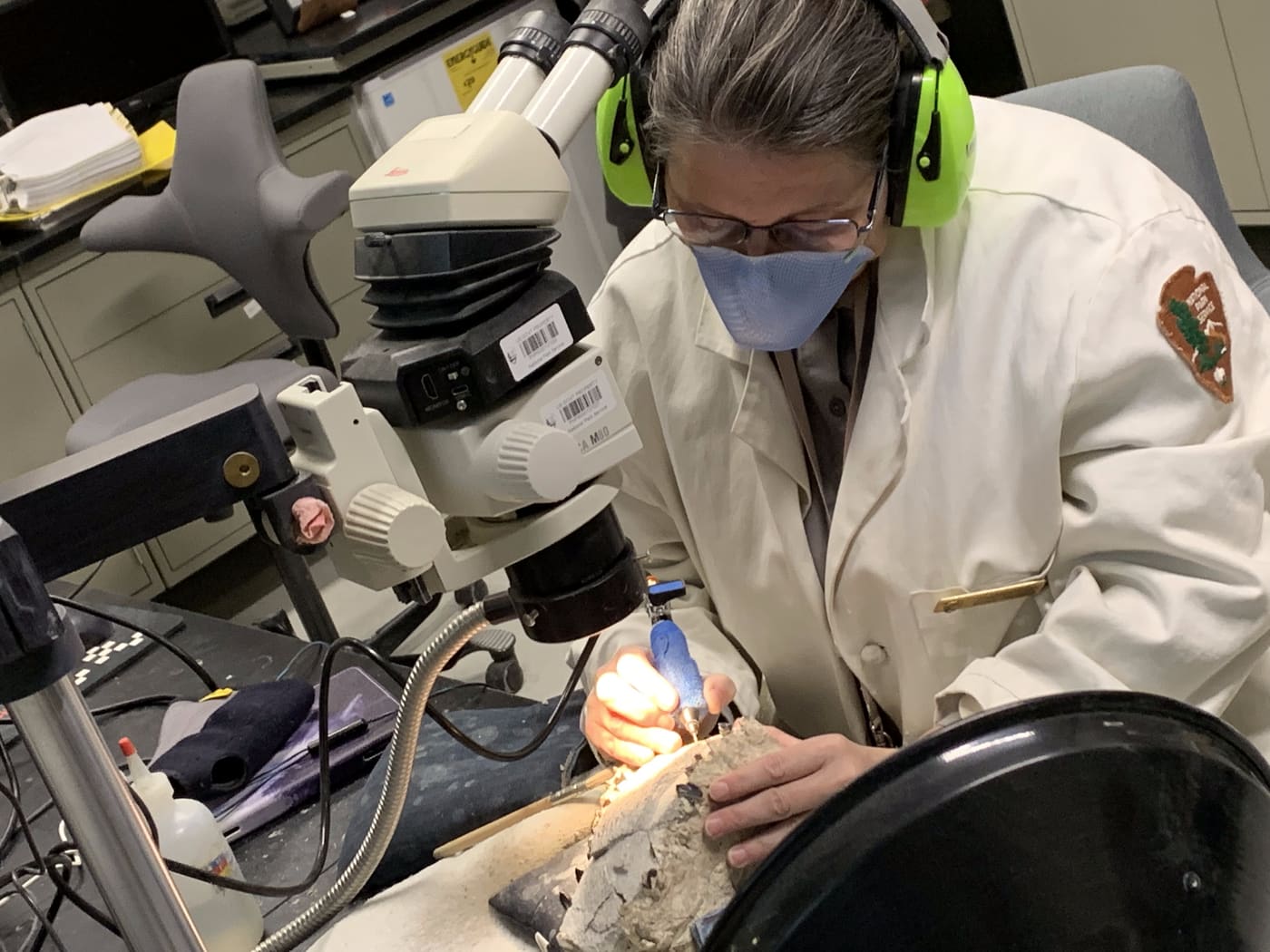
Image context: the cover image is a real NPS photograph from the John Day fossil-preparation page. It is not decorative lab atmosphere. It shows the article's central claim in one frame: preparation is controlled contact between tool, specimen, matrix, documentation, and safety practice.[2]
The video is really about the boundary between rock and evidence
The useful habit while watching the video is to pay attention to what is being removed. In popular fossil imagery, surrounding rock is often treated as a nuisance: the thing between us and the animal. In a preparation lab, matrix is more complicated. It can hide anatomy, support fragile bone, preserve context, or record the forces that buried the organism. Removing it is not the same as cleaning mud from a boot. It is a controlled intervention in a scientific object.[1][2]
The NPS page gives the practical vocabulary for this work. Preparators may use air scribes, dental picks, and micro-needles; the air scribe is described as a tiny jackhammer that removes matrix without directly striking the fossil itself.[2] The Florida Museum's preparation guide makes the same caution visible from another direction: proper preparation can develop and preserve fossil information, but poor choices in consolidants, adhesives, or mechanical tools can change the object in ways that matter later.[4] A fossil is not simply liberated from its rock. It is altered by the path chosen to reveal it.
That is the first lesson of the John Day viewing. The preparator is not just making a specimen prettier for display. The preparator is deciding how much matrix should remain, where support is needed, whether a tool is too aggressive, and what surfaces have enough information to justify exposure. A good lab video slows the viewer down enough to notice that judgment.
Safety gear is part of the scientific method, not a costume
The video's lab setting also makes safety visible in a way field-discovery stories often do not.[1] On the NPS page, safety appears alongside technique: preparators wear eye protection, masks, vibration protection, and ear protection because fossil debris, dust, vibration, and noise are part of the work.[2] That detail can look mundane, but it tells us something important about preparation as a professional practice. The evidence is produced by repeated, close-range work, often under magnification and often with powered tools. The labor conditions are not incidental to the result.
The Society for the Preservation of Natural History Collections makes this broader in its core competencies for natural-history preparators. A qualified preparator must consider both immediate physical impacts on the specimen and the long-term effects of materials and techniques; they must also know health and safety hazards, select protective equipment, and understand when to seek guidance.[5] That professional framing is useful because it resists a romantic view of fossil work as talented tinkering. Skill is not only a steady hand. It is risk assessment: risk to the specimen, risk to the worker, and risk to the future usefulness of the object.[5]
When the video shows a tool near bone, the point is therefore not "look how delicate this looks." The point is that delicacy has a system around it: magnification, support, protective equipment, written records, and restraint.[1][2][5] Without that system, the work would still look dramatic, but it would be less scientific.
Documentation is the invisible output
The most important product of preparation may not be the exposed fossil surface. It may be the record of what was done to get there. John Day's lab description says each step of preparation is documented, including the fossil, hours spent, tools or chemicals used, and any pre-existing damage.[2] That matters because future researchers inherit not just the object but the history of interventions applied to it.
This is where preparation joins collection care. SPNHC explicitly connects fossil preparation to archival labeling, housing, storage environment, and ethical use of specimens.[5] The NPS Point Reyes collaboration article gives a concrete example: John Day's preparator describes condition notes, tool choices, additional hours, glues, and consultations with marine-mammal researchers while preparing fossil skull material from Point Reyes.[6] The scientific value of the final specimen depends partly on those choices being traceable.[6]
The lesson for the viewer is simple but easy to miss: a prepared fossil without preparation history is less informative than it looks. If later researchers need to know whether a shiny surface is original bone, consolidant, glue, repair, or exposed matrix, the answer should not depend on memory. Documentation is how preparation remains accountable after the preparator has moved on to the next jacket.[2][5][6]
The lab window changes what the public is allowed to notice
John Day's visitor-center lab has another function. The NPS describes it as a window that lets visitors watch the preparation process.[2] That architecture matters. It shifts public paleontology away from the finished mount and toward the chain of work that makes finished specimens possible. A visitor who sees only a display case can mistake fossils for self-evident facts. A visitor who sees preparation can understand that facts are made durable through controlled handling, documentation, and conservation.
This is especially useful at John Day because the monument's significance comes from sequence and comparison across ecosystems, not from one trophy animal.[3] A small mammal jaw, a plant fossil, or a fragmentary skull can matter if it is prepared well enough to preserve diagnostic anatomy and context. Conversely, a spectacular-looking specimen can lose research value if preparation destroys information or makes later interpretation uncertain.[4][5]
The video is worth embedding because it gives the slow middle of paleontology its proper weight.[1] Field discovery begins the story, and museum display often finishes it for the public, but preparation is where the object becomes evidence that can move between those worlds. The fossil must be stable enough to survive storage, clear enough to be studied, honest enough to preserve what is known and unknown, and documented enough for later scientists to audit the work.[2][5][6] The lab window is not a sideshow after discovery. It is where paleontology earns the right to keep asking questions of old stone.
Sources
- John Day Fossil Beds National Monument, "John Day Fossil Beds National Monument: Fossil Preparation," YouTube video.
- National Park Service, "Fossil Preparation Laboratory," John Day Fossil Beds National Monument.
- National Park Service, "Fossils," John Day Fossil Beds National Monument.
- Florida Museum of Natural History, Vertebrate Paleontology Collection, "Preparation and Conservation."
- Society for the Preservation of Natural History Collections, "Core Competencies."
- National Park Service, Jennifer L. Cavin, "Preparation of Marine Mammal Fossils from Point Reyes National Seashore: A Collaboration with John Day Fossil Beds National Monument."