Glossopteris is easy to make too large too quickly. In textbook memory it becomes a map symbol: a fossil leaf stamped across South America, Africa, India, Australia, and Antarctica, proving that the southern continents once touched. That story is true enough to survive. It is also too smooth. The more interesting close reading starts with the leaf itself - narrow, tongue-shaped, marked by a midrib and a net of veins - and asks why a plant impression could carry so much geological weight.[1][2]
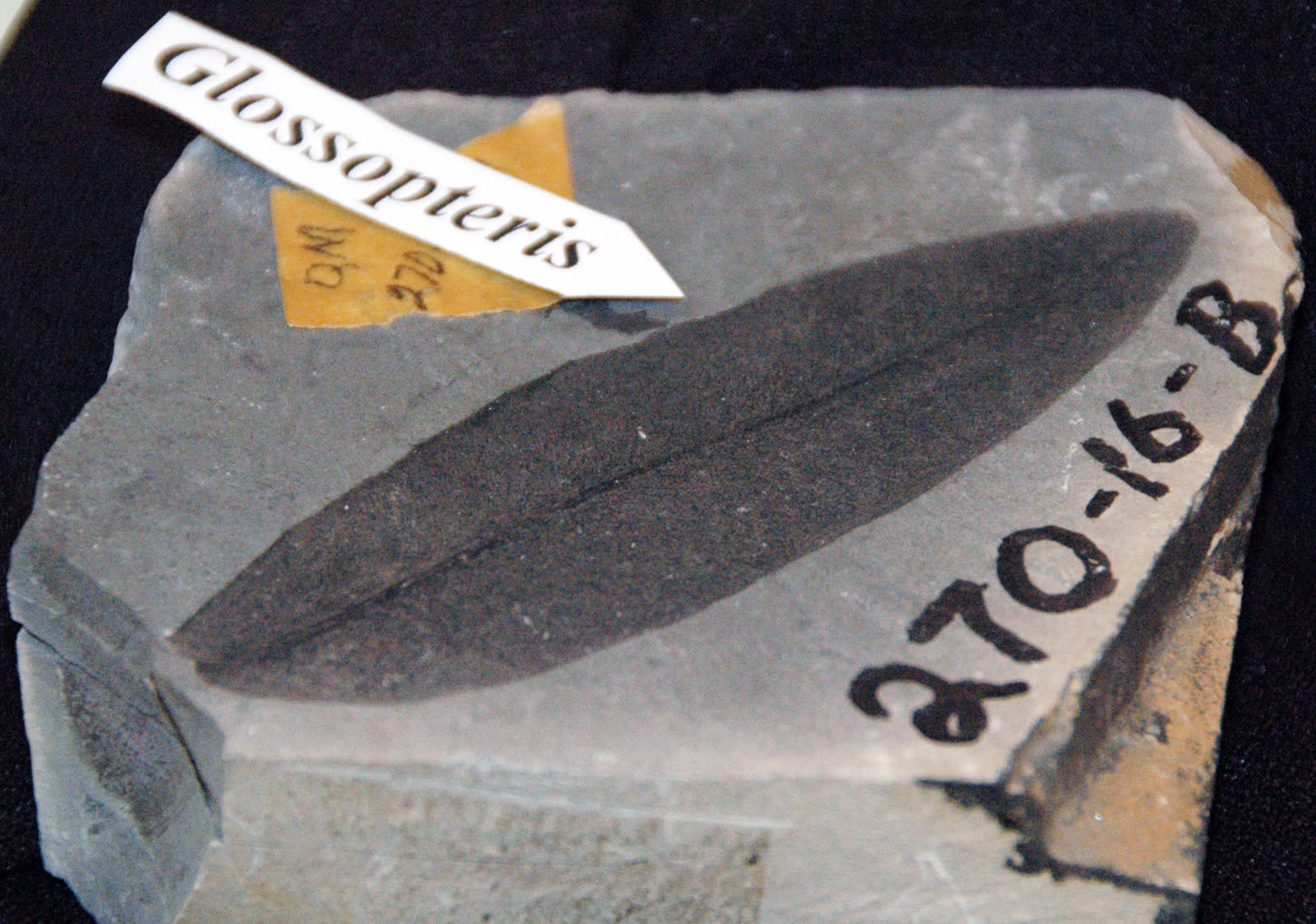
The lead photograph is deliberately plain. It shows a Permian Glossopteris leaf from Antarctica, photographed as a physical fossil rather than turned into a colored distribution diagram.[1] That matters because the continental argument did not begin as an abstract plate-tectonic animation. It began with repeated finds: the same kind of distinctive plant fossil appearing in places now separated by oceans. Before the mechanism of seafloor spreading made continental drift easy to teach, fossil distribution made separation look suspicious.[3][4]
The leaf has to be read before the map
The name Glossopteris points to the shape: a tongue-like leaf. Britannica summarizes the common fossil as a tongue-shaped leaf with a prominent midrib and reticulate venation, and the Commons specimen page describes the photographed Antarctic leaf in the same anatomical register: elongated, spatulate, with closed patchwork veining rather than the open vein style of many other Paleozoic tree leaves.[1][5] Those details are not decoration. They are the reason the fossil could travel through arguments.
Plant fossils are often fragments. A leaf, a root, a trunk, pollen, and a seed-bearing structure may not arrive attached to one another. UCMP's overview of glossopterids stresses that reproductive structures were unusual and controversial, and that the living plant has to be reconstructed from incomplete pieces.[2] That uncertainty should not weaken the leaf. It should sharpen what the leaf can and cannot do. A Glossopteris leaf is not a whole forest. It is a repeatable marker that can be compared across rocks, museums, and continents.
This is why the fossil works as a close-reading object. If it were just a generic fernlike impression, its distribution would be easier to dismiss as convergent resemblance. If it preserved a whole tree every time, the story would be simpler but less representative of paleobotany's normal evidence problem. Instead, Glossopteris sits in the hard middle: distinctive enough to track, incomplete enough to demand caution.
Gondwana was not proved by one pretty slab
GUM's collection note gives the historical version clearly: Eduard Suess saw that Glossopteris fossils occurred on different continents and used that distribution as a key argument for a former southern supercontinent, Gondwana.[3] The Geological Society's plate-tectonics education material makes the broader fossil logic explicit: if related fossils occur on separated continents and nowhere else, the alternatives become strained - independent evolution in multiple places or impossible dispersal across oceans.[4]
The power of Glossopteris was that it made that problem botanical. Animals such as Mesosaurus often carry the drift story because a freshwater reptile crossing an ocean is obviously absurd.[4] A plant adds a different kind of pressure. Seeds, spores, and plant fragments can move, but Glossopteris was not merely a stray seed in one odd bed. It was part of a major Permian southern flora. Britannica places it in rocks deposited on Gondwana and notes its broad occurrence in southern landmasses.[5] The fossil was not a message in a bottle. It was a vegetation signal.
That distinction matters. A map covered in matching leaves can look like a proof by illustration. The stronger claim is stratigraphic and ecological: Permian rocks on the now-separated southern continents repeatedly preserve a flora in which glossopterids were important enough to become markers of place and time.[5][6] Continental connection made that distribution intelligible. Later plate tectonics supplied the mechanism, but the fossil pattern had already made the old geography feel less optional.
The plant was larger than the leaf
The leaf map can also shrink the organism. If Glossopteris becomes only evidence for continental drift, the plant itself disappears into geology. UCMP's overview helps recover it as a living problem. Glossopterids produced pollen and seeds in separate organs, carried unusual ovule-bearing structures, and had roots assigned to the form genus Vertebraria, with a partitioned appearance that inspired the name.[2]
Those roots are important because they restore ecology to the fossil. Glossopteris was not a floating label. It belonged to plants with underground architecture, woody bodies, reproductive systems, and growth habits that remain partly reconstructed rather than directly observed.[2] The Commons specimen page notes that different organs receive different form-genus names, which is a basic paleobotanical warning: a fossil plant can be known by parts long before its whole body becomes secure.[1]
Read this way, a Glossopteris leaf is like a handle on a missing machine. It does not show the whole plant, but it lets researchers pull together roots, wood, reproductive structures, coal-forming wetlands, and high-latitude forest questions. That is why the fossil is better than a continental-drift icon. It connects three scales at once: the visible leaf, the reconstructed plant, and the southern Permian landscapes in which those plants became abundant.
A good index fossil still has boundaries
There is a temptation to treat Glossopteris as if it solves every Permian southern-hemisphere rock problem by itself. It does not. Britannica notes the genus is known from Permian and Triassic rocks in a broad sense, while the more detailed recent literature is careful about timing, survival, and reworking.[5][6] The 2024 Frontiers survey describes Permian Gondwanan floras as overwhelmingly dominated by glossopterid gymnosperms, but it also emphasizes that reports of glossopterids surviving the end-Permian extinction event into the earliest Triassic remain equivocal and need verification.[6]
That boundary is useful. It prevents the fossil from becoming a magic stamp. A Glossopteris leaf in a collection drawer has to be tied to locality, stratigraphy, preservation, and associated assemblage. The same outline cannot automatically settle age, environment, or survival across the Permian-Triassic transition. The fossil's fame came from repetition, but repetition still has to be checked bed by bed.
This is also where paleontology becomes less heroic and more interesting. The classic story says the leaf helped reveal a lost supercontinent. The working story says every specimen has to pass through identification, stratigraphic placement, comparison with associated plant parts, and a judgment about whether it is in place or reworked. The map is the public result. The slab is the discipline.
The end of the forest is part of the reading
The close reading should not stop with continental assembly. Glossopteris also points toward loss. The Frontiers survey frames the end-Permian event as a major ecological break in which Gondwanan glossopterids disappeared and new terrestrial ecosystems slowly took shape through the Early and Middle Triassic.[6] That makes the leaf doubly historical. It helped make an older world spatially readable, and it marks a vegetation regime that did not simply continue unchanged into the next era.
This matters because supercontinent stories often feel static: continents fit, fossils match, case closed. Glossopteris asks for a time dimension. The plant belonged to a Permian Gondwana with broadleafed arborescent seed plants dominating many assemblages.[6] Then the end-Permian crisis changed the terrestrial baseline. Later floras were not just the same leaf map shifted forward. They were different communities growing after collapse, climate stress, and ecological sorting.
So the photographed Antarctic leaf is not only evidence that Antarctica was once connected to other southern lands. It is evidence that Antarctica once participated in a vegetated Permian world unlike the ice-covered continent familiar today.[1][5] The surprise is not just geography. It is biography at planetary scale: a cold modern place preserving the remains of plants that grew when land, climate, and ecosystems were arranged differently.
Why this modest fossil still carries weight
The strongest reading of Glossopteris is neither "one leaf proved continental drift" nor "the fossil is only a historical curiosity now that plate tectonics is settled." The stronger reading is that Glossopteris shows how a modest fossil can become powerful when anatomy, repetition, and geography align. The leaf is recognizable. The distribution is hard to explain on separated continents without former connection. The plant's reconstructed biology keeps the story from shrinking into a map symbol. The end-Permian record keeps the story from freezing in time.[2][3][4][6]
That is why the real photograph matters. A diagram would show the conclusion. The slab shows the evidence problem. It asks the reader to move from vein pattern to identification, from identification to distribution, from distribution to Gondwana, and from Gondwana to the disappearance of a once-dominant flora. Glossopteris made continents readable because it first made a leaf readable.
Sources
- Wikimedia Commons, "File:Glossopteris sp. (fossil leaf) (Permian; Antarctica) 2 (49062918518).jpg" - photographed Antarctic Permian Glossopteris leaf used as the article image.
- University of California Museum of Paleontology, "Introduction to the Glossopteridales" - overview of foliage, reproductive organs, roots, and reconstruction uncertainty.
- GUM - Gents Universiteitsmuseum, "Glossopteris fossil leaves" - collection note on Glossopteris and the Gondwana/continental-drift argument.
- The Geological Society, "Fossil Evidence" - continental-drift teaching page explaining fossil-distribution logic across separated continents.
- Nan Crystal Arens and Encyclopaedia Britannica editors, "Glossopteris" - fossil plant overview, morphology, age range, and Gondwanan setting.
- Chris Mays et al., "Comprehensive survey of Early to Middle Triassic Gondwanan floras reveals under-representation of plant-arthropod interactions," Frontiers in Ecology and Evolution 12 (2024).