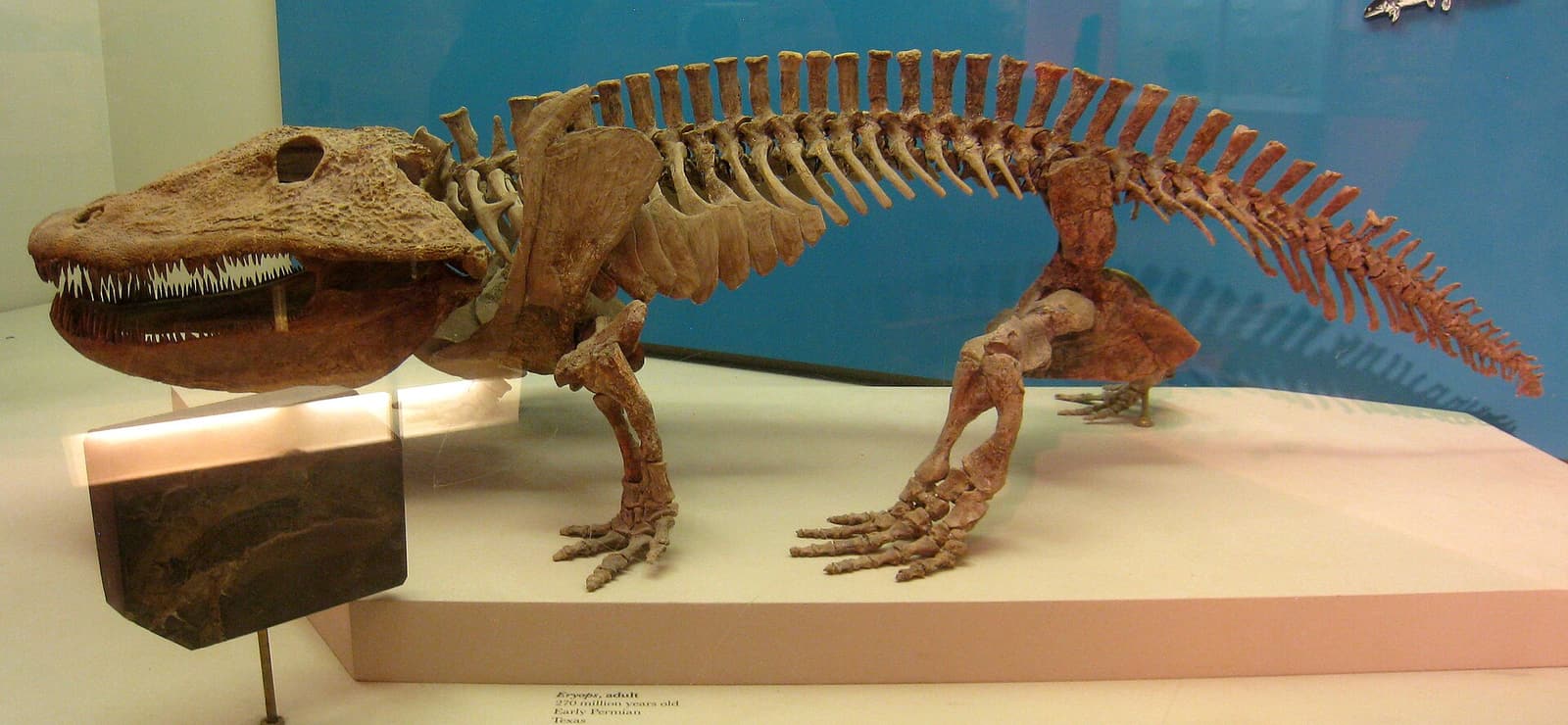
Eryops megacephalus is the kind of fossil animal that invites a shortcut. Big head, broad mouth, early Permian age, swampy North American setting: the easy label is "crocodile-like amphibian." The label is not useless, but it is too smooth. Eryops was not a crocodile preview and not a giant frog ancestor. It was a temnospondyl, one of the large Paleozoic and Mesozoic amphibian-grade tetrapods, and its best profile comes from the tension between a water-linked life cycle and a surprisingly sturdy adult skeleton.
That tension is why the animal still works as more than a textbook silhouette. Horace J. Sawin's 1941 monograph on the cranial anatomy of Eryops megacephalus treated the skull as a major object in its own right, with enough detail to require twelve plates in the Museum of Comparative Zoology bulletin record.[1] Later work on the limb skeleton moved the animal out of the cartoon swamp. Pawley and Warren described the appendicular skeleton of Lower Permian Eryops as similar to most temnospondyls in broad plan, but unusually highly ossified, with terrestrial adaptations including relatively large limbs, strong muscle-attachment processes, and a reduced dermal pectoral girdle.[2]
Put those two facts together and the animal becomes clearer. The skull gives Eryops its public face. The limbs give it its ecological boundary. This was a big-headed predator whose body was not just floating behind the jaws.
The Head Is The Hook, Not The Whole Animal
The species name megacephalus makes the joke for you: big head. It is accurate enough to be useful. The wide skull, marginal teeth, palatal teeth, upward-facing eye placement, and heavy roof bones make Eryops feel at home near ponds, channels, and wet lowlands. A predator with that head probably did not nibble its way through the early Permian. It seized prey and swallowed it with a mouth built for holding rather than chewing.
But the skull can also mislead if it becomes the only evidence. A broad head in an old amphibian does not automatically equal a crocodile lifestyle. Crocodiles are living reptiles with their own skull mechanics, armor, tails, lungs, and aquatic specializations. Eryops belongs to a different experiment in tetrapod design. Sawin's cranial study matters because it slows the reader down: the head is an anatomical structure with named bones, sutures, openings, and surfaces, not just a mood board for "ancient swamp predator."[1]
Recent collecting shows why the head remains scientifically seductive. A 2025 report from North Central Texas described a nearly complete Eryops megacephalus skull found at the Permian Quarry in Archer County, with the discoverer stressing that Eryops is well known but that a nearly complete skull is much less common than fragments.[5] That is a useful distinction. The animal is familiar in the record, but completeness still changes what researchers can compare, scan, restore, and share.
The new-skull story should not be inflated into a rewritten species profile before the specimen is prepared and studied. Its value for a general reader is simpler: Eryops is common enough to be a classic, yet still incomplete enough that one good skull can matter.
The Limbs Pull It Onto Land
The body behind the head is where Eryops becomes more interesting. Pawley and Warren's appendicular study is a good corrective to the lazy image of a helpless water animal with a huge skull. They emphasized terrestrial signals in the limb skeleton: comparatively large limbs, well-developed muscle attachments, and a pectoral region less dominated by dermal armor than in more aquatic-looking early tetrapod plans.[2]
That does not make Eryops a dry-land runner. It makes it a boundary animal. The adult body seems capable of meaningful movement on land, but the skull, teeth, and broader temnospondyl context keep water nearby. A better mental picture is not "crocodile amphibian" or "oversized salamander." It is a heavy, low-slung tetrapod whose adult skeleton had to work across mud, banks, shallow water, and firm ground.
The distinction matters because early tetrapod reconstructions often over-borrow from living analogs. If the animal is amphibian-grade, the temptation is to make it salamander-like. If it is large and broad-skulled, the temptation is to make it crocodile-like. Eryops accepts parts of both comparisons and then breaks the simplification.
A Salamander-Like Gait Is A Test, Not A Costume
Herbst, Manafzadeh, and Hutchinson approached the locomotion problem directly by asking whether the hindlimb morphology of Eryops megacephalus could support salamander-like configurations during terrestrial walking.[3] The important part is methodological. They were not merely saying that Eryops looked a bit like a salamander from the side. They tested multi-joint pose viability, comparing whole limb configurations rather than treating each joint as an isolated hinge.[3]
Their conclusion supported the possibility of salamander-like hindlimb kinematics.[3] That is a careful sentence, and it should stay careful. "Possible" is not the same as "proved in life," and gait is not the whole animal. A fossil limb can reject some poses and permit others, but it cannot preserve muscle timing, substrate choice, fatigue, escape behavior, or the exact texture of a Permian shoreline.
Still, the result is valuable. It gives the salamander analogy a testable anatomical footing instead of leaving it as a museum habit. Eryops may have been able to use a sprawling, salamander-like sequence on land, but at a much larger scale and inside a body plan with a heavy head, robust limbs, and a stiff-looking trunk. The analogy helps only when the differences stay visible.
The Life History Keeps Water In The Story
The adult skeleton can make Eryops look more terrestrial than expected, but temnospondyl life history keeps the water boundary alive. Rainer Schoch's 2021 study of late Paleozoic eryopid temnospondyls focused on life cycle, developmental variation, plasticity, and phylogeny, and tied broad variation in some eryopid samples to environmental stresses such as fluctuating hydrology, nutrients, salinity, competition, and algal blooms.[4]
That study is not a license to assign one simple tadpole-to-adult script to every Eryops individual. It is a warning against making adult bones carry the whole ecology. Eryopid bodies changed through growth, and their development could be shaped by water bodies that were not stable laboratory tanks. Lakes, ponds, floodplain pools, and channels impose different risks on juveniles than on adults.
This is where the Smithsonian display photograph earns its place. The image shows an Eryops fossil specimen with associated tadpole material, formerly known as Pelosaurus, in a museum case.[6] It is not an analytical diagram, and it should not be treated as a full ontogenetic sequence by itself. But visually it does the right thing: it places the heavy adult-looking animal and the juvenile water-linked problem in the same field of attention.
The strongest profile therefore has two clocks. One is anatomical: skull, girdle, limbs, joints. The other is developmental: growth, habitat, water conditions, and the different vulnerabilities of young and adult animals. Eryops sits where those clocks meet.
The Real Animal Is Heavier Than The Analogy
The secure version of Eryops is more interesting than the shorthand. It was a Lower Permian North American temnospondyl with a famous broad skull and a well-studied limb skeleton.[1][2] Its adult appendicular anatomy shows a more terrestrial-capable body than a purely aquatic caricature would allow.[2] Its hindlimbs may have permitted salamander-like terrestrial configurations, but that conclusion comes from a bounded biomechanical test rather than from a living animal walking in front of us.[3] Its broader eryopid life-history context keeps water, development, and environmental plasticity in the center of the story.[4]
That is the land-water compromise. Eryops does not become scientific by being made modern. It becomes scientific when the analogies are kept under control. The skull can remind us of aquatic ambush. The limbs can remind us of weight-bearing on land. The life cycle can remind us that even a robust adult temnospondyl began in a world where water conditions mattered.
The result is not a monster amphibian and not a failed reptile. It is a successful early Permian predator built from a different set of assumptions: a big head, a heavy skeleton, a body capable of leaving the water's edge, and a life history that never lets the water disappear.
Sources
- Horace J. Sawin, "The cranial anatomy of Eryops megacephalus," Bulletin of the Museum of Comparative Zoology 88, no. 5 (1941), MCZbase publication record.
- Kat Pawley and Anne Warren, "The appendicular skeleton of Eryops megacephalus Cope, 1877 (Temnospondyli: Eryopoidea) from the Lower Permian of North America," Journal of Paleontology 80, no. 3 (2006).
- Eva C. Herbst, Armita R. Manafzadeh, and John R. Hutchinson, "Multi-Joint Analysis of Pose Viability Supports the Possibility of Salamander-Like Hindlimb Configurations in the Permian Tetrapod Eryops megacephalus," Integrative and Comparative Biology 62, no. 2 (2022), PMC full text.
- Rainer R. Schoch, "The life cycle in late Paleozoic eryopid temnospondyls: developmental variation, plasticity and phylogeny," Fossil Record 24 (2021).
- Chron, "Fossil found in Texas may be one of the most complete yet" (June 24, 2025), report on a newly found Eryops skull from Archer County.
- Wikimedia Commons, "File:Eryops - National Museum of Natural History - IMG 1974.JPG" - source page for the Smithsonian fossil-display photograph used as the article image.