The Jehol Biota is famous enough that many readers meet it through a single silhouette: a feathered dinosaur, an early bird, a small mammal with improbable soft tissue, a fish that still looks freshly pressed into stone. That way in is understandable, but it also shrinks the site too quickly. Jehol is better read as an archive before it is read as a mascot gallery. The stronger unit is not one celebrity fossil. It is a volcanic-influenced Early Cretaceous lake system spread across formations, basins, and time slices in northeastern China.[1][2]
That shift in scale changes almost every interpretive habit. Once the archive comes first, the old shorthand of "China's feathered dinosaur treasure house" stops being wrong and starts being incomplete. The Jehol record is valuable because plants, insects, fish, amphibians, reptiles, birds, non-avian dinosaurs, and mammals were buried in a preservational setting that kept far more than bone. Review work in National Science Review accepts a definition of Jehol as organisms living in volcanic-influenced environments of northeastern China and buried mainly in lacustrine, more rarely fluvial, sediments where many became exceptionally preserved fossils.[1] That is not a narrow dinosaur story. It is a whole-ecosystem statement.
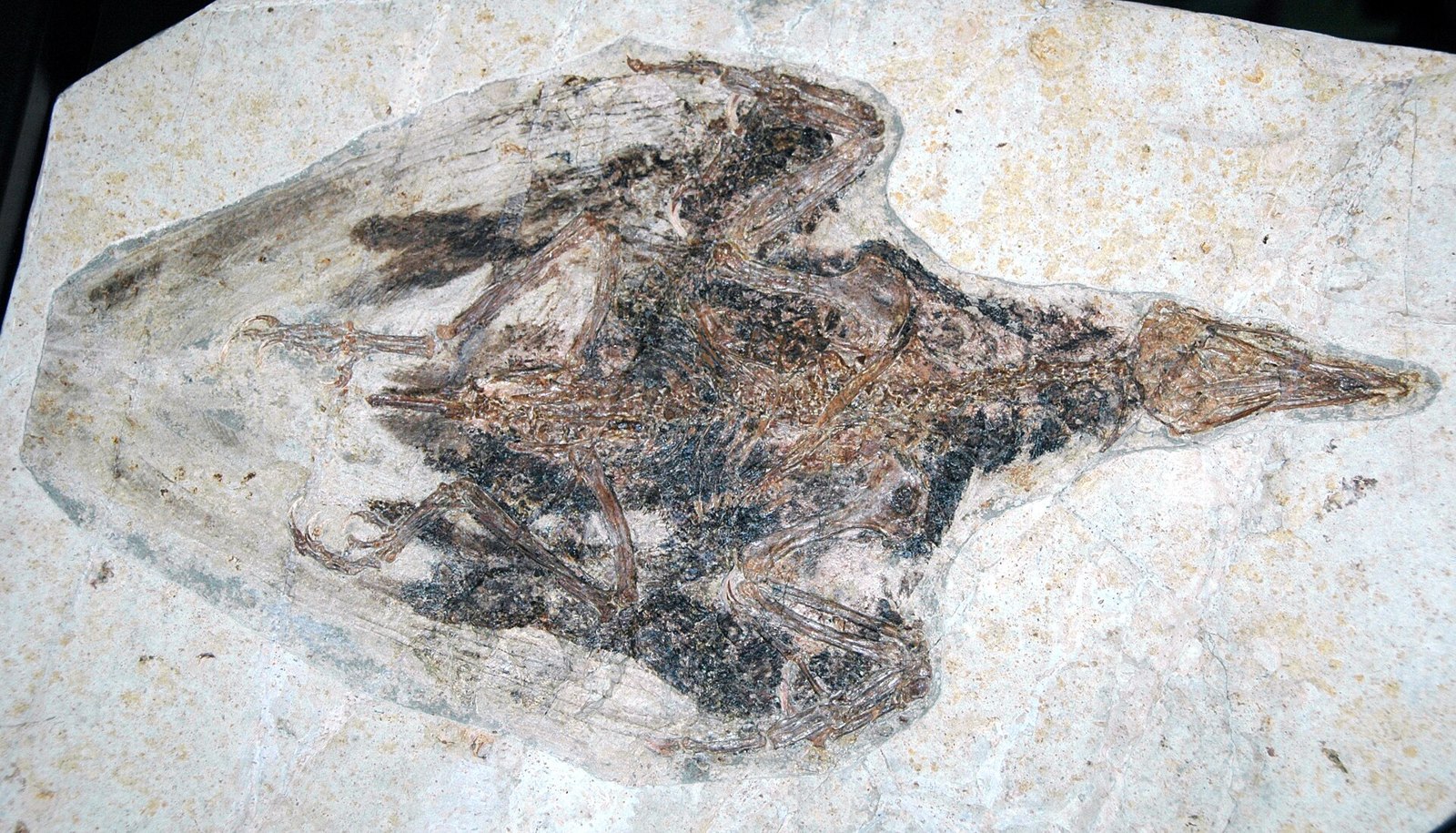
Image context: the cover uses a photographed Jeholornis holotype slab from Wikimedia Commons. It belongs here because the article's claim is taphonomic and stratigraphic before it is taxonomic. A real slab keeps attention on the actual archive surface: articulated bones on lake-laid rock, preserved because the wider Jehol system kept delicate bodies readable long enough to enter the fossil record.[7]
The right unit is the basin network, not one miracle bed
The 2021 Jehol spatiotemporal review is useful because it refuses the flattening effect of fame.[2] Instead of treating Jehol as one frozen scene, it discusses three stages of the biota and links its expansion and turnover to basin development, volcanism, and the broader destruction of the North China craton.[2] That is the first field-report correction worth keeping. Jehol is not one bed with a strong brand. It is a distributed terrestrial-lacustrine archive whose best-known fossil windows, especially the Yixian and Jiufotang formations, belong to a moving geological and ecological system.[1][2]
This matters because the usual popular frame turns every Jehol fossil into evidence for the same claim. In practice, the archive is doing several jobs at once. Some fossils illuminate the emergence of feathers, beaks, and early avian flight. Others illuminate lake food webs, volcanically stressed landscapes, floral change, insect abundance, and the coexistence of archaic and more derived lineages inside one regional record.[1][6] The Jehol question is therefore not just "What spectacular animal came out of Liaoning?" The sharper question is "What kind of basin network kept so many different organisms, from fish to birds to mammal hair, inside a common preservational language?"[1][2]
The time scale is short enough to feel eventful, but too long for one-calamity myth
Geochronology helps here because it disciplines the temptation to turn Jehol into one dramatic instant. The 2021 National Science Review dating paper on the Yixian Formation bracketed the onset and termination of that formation in the Jin-Yang basin at 125.755 ± 0.061 Ma and 124.122 ± 0.048 Ma, for a duration of 1.633 ± 0.078 million years.[3] That interval is geologically short enough to preserve a strong sense of concentrated environmental change, but it is still far too long to be reduced to one afternoon of volcanic disaster.
That chronology is important for another reason. It keeps Jehol from being misread through a single metaphor such as "Chinese Pompeii."[3] The metaphor captures something real about rapid burial in some horizons, but it distorts the archive when used as a total explanation. A formation that lasts on the order of 1.6 million years can preserve repeated volcanic influence, repeated lake deposition, repeated mortality pathways, and repeated ecological resets without collapsing into one terminal event.[3] The archive becomes more interesting, not less, when that repetition stays in frame.
The preservation story has more than one gear
The preservation debate itself shows why the archive frame is stronger than the showroom frame. The 2014 Nature Communications paper argued that phreatomagmatic eruptions and pyroclastic density currents explain many major Jehol death assemblages. In that model, terrestrial vertebrates from different habitats were transported into lacustrine settings and sealed within pyroclastic flows, producing the remarkable articulation and exceptional preservation that made the biota famous.[4]
That model still matters, but it is no longer the whole story. The 2024 PNAS paper on flattened-feathered and 3D dinosaurs argues for a more complicated system: Jehol fossils include flattened specimens in laminated lacustrine strata and three-dimensional skeletons in more massive deposits, and the broader preservation pattern can be extremely rapid without being uniformly catastrophic.[5] This is exactly the kind of distinction a field report should keep alive. Jehol is not one preservation machine running one setting on repeat. It is a cluster of related depositional settings and burial pathways whose outputs resemble one another enough to share a label, but differ enough to resist one universal script.[4][5]
That is also why the archive keeps paying out after the first wave of feather headlines. When one system can preserve flight feathers, fish, skin, mammal integument, ovarian follicles, stomach contents, and articulated skeletons across many taxa, the scientific value no longer sits only in novelty species.[1][6] It sits in comparison. Jehol lets paleontology compare ecological layers, burial modes, anatomical detail, and evolutionary timing within a shared regional framework.[1][2][5]
Why the lake matters as much as the dinosaur
The older 2003 Nature synthesis remains foundational because it described Jehol as an exceptionally preserved Lower Cretaceous ecosystem, not just an assortment of headline vertebrates.[6] That wording still holds up. The archive is powerful because delicate structures survive in enough context that paleobiology can move past silhouette-recognition and into ecology, development, diet, integument, and habitat structure.[1][6]
That is why a fish or bird slab can stand for more than one species. A Jeholornis fossil, a Lycoptera plate, or a feathered theropod skeleton all point back to the same larger fact: lake sediments and volcanic input kept turning fragile bodies into readable evidence surfaces.[1][4][5][7] The real Jehol achievement is not that one extraordinary animal appeared. It is that the basin network preserved a continental ecosystem with enough fidelity that different lines of Cretaceous life can still be read together rather than one by one.
The strictest summary is therefore the least cinematic one. Jehol matters because northeastern China's Early Cretaceous lake basins kept producing repeated windows in which volcanic disturbance, quiet-water deposition, and exceptional preservation overlapped.[1][2][3][5] Feathered dinosaurs remain part of that story, but they are not the whole subject. The whole subject is the archive that made them legible beside fish, plants, insects, mammals, and early birds, then kept enough temporal depth intact that the biota reads as a sequence of time slices rather than one fossil miracle.
Sources
- Zhonghe Zhou, David J. Barrett, and Jason Hilton, "Jehol Biota, an Early Cretaceous terrestrial Lagerstätte: new discoveries and implications," National Science Review 1, no. 4 (2014).
- Spatiotemporal evolution of the Jehol Biota: Responses to the North China craton destruction in the Early Cretaceous (2021).
- High-precision geochronological constraints on the duration of 'Dinosaur Pompeii' and the Yixian Formation, National Science Review 8, no. 6 (2021).
- Baoyu Jiang, George E. Harlow, Kenneth Wohletz, Zhonghe Zhou, and Jin Meng, "New evidence suggests pyroclastic flows are responsible for the remarkable preservation of the Jehol biota," Nature Communications 5 (2014).
- Extremely rapid, yet noncatastrophic, preservation of the flattened-feathered and 3D dinosaurs of the Early Cretaceous of China (2024).
- Z. H. Zhou, P. M. Barrett, and J. Hilton, "An exceptionally preserved Lower Cretaceous ecosystem," Nature 421 (2003).
- Wikimedia Commons, "File:Jeholornis holotype.jpg" — photographed holotype slab used for the lead image.