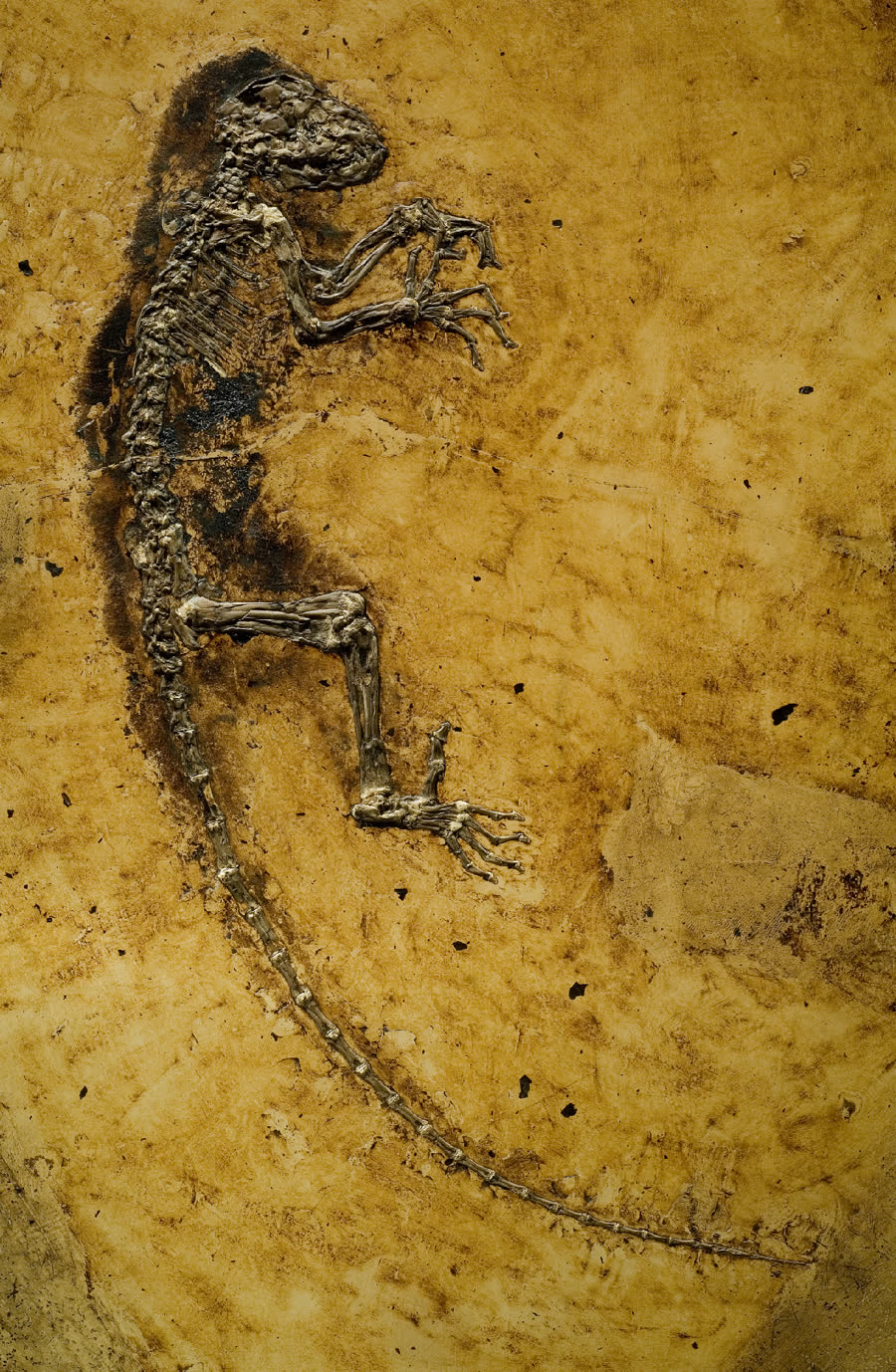
Darwinius masillae is more interesting when the grand label is removed. In May 2009, the small Messel primate arrived in public as "Ida," a 47-million-year-old fossil surrounded by media language about "the link" between early primates and humans.[1][3] That framing made the fossil famous, but it also made the evidence smaller than the specimen. A missing-link story asks one overbright question: does this animal belong on the line to us? The fossil itself asks better questions about preservation, juvenile growth, preparation, locomotion, diet, and the difference between anatomical detail and evolutionary placement.[1][2]
That is why Darwinius deserves a fossil-find close reading rather than another verdict on the publicity campaign. The specimen is a nearly complete juvenile primate from Messel, Germany, preserved on a slab with a soft body outline and remains in the digestive tract.[1] It also carries a strange modern history: part and counterpart were separated, one side entered a private collection, and the less complete counterpart was partly fabricated before the more informative Oslo slab came to light.[1] In other words, this is a fossil that teaches two forms of caution at once. Deep-time preservation can be astonishingly generous; modern handling and public narrative can still distort what that generosity means.
Image context: the lead image is a real fossil photograph of the main PMO 214.214 slab, extracted from the open PLOS publication and hosted on Wikimedia Commons. It is used here because the animal's body, not an artist's reconstruction or a promotional scene, should set the reading order.[1][6]
1) The Messel setting explains why this fossil could become so complete
Messel matters before Darwinius matters. UNESCO describes the Messel Pit as an exceptional Eocene fossil site, with preservation ranging from articulated mammal skeletons to feathers, hair, skin, and stomach contents.[5] The PLOS description places Darwinius inside that same preservation logic: the animal died in a middle Eocene, lake-margin world and entered oil-shale conditions capable of holding a level of bodily information that most fossil-primate sites never approach.[1]
That context changes the first reading of the slab. The fossil is not simply a complete skeleton in the ordinary sense. It is an articulated juvenile body with a tail, hands, feet, soft outline, and digestive remains visible enough to support questions about growth, locomotion, and diet.[1] Paleoprimatology often works through teeth, jaws, and scattered bones. Here the animal arrives as a body plan almost whole enough to tempt biography.
The temptation needs discipline. Messel's preservation window does not make the animal a direct ancestor, and it does not convert every feature into a human-origin clue. It gives paleontologists a rare chance to separate life-history evidence from phylogenetic claim. That separation is the reason the fossil remains valuable after the public drama fades.
2) The slab is also a warning about preparation history
The most useful detail in the 2009 paper may be the least glamorous one. Darwinius was collected in 1983, split into part and counterpart, and sold along separate paths.[1] Plate A, PMO 214.214, later entered the Natural History Museum of the University of Oslo; Plate B, WDC-MG-210, went through a different market and museum history. The PLOS paper states that all of Plate A is genuine, while only parts of Plate B are genuine and the rest of Plate B had been fabricated during preparation.[1]
That matters because Darwinius is often remembered as if completeness were a single property. The fossil is more complicated. One slab is an exceptionally informative specimen; the counterpart includes real sections embedded within a restored, partly artificial presentation.[1] The lesson is not cynicism. It is provenance. A fossil's scientific meaning depends on which surface is original, which traces are preparation, which pieces were added, and how part and counterpart correspond.
This is where the missing-link frame did active damage. It encouraged readers to leap past the object's history and land on ancestry. The stronger reading moves in the opposite direction. It starts with the slab, follows the preparation record, and treats the fossil as a material object before it becomes a node in a tree.
3) The anatomy is rich, but rich anatomy does not settle ancestry by itself
The original PLOS paper made a large phylogenetic claim alongside its anatomical description. It emphasized the absence of a toothcomb and toilet claw and argued that Darwinius was not simply a fossil lemur but belonged among Adapoidea as part of early haplorhine diversification.[1] Those features are important. They explain why the fossil immediately mattered to primate-evolution debates. A complete skeleton gives researchers more than isolated molars; it lets them ask how teeth, limbs, skull, hands, growth stage, and soft-tissue traces fit together.
But a broad anatomical inventory is not the same thing as a settled placement. Later in 2009, Seiffert and colleagues published a Nature analysis of Eocene adapiform primates that scored 360 morphological features across 117 living and extinct primates.[2] Their result did not place adapiforms as haplorhines or stem anthropoids. Instead, it placed Afradapis and Darwinius among caenopithecine adapiforms more closely allied with the strepsirrhine side and with no known descendants.[2]
That correction does not make Darwinius unimportant. It makes the fossil cleaner. The specimen can be extraordinary without being ancestral to humans. It can preserve a rare juvenile primate body while still representing a side branch or near-neighbor in Eocene primate diversity. The strongest science here is not the slogan that the fossil "changes everything." It is the slower demonstration that some anthropoid-like features can evolve in lineages that do not become anthropoids.[2]
4) The public controversy is part of the fossil's afterlife
Brian Switek's open-access review of the Darwinius episode is useful because it treats the 2009 launch as a case study in science, media, and interpretation.[3] The controversy was not only about one cladogram. It also involved acquisition history, documentary timing, book promotion, press language, and the way online scientists and writers responded to exaggerated claims.[3] That afterlife belongs in a close reading because it shaped how many readers first encountered the fossil.
The media story also clarifies why paleontology needs dull-sounding boundaries. "A nearly complete Eocene adapiform juvenile from Messel with soft-tissue outline and gut contents" is a magnificent sentence for science. It is less convenient for mass publicity than "the missing link." The first sentence preserves uncertainty and structure; the second burns through both. Once the fossil is made to answer for human ancestry, every other kind of evidence becomes secondary.
The later pathology work helps restore scale. Franzen and colleagues returned to the body itself, using micro-CT and anatomical observation to examine a wrist injury and the possible circumstances of Ida's final weeks and death.[4] Those claims stay narrower than the 2009 publicity frame. They ask how one juvenile moved, suffered, and entered the Messel record. That kind of question suits the fossil better. It treats Darwinius as an animal first.
5) What remains after the label falls away
The best reading of Darwinius in 2026 is therefore layered. The Messel site explains the preservation window.[5] The PMO 214.214 slab gives a rare whole-body view of an Eocene primate.[1][6] The preparation history warns that part and counterpart have to be audited before they are treated as evidence.[1] The phylogenetic pushback shows why a complete fossil still needs broad comparative analysis.[2] The media history shows how easily a real scientific event can be narrowed by a stronger public phrase.[3]
That layered reading is more durable than the missing-link story because it lets the fossil be what it is. Darwinius is not a magic hinge in human evolution. It is a remarkable Messel primate whose body preserves more biological information than most fossil primates can offer, and whose public life preserves a second lesson about evidence under pressure. The animal became famous for an overdrawn ancestry claim. It remains important because the slab keeps asking better questions than the slogan did.
Sources
- Jens L. Franzen et al., "Complete Primate Skeleton from the Middle Eocene of Messel in Germany: Morphology and Paleobiology," PLOS ONE 4, no. 5 (2009).
- Erik R. Seiffert et al., "Convergent evolution of anthropoid-like adaptations in Eocene adapiform primates," Nature 461 (2009).
- Brian J. Switek, "Ancestor or Adapiform? Darwinius and the Search for Our Early Primate Ancestors," Evolution: Education and Outreach 3 (2010).
- Jens L. Franzen et al., "Palaeopathology and fate of Ida (Darwinius masillae, Primates, Mammalia)," Palaeobiodiversity and Palaeoenvironments 93 (2013).
- UNESCO World Heritage Centre, "Messel Pit Fossil Site" (World Heritage listing and Outstanding Universal Value statement).
- Wikimedia Commons file page for the photographed Darwinius masillae PMO 214.214 fossil slab used as the lead image.