Amargasaurus cazaui looks as if it should be easy to explain. A sauropod with a short neck and two rows of tall spines seems to invite one instant answer: sail, horns, display crest, or defensive rack. The fossil is better than that. Its importance lies in how stubbornly it turns a dramatic outline into a soft-tissue problem. Bone is present; the living surface is not. The science begins in the space between those two facts.[1][2][3]
Salgado and Bonaparte named Amargasaurus in 1991 from the lower part of the La Amarga Formation in Neuquen Province, Argentina. Their original description placed the animal in Dicraeosauridae and emphasized the unusual presacral vertebrae, where the neural spines were deeply split and, in the neck, strongly elongated.[1] That is the first boundary. Amargasaurus is not just a strange sauropod ornament. It belongs to a diplodocoid lineage in which bifid neural spines and short-necked body plans make the neck a repeated site of anatomical experimentation.[1][2][3]
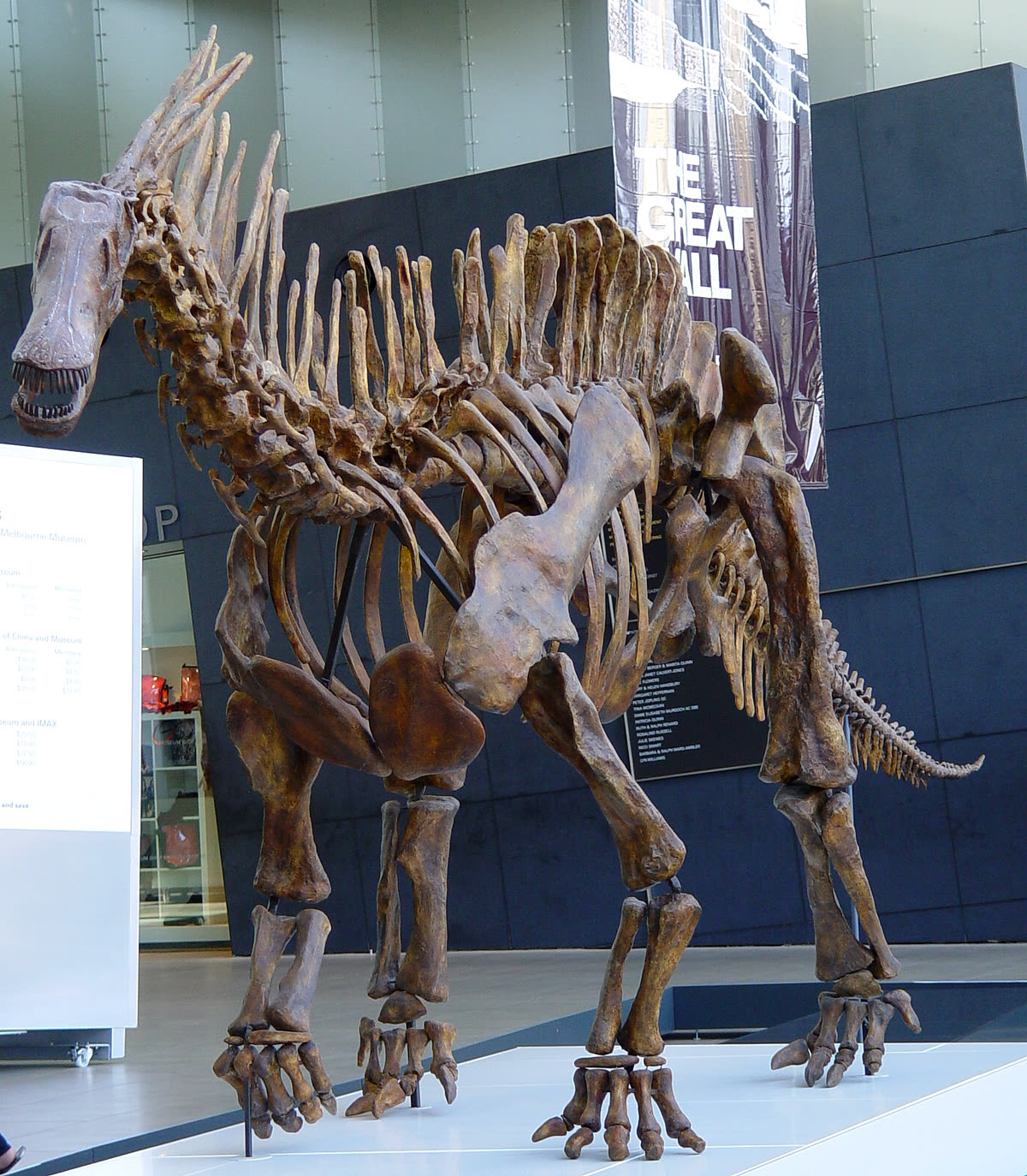
The cover photograph shows an Amargasaurus skeletal mount at the Museum of Victoria, taken in 2007.[5] It is useful because it withholds the most tempting answer. You can see the paired spines, but you cannot see a sail, horny sheaths, skin folds, muscles, or display colors. The mount therefore does what a good paleontological image should do: it keeps the reader with the preserved structure before any reconstruction supplies the missing surface.
The lineage problem is not length alone
Most sauropod neck stories start with length. Diplodocids and macronarians stretch the neck into a familiar long-reach symbol, and the public image of sauropods usually follows that line. Dicraeosaurids interrupt it. Their necks were not simply shorter versions of the same design; their vertebrae put more emphasis on bifurcated neural spines, paired soft-tissue channels, and structures rising above the neck and back.[1][2]
That matters because Amargasaurus changes the kind of question the neck asks. In a very long-necked sauropod, the first problems are support, weight, reach, feeding height, and pneumatic lightening. In Amargasaurus, those problems do not disappear, but the paired spine rows add another layer: what soft tissues occupied the space around and between them, and what biological job would make such tall projections worth carrying?[2][3]
Schwarz, Frey, and Meyer approached that question by reconstructing the axial soft-tissue system of diplodocid and dicraeosaurid necks from comparative anatomy. Their 2007 study argued that bifurcated neural spines split the supraspinal ligament into paired sheets, with interspinal septa, muscles, ligaments, and pneumatic diverticula occupying different zones around the neck.[2] In other words, the split spine is not a decorative fork. It is a structural landscape where several soft systems meet.
That is the cleanest way to enter Amargasaurus: not as a single fossil with a gimmick, but as one extreme expression of a lineage-level neck architecture. The spines were real. The interpretive challenge is deciding which soft-tissue reconstruction fits those bones best.
The horn version had a reason, but it needed a test
One durable reconstruction turned the paired cervical spines into internal cores for keratinous sheaths. That model had obvious appeal. If living horn cores can be covered by keratin, and if some Amargasaurus spine surfaces appeared comparable to horn-supporting structures, then a horn-like restoration seemed biologically plausible. Schwarz and colleagues discussed a keratin sheath hypothesis for part of the hyperelongated spines, and the later description of Bajadasaurus pronuspinax made the defensive version of that idea even more vivid.[2][4]
The 2019 Bajadasaurus paper matters here because it prevents Amargasaurus from standing alone. Bajadasaurus, another Argentine dicraeosaurid, preserved long, forward-curving cervical hemispines, and Gallina and colleagues interpreted the structure as part of a passive defense system, with keratinous coverings protecting fragile bony cores.[4] That comparison widened the issue from one famous genus to a recurring dicraeosaurid design question. If several related sauropods carried extreme paired spines, perhaps the answer was not local oddity but a shared functional pathway.[3][4]
But plausibility is not proof. A horn hypothesis has to leave correlates in bone: surface texture, histology, vascular patterns, attachment evidence, and mechanical logic. The fossil cannot be asked to carry a living sheath just because the restored animal looks more dramatic with one.
Histology narrowed the living surface
The strongest recent correction came from histology. Cerda and colleagues sampled the hyperelongate hemispinous processes of the Amargasaurus holotype and an indeterminate dicraeosaurid from the La Amarga Formation. They examined external morphology, internal microanatomy, and bone microstructure across cervical and dorsal spine sections.[3]
Their conclusion is important because it does not merely swap one paleoart style for another. The anatomical and histological evidence did not support a keratinized sheath covering the hyperelongated processes of Amargasaurus. Instead, the distribution and orientation of Sharpey's fibers pointed toward an important system of interspinous ligaments connecting successive hemispines, while the mechanical signal in the bone supported loading along the spines.[3]
That result shifts the best current reading. A horned Amargasaurus becomes less secure. A soft-tissue sail or crest, held and organized by ligamentous tissue along the paired spine series, becomes more defensible on present evidence.[3] The article's point is not that the animal definitely carried one exact sail shape. The point is stricter: histology makes some living surfaces easier to defend than others.
This is where the fossil becomes more interesting than the famous silhouette. A child can draw the spines. A scientist has to ask whether the bone surface behaves like horn support, ligament attachment, skin-sail support, muscle anchoring, or some combination. The better reconstruction is not the one that looks most memorable. It is the one that makes the preserved microstructure, comparative anatomy, and lineage context agree.
Defense, display, and support may not separate cleanly
It is tempting to force the spines into one job. Defense has the drama of a built-in barrier. Display has the social logic of a visible structure. Thermoregulation has the older sail-backed-animal familiarity. Neck support has the mechanical sobriety that paleontologists often trust more than spectacle. Amargasaurus resists that sorting.
The evidence does not require the structure to have only one biological role. A ligament-supported crest could have affected display and species recognition while also adding stiffness or soft-tissue organization to the neck. A visually prominent structure could still have had some defensive value without being a sharpened horn rack. A soft sail could have altered silhouette and signaling without functioning like the oversized heat exchanger imagined for older sail-backed reconstructions.[2][3][4]
The key is to keep the inference ladder visible. Bone proves the paired spines. Comparative anatomy supports ligaments, muscles, and pneumatic tissues around bifurcated sauropod necks. Histology weakens the horn-sheath model for Amargasaurus and strengthens a ligament-connected sail reading. Behavior remains a further inference, not a preserved fact.[2][3]
That boundary also keeps Bajadasaurus in the right place. Its forward-projecting spines show that dicraeosaurids explored more than one extreme neck-spine geometry, and the defense interpretation is a serious hypothesis for that animal.[4] It does not automatically transfer, unchanged, to Amargasaurus. The lineage context supplies comparison, not permission to ignore specimen-level evidence.
The useful animal is narrower than the fantasy one
The safest summary is not that Amargasaurus wore horns, and not that it certainly carried a single smooth sail like a restored model. The safer and better summary is that this Early Cretaceous dicraeosaurid made the sauropod neck into a soft-tissue experiment visible through bone. Its paired cervical and dorsal spines preserve the scaffold; comparative anatomy reconstructs the support systems; histology constrains the surface; and related long-spined dicraeosaurids show that this was part of a broader evolutionary exploration, not a one-off flourish.[1][2][3][4]
That is why Amargasaurus remains a strong lineage-context fossil. It does not make sauropods less strange by explaining them away. It makes their strangeness accountable. The neck spines are spectacular, but their scientific value is not spectacle. Their value is that they force paleontology to say, carefully, what bone can prove, what soft tissue can be inferred, and where reconstruction must stop before imagination outruns evidence.
Sources
- Leonardo Salgado and Jose F. Bonaparte, "A new sauropod Dicraeosauridae, Amargasaurus cazaui gen. et sp. nov., from the La Amarga Formation, Neocomian of Neuquen Province, Argentina," Ameghiniana 28 (1991), English translation PDF.
- Daniela Schwarz, Eberhard Frey, and Christian A. Meyer, "Pneumaticity and soft-tissue reconstructions in the neck of diplodocid and dicraeosaurid sauropods," Acta Palaeontologica Polonica 52, no. 1 (2007).
- Ignacio A. Cerda et al., "Osteohistology of the hyperelongate hemispinous processes of Amargasaurus cazaui: Implications for soft tissue reconstruction and functional significance," Journal of Anatomy 240 (2022), PMC full text.
- Pablo A. Gallina, Sebastian Apesteguia, Juan I. Canale, and Alejandro Haluza, "A new long-spined dinosaur from Patagonia sheds light on sauropod defense system," Scientific Reports 9 (2019), PMC full text.
- Wikimedia Commons, "File:Dino amargasaurus.jpg" - photograph of an Amargasaurus mount at the Museum of Victoria, Melbourne.