Isotelus is famous for the right reason and often understood for the wrong one. The headline is size: one species, Isotelus rex, produced the largest known complete trilobite fossil, a more than 70-centimeter articulated dorsal shield from the Upper Ordovician Churchill River Group of northern Manitoba.[1][2] But the better species profile does not stop at "giant trilobite." It asks what kind of animal could become that large while staying low, broad, and tied to the seafloor.
That distinction matters because trilobites are easy to flatten into icons. The name already tempts the eye toward three lobes, a neat head-body-tail diagram, and the satisfying geometry of a mineralized shell. The Australian Museum's overview is a useful reset: trilobites were arthropods with a calcite-mineralized dorsal exoskeleton, a cephalon, a segmented thorax, and a fused tail plate called the pygidium.[4] Isotelus takes that general plan and makes it unusually smooth, wide, and understated. Its importance is not a forest of spines or a predator's theatrical mouthparts. Its importance is a body that looks almost too plain until the seafloor logic comes into view.
A big animal built close to the bottom
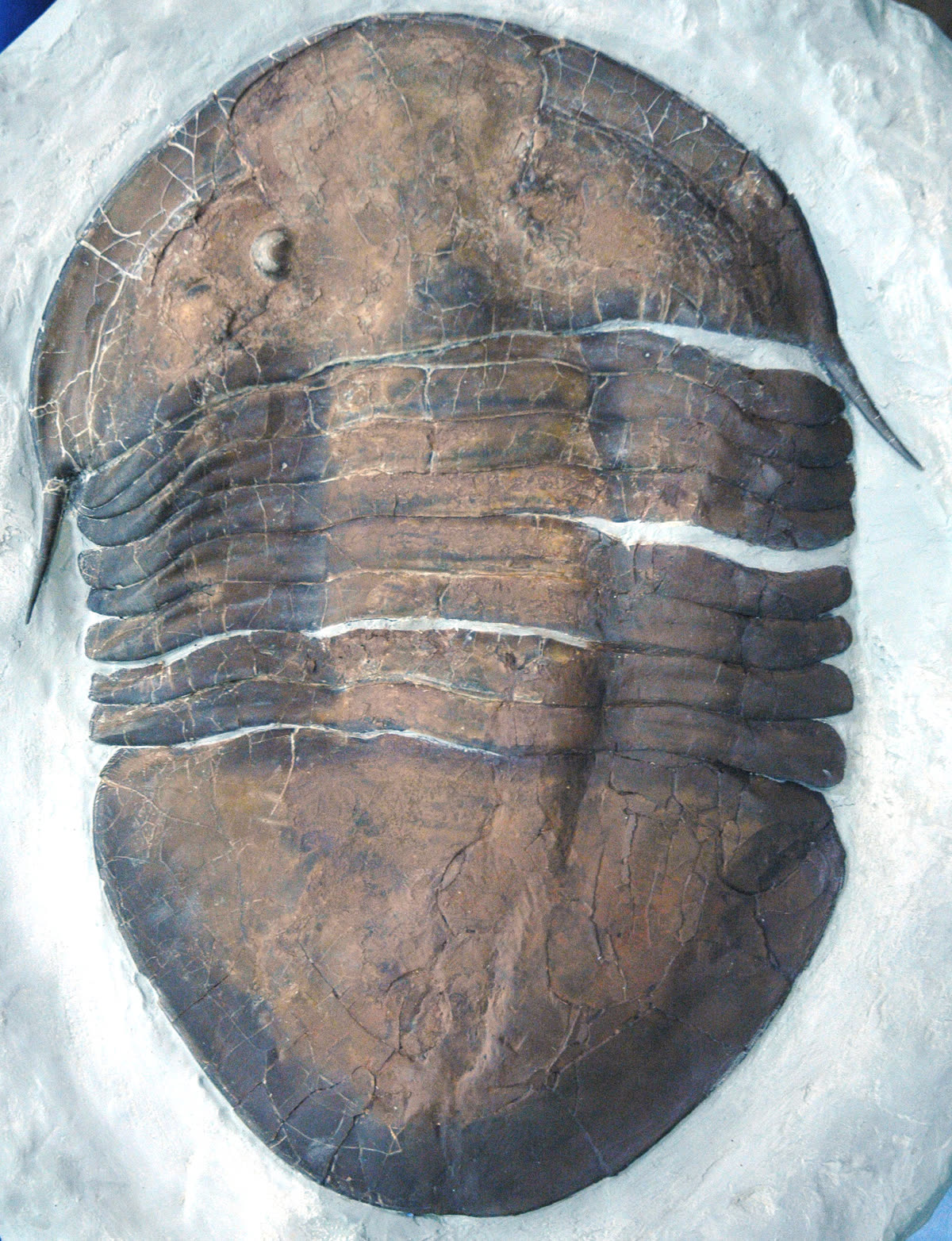
The Atlas of Ordovician Life describes Isotelus as a large asaphid trilobite with an oblong carapace, broad axial lobe, prominent eyes, eight thoracic segments, and a pygidium that can approach the cephalon in size.[3] Those details make the animal feel less like a segmented pill bug and more like a living shield. The head and tail are not tiny end pieces attached to a long wormlike middle. They are broad plates in a flattened animal whose outline spreads across the sediment.
That body plan helps explain why size alone is an incomplete story. A long trilobite can be long in many ways: spined, narrow, arched, rolled, or shieldlike. Isotelus is compelling because its size is carried through a low-level, benthic design. The Atlas identifies the genus as a fast-moving, low-level, epifaunal deposit feeder.[3] That ecological phrase is less dramatic than "king of trilobites," but it is more useful. It places the animal on and just above the seabed, where feeding, movement, burial, and sediment contact all shape anatomy.
The broadness also changes how the fossil should be read. A museum visitor sees a large oval body and may assume the animal is simply "complete." A paleontologist sees a dorsal exoskeleton that survived because trilobites mineralized the upper side of the body, while legs, gills, gut, and other softer structures usually required rarer preservation pathways.[4] The fossil is therefore both generous and selective. It gives the shield beautifully; it withholds much of the living underside.
The underside may be the key
One of the most interesting features of Isotelus sits not in the headline size but in the surfaces that touched sediment. The Atlas notes conspicuous terrace lines on parts of the underside, including the doublure, labrum, and genal spines, and cites the interpretation that such lines in benthic trilobites probably helped stabilize the animal during feeding by gripping sediment at the margins of the exoskeleton.[3] That is a small anatomical clue with large ecological force.
If those lines helped the animal hold position, then Isotelus becomes easier to imagine as a working seafloor machine. The shield was not merely armor. The margin may have helped the animal brace, probe, feed, or resist being shifted while interacting with soft bottom sediment. The body becomes less like a passive cap and more like a low platform for controlled contact with the substrate.
That view also keeps the animal from being over-romanticized. Isotelus was not the trilobite version of a cruising shark. It belonged to a marine arthropod world in which feeding could be slow, close, and sediment-mediated. Deposit feeding does not mean dull feeding. It means the animal's life depended on sorting edible material, moving across bottom surfaces, and using its body plan to manage the physics of soft ground.
Why Isotelus rex is more than a record holder
The Manitoba specimen is still the unavoidable climax. Rudkin, Young, Elias, and Dobrzanski described Isotelus rex as a new species from Upper Ordovician nearshore carbonates of northern Manitoba, with the holotype exceeding 700 millimeters in length.[1] Their abstract emphasizes that this was almost 70 percent longer than the largest previously documented complete trilobite and provided clear evidence that trilobites could exceed half a meter in maximum length.[1] The Manitoba Museum identifies that type specimen, MM I-2950, as the world largest trilobite in its paleontology collections and notes that it was collected near Churchill in 1998.[2]
Those are the trophy facts. The scientific value begins after them. The 2003 paper did not treat I. rex as a freak isolated from environment. It placed the animal in nearshore carbonates of the Churchill River Group and discussed low-latitude gigantism, shallow furrowing, probing, predation, and scavenging as part of its possible benthic ecology.[1] That interpretation is exactly why Isotelus works as a species profile. A giant fossil becomes stronger when the giant body is tied back to habitat and behavior.
The largest trilobite was not simply large because evolution likes records. It was large inside a particular Ordovician marine setting, with a shape that still makes sense against the seabed. The contrast with many modern examples of polar gigantism in benthic arthropods made the paper's low-latitude example especially striking.[1] Even if readers do not carry that biogeographic comparison around afterward, the boundary should stick: size is not a free-floating trait. It has to be paid for with ecology.
Smooth fossils can hide sharp questions
There is a reason Isotelus can look less exciting than a spiny Devonian trilobite in a display case. Its smoothness reads as simplicity. But smooth does not mean biologically empty. The combination of broad plates, prominent eyes, eight thoracic segments, a large pygidium, terrace-lined underside structures, and large adult size makes the genus a good test of how much paleontology can infer from external skeletal architecture.[3][4]
It also makes the image choice important. The photographed Isotelus maximus fossil from southwestern Ohio is about 40 centimeters long and shows a large holaspid with visible damage around the right eye area, according to the Wikimedia file description.[5] This is not the Manitoba I. rex holotype, and the article should not pretend it is. It is useful because it shows the genus in real fossil form: broad, flattened, shieldlike, and large enough to make the body plan legible without artwork.
That visual restraint matters. A reconstruction might make Isotelus feel faster, stranger, or more charismatic than the fossil record can support. A real fossil photograph forces the profile back to the evidence that usually survives: shield outline, segment pattern, head and tail proportions, and the absence of the soft underside. The animal becomes more interesting when the missing parts remain visible as missing.
The record is not the lesson
The cleanest way to remember Isotelus is this: it is a trilobite whose fame starts with size but whose importance sits in the relationship between size, sediment, and a broad benthic body. I. rex earns the record-book line, but the genus earns attention because its anatomy makes large Ordovician seafloor life feel mechanically specific.[1][3]
That is a better ending than "the biggest trilobite ever." It leaves room for the animal as an animal: an extinct marine arthropod moving over Paleozoic bottom sediment, seeing through prominent eyes, carrying a calcite shell, gripping and probing the substrate, and leaving behind a dorsal architecture that is clear enough to study yet incomplete enough to demand caution. Isotelus is not only big. It is big in a way that makes the seafloor visible.
Sources
- David M. Rudkin, Graham A. Young, Robert J. Elias, and Edward P. Dobrzanski, "The world's biggest trilobite--Isotelus rex new species from the upper Ordovician of northern Manitoba, Canada," Journal of Paleontology 77, no. 1 (2003), Cambridge Core record.
- Manitoba Museum, "Palaeontology & Geology Museum in Winnipeg - Minerals, Rocks, and Fossils Collections" - collection note on Isotelus rex type specimen MM I-2950.
- Digital Atlas of Ordovician Life, "Isotelus" - morphology, identification features, and paleoecology summary.
- Australian Museum, "What are trilobites?" - overview of trilobite body plan, arthropod placement, and calcite exoskeleton.
- Wikimedia Commons, "File:Isotelus maximus fossil trilobite (Upper Ordovician; southwestern Ohio, USA) 1 (15076169569).jpg" - source page for the real fossil photograph used as the article image.