The Doushantuo embryo-like fossils are strongest when they are read as a preservation problem before they are used as an origin story. A round object with cell-like divisions can look instantly biological, even intimate: a tiny body at the beginning of animal life. But the Doushantuo record is more interesting, and more demanding, than that. It asks whether phosphate minerals captured developmental anatomy, whether similar forms might instead belong to non-animal eukaryotes, and how far paleontologists can push cellular preservation before interpretation outruns the fossil.[1][2][3][4]
The setting matters. The Doushantuo Formation of South China sits in the Ediacaran, after the great Cryogenian glaciations and before the Cambrian fossil record becomes crowded with larger, harder, and easier-to-place animals. U-Pb dating of volcanic ash beds brackets the formation from about 635 to 551 million years ago, while Condon and colleagues argued that the spectacular fossil material is mostly younger than 580 million years.[5] That places the fossils in exactly the interval where any credible sign of animal development feels consequential.
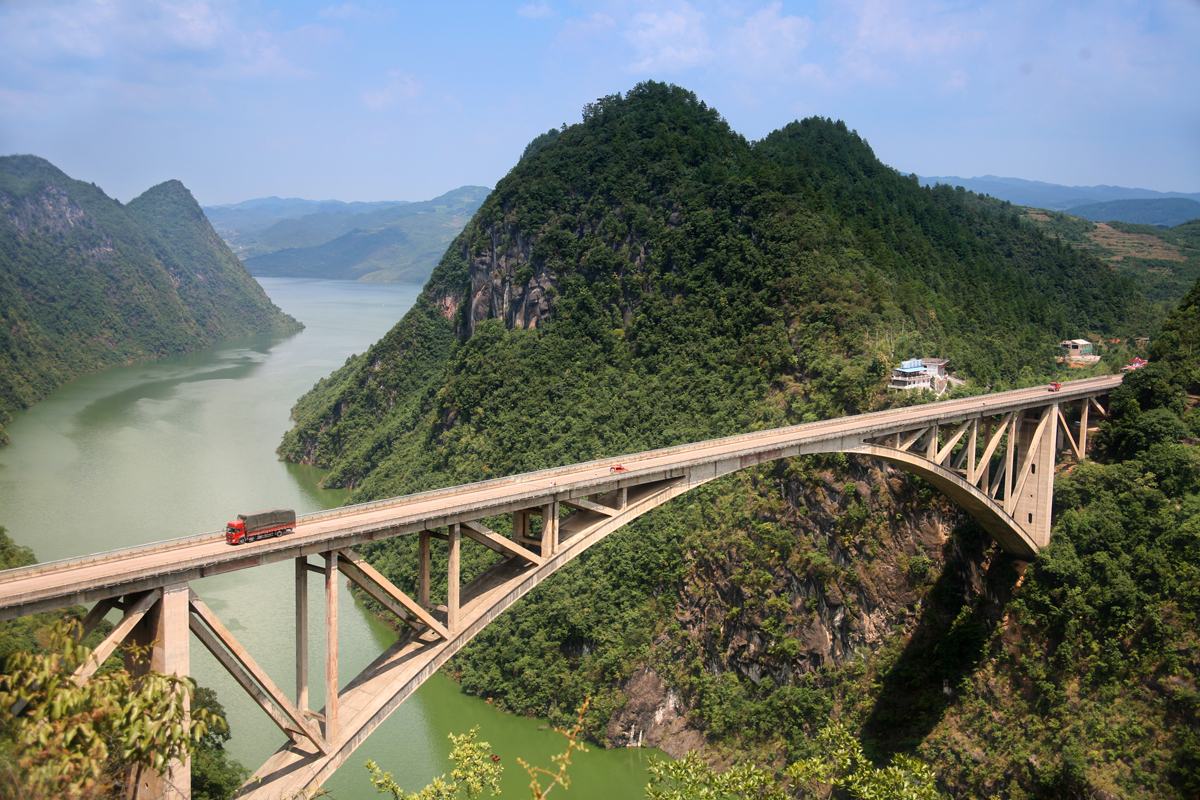
The lead image now keeps the excitement under control in a different way. It shows Weng'an County landscape rather than a microscope panel, life reconstruction, map, or diagram. That choice fits the active feed's immersive image rule while still pointing toward the material setting of the argument: the South China terrain and phosphorite beds that made cellular-grade preservation possible. The fossil itself remains a matter for the sources and the text, where mineral replacement, wall structure, and comparative biology carry more weight than visual drama.[2][3][6]
The fossil is tiny, but the claim is large
The 1998 Nature paper by Xiao, Zhang, and Knoll made the Doushantuo material famous because it reported three-dimensional preservation of algae and animal embryos in Neoproterozoic phosphorite.[1] That combination was the shock. These were not flattened impressions like many Ediacaran macrofossils. They were mineralized microscopic bodies that could preserve internal organization in a way paleontologists could section, image, and compare.
Xiao and Knoll's later Journal of Paleontology treatment of the Weng'an material sharpened the claim around phosphatized animal embryos from Guizhou.[2] The fossils were read through cleavage-stage geometry: round bodies divided into cell-like compartments, sometimes with patterns suggestive of early embryonic development. If that interpretation held, the fossils would push recognizable animal developmental evidence deep into the Ediacaran, well before the Cambrian's more familiar shells, tracks, and articulated bodies.
That is why the Doushantuo fossils became tempting shorthand for "earliest animals." But shorthand is exactly what the fossils punish. A sphere divided into smaller units is not automatically an animal embryo. It has to be separated from algal reproductive stages, cysts, protists, bacterial lookalikes, mineral artifacts, and decay experiments. The fossil can be beautiful and still not be self-explanatory.
Phosphate is the co-author
Doushantuo-type preservation matters because phosphate can mineralize soft biological structures early enough to retain microscopic detail. The fossil is therefore not only an organismal record. It is also a chemical event. The biology had to be present, but the sediment-water chemistry and microbial conditions had to turn fragile tissue into apatite before collapse and decay erased the evidence.[1][2]
That is the first boundary a close reading should protect. The fossil does not simply "show cells" in the ordinary sense. It shows mineralized traces interpreted as cellular or subcellular structures. That distinction is not pedantry. In deep time, the route from living cell to fossil texture is full of filters: decay, mineral nucleation, compaction, diagenesis, and later imaging choices.
The preservation route also explains why Doushantuo is both powerful and dangerous as evidence. It preserves detail at a scale that most Ediacaran deposits cannot. But because the fossils are microscopic and development-like, relatively simple geometries can carry too much interpretive weight. A clean spherical boundary, repeated internal partitions, or dark inclusions may strengthen an embryo reading only when they fit a broader pattern of wall structure, growth sequence, and comparison with living organisms.[3][4]
The cyst changed the argument
The 2007 Nature paper by Yin and colleagues argued that some Doushantuo embryo-like fossils were preserved inside diapause egg cysts.[3] That was an important move because the enclosing wall shifted the debate from "round clusters in phosphate" to a more specific biological package: embryo-like bodies within ornamented organic vesicles. In their reading, the cyst context supported a eukaryotic organism and made an early-cleavage embryo interpretation more plausible.[3]
The most important image in that interpretive world is the fossil wall itself, even though the active article no longer leads with a micrograph. The outer acritarch-like wall is not a decorative border; it is part of the evidence. If the internal body is treated as an embryo, the wall helps explain why it might have been preserved and what kind of life stage it represents. The fossil becomes less like an isolated cell cluster and more like a developmental object caught inside a protective resting structure.[3]
Even then, the phrase "animal embryo" remains a hypothesis with boundaries. The fossil may preserve developmental stages, but it does not hand over an adult animal with diagnostic organs. There is no little bilaterian body waiting inside the wall, no mouth, gut, limbs, or nervous system visible enough to settle the tree position. The cyst strengthens the biological reading, but it does not remove the need for caution about affinity.
Later work made the story less simple, not less useful
The most useful Doushantuo story is not a march from discovery to certainty. It is a tightening of questions. In 2014, Huldtgren and colleagues described cell differentiation and germ-soma separation in Ediacaran animal embryo-like fossils.[4] Their work pushed the discussion beyond crude resemblance by looking at developmental organization and internal differentiation. That kind of claim is stronger than "it looks like an embryo," because it asks whether the fossil records a biological process.
At the same time, the broader debate around Doushantuo has repeatedly shown how difficult these objects are. Some embryo-like fossils have been compared with encysting protists or other non-animal eukaryotes. Other Doushantuo microfossils once assigned near animals have later been reinterpreted. The lesson is not that the fossils are useless. The lesson is that cellular-grade preservation does not automatically solve affinity. It gives paleontologists sharper evidence and sharper ways to be wrong.
That tension is the scientific value. A weak fossil would leave no testable structure. Doushantuo does the opposite. It preserves enough organization to let researchers ask whether there are cleavage patterns, cyst walls, nuclei-like bodies, germ-soma separation, or developmental sequences. Then each claim can be tested against decay, mineralization, modern analogs, and other fossils from the same deposits.[1][3][4]
What the close reading allows
Read carefully, the Doushantuo embryo-like fossils do not need to be turned into a simple "first animal" trophy. Their importance is more durable if it stays tied to method. They show that Ediacaran phosphorites can preserve microscopic biological structure in three dimensions. They show why developmental stages may enter the fossil record more easily than adult soft bodies under certain chemical conditions. They show how a fossil can be highly informative and still taxonomically unresolved.[1][2][5]
They also change the emotional scale of animal origins. The usual Cambrian story is crowded with shells, limbs, burrows, eyes, and predators. Doushantuo pulls the question inward, toward resting cysts, cell division, and mineralized interiors. The drama is not a large animal moving through an ecosystem. It is a fossil so small that its meaning depends on whether a wall is biological, whether a partition records cleavage, and whether a dark inclusion is anatomy or alteration.
That is why the Doushantuo fossils still matter. They make early animal history harder, not easier. They refuse a clean slogan while preserving evidence too rich to ignore. The best claim is therefore narrow but powerful: Doushantuo does not simply show where animals began; it shows that the origin of animals can only be read through the chemistry of preservation, the biology of development, and the discipline to keep an embryo-like fossil from becoming more certain than the rock allows.
Sources
- Shuhai Xiao, Yun Zhang, and Andrew H. Knoll, "Three-dimensional preservation of algae and animal embryos in a Neoproterozoic phosphorite," Nature 391 (1998).
- Shuhai Xiao and Andrew H. Knoll, "Phosphatized animal embryos from the Neoproterozoic Doushantuo Formation at Weng'an, Guizhou, South China," Journal of Paleontology 74 (2000), Cambridge Core PDF.
- Zongjun Yin et al., "Doushantuo embryos preserved inside diapause egg cysts," Nature 446 (2007).
- Therese Huldtgren et al., "Cell differentiation and germ-soma separation in Ediacaran animal embryo-like fossils," Nature 516 (2014).
- Daniel Condon et al., "U-Pb ages from the Neoproterozoic Doushantuo Formation, China," Science 308 (2005), PubMed record.
- Wikimedia Commons, "Jiangjie River Bridge - panoramio.jpg," Weng'an County contextual landscape used as the article image.