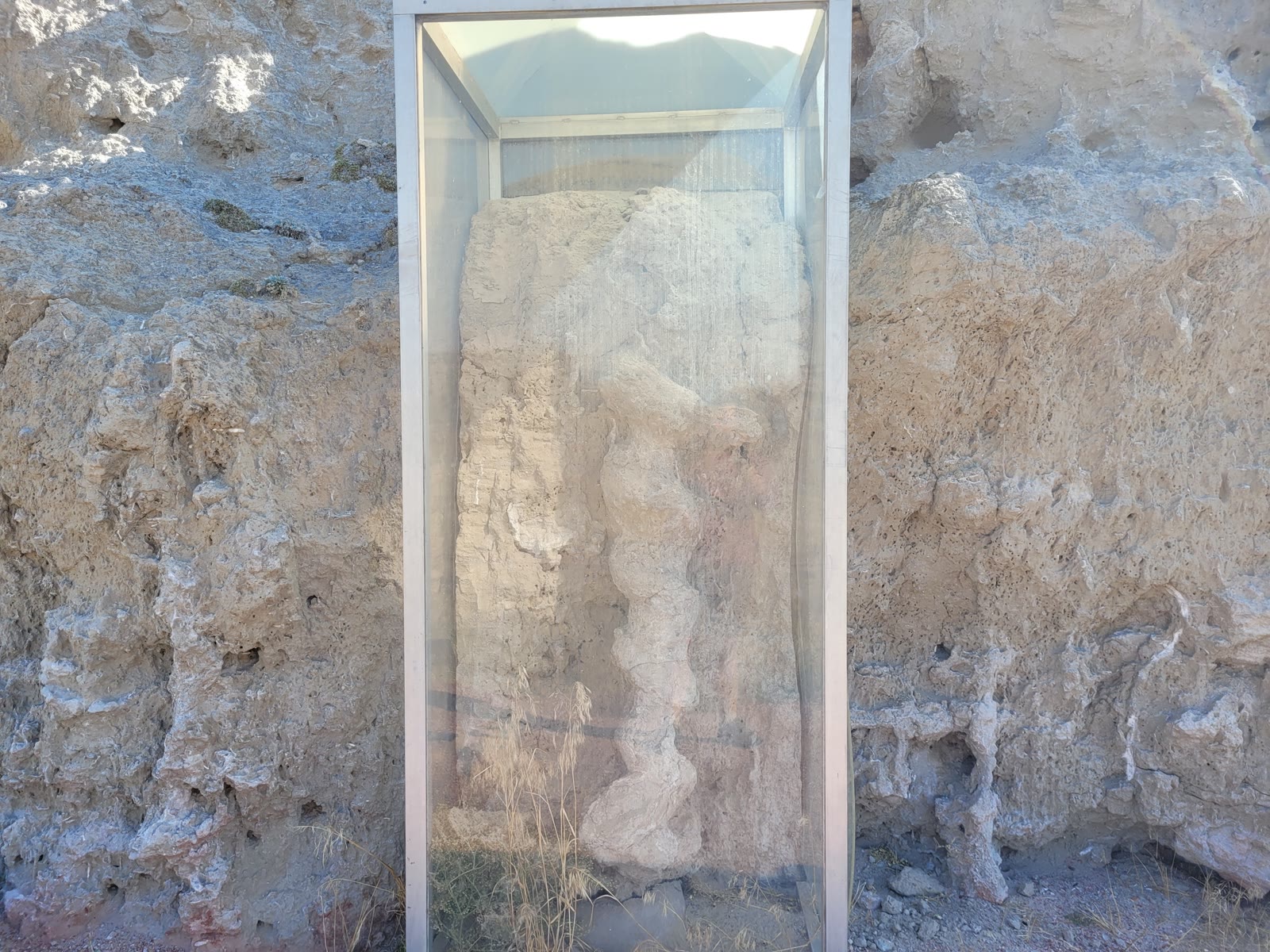
Behind glass on the Daemonelix Trail in northwestern Nebraska, a pale column turns through the rock like an auger stopped mid-stroke. It has no skull, shell or leaf to announce what kind of fossil it is. The form is an absence made solid: the path an animal excavated through Early Miocene ground, later filled and mineralized strongly enough to outlast the softer sediment around it.[1][2]
The local name, Devil’s Corkscrew, captures both the geometry and the original bewilderment. When Erwin H. Barbour began excavating the structures at Agate in 1891–92, he considered a giant freshwater sponge and then a plant with an enormous coiled root system. Plant tissue really did occur inside and around the spirals. Other paleontologists argued almost immediately that the objects were burrow casts. Then skeletons of a small extinct beaver, Palaeocastor, began appearing in their lower chambers.[1][3]
That association solved the largest mystery: these particular corkscrews record mammalian behavior. It did not solve every mystery. The fossil identifies a builder and preserves parts of the building process much more securely than it identifies the evolutionary reason for building a helix. More than a century after the root debate, the most interesting question has moved from “plant or burrow?” to “which claims can a burrow actually carry?”
A fossil of occupied space
The Agate corkscrews occur in the Harrison Formation, deposited roughly 20–23 million years ago in a seasonally dry, upland setting. Fine sediment accumulated across a landscape of paleosols, dunes and broad sandy drainage systems rather than on the bottom of the deep lake Barbour imagined. The park’s larger bonebeds preserve rhinos, camel relatives, chalicotheres and other mammals, but Daemonelix records something different: an animal repeatedly modifying the ground while alive.[1][2][3]
The name itself needs a boundary. Historical literature alternates Daimonelix and Daemonelix, and Barbour applied it to a mixed assortment that included genuine burrows as well as structures of plant or mineral origin. The Kansas Geological Survey therefore treats the old generic usage as obsolete and separates the beaver burrows from actual roots and caliche stringers once gathered under the same label.[6] This article follows the National Park Service spelling for the spiral Palaeocastor burrows at Agate, not for every object ever called a Devil’s Corkscrew.
A trace fossil does not normally name its maker as confidently as a skeleton names an animal. Similar shapes can be produced by unrelated organisms, and one animal can leave several kinds of traces. A body inside a tunnel is stronger evidence, but even that association needs testing: an animal may occupy an abandoned burrow, fall into it or enter as a predator. The Agate interpretation became persuasive because several lines converge rather than because one beaver happened to lie at the bottom.
The root hypothesis failed in layers
Barbour had not invented the plant tissue. Roots invaded the burrow walls after excavation, and their presence made the coiled object look botanical. What changed the reading was the order of events.
First came the architecture: a regular descending helix connected to an inclined chamber, a layout more readily explained as a route through sediment than as a taproot. Then came repeated skeleton associations. In 1904, Carnegie Museum paleontologist Olaf Peterson recovered a small rodent skeleton inside a corkscrew; other specimens put the same kind of animal in comparable positions. Finally, burrow dimensions and surface marks could be compared with the animal itself.[1][3]
Larry Martin and Deb Bennett’s 1977 study tied a large sample of the Harrison Formation structures to Palaeocastor fossor using incisor widths and mean shaft diameters. It also interpreted the deposit as a semiarid upland habitat and showed that rapid silicification of roots invading the abandoned or occupied tunnels helped preserve the burrows in exceptional relief.[3] The feature that had seemed fatal to the animal hypothesis—plant material inside the spiral—became part of the taphonomic explanation.
That reversal is more instructive than a simple story of one scientist being wrong. Barbour correctly observed roots but placed them too early in the sequence. The burrow was excavated; roots entered its comparatively moist, disturbed margins; silica mineralized that root network; later erosion exposed the resistant structure. A fossil can preserve several organisms and several moments in one shape. Identification depends on deciding which feature made the original space and which features arrived afterward.
The beaver fits the work
Palaeocastor was a beaver, but not a dam-building version of the living genus Castor. It belonged to an extinct radiation of dry-land, burrowing castorids. At Agate, the animal’s long curved incisors and powerful, clawed forelimbs fit a division of labor in which teeth cut soil and forelimbs shifted the loosened material. A recent comparison of helical burrow makers likewise treats Palaeocastor excavation as relying primarily on incisors and claws—an ecology closer to subterranean rodents than to the familiar lodge builder.[1][5]
Fit is not the same as a filmed act. Paleontologists do not see a Miocene beaver cutting one complete spiral. They infer construction from the repeated body–burrow association, the match between animal and shaft, the marks left on the burrow surface, and a skull and forelimb capable of doing the proposed work. Each strand has alternatives; together they make Palaeocastor the far better builder than a plant, sponge or accidental occupant.[1][3]
Dense clusters add an ecological clue. The National Park Service compares the concentrations to prairie-dog towns and describes the beavers as living in communities.[1] The spatial pattern securely shows that many burrows occupied selected patches of the ancient landscape. It is weaker evidence for a particular social system. Burrows could accumulate through time, and proximity does not by itself reveal cooperation, kinship or simultaneous residence. The trace preserves neighborhood before it preserves society.
The helix is evidence before it is an explanation
Once the builder is accepted, the corkscrew tempts a second overreach: every elegant shape seems to demand one elegant function. Explanations proposed for Daemonelix include keeping the chamber’s temperature and humidity steadier, resisting floodwater, frustrating predators, reducing interference among neighboring burrows, limiting falling sediment and making excavation mechanically easier. Several may have supplied benefits after construction. None is written directly into the stone.
A 2024 review surveyed helical burrowing across living animals and trace fossils, compiling ten functional hypotheses. It found no universal explanation. Antipredator and biomechanical advantages remained possible across the reviewed examples, while drainage, feeding and microbial-farming ideas failed across much of the sample. Crucially, the authors separated construction benefits—advantages while the tunnel is being dug—from post-construction benefits such as refuge or microclimate control.[4]
That distinction changes the question. A stable, humid chamber could be useful without humidity being the reason the spiral evolved. A helix may first arise because it changes how a small animal penetrates stiffening sediment or moves spoil, then acquire advantages as a dwelling. In evolutionary language, current usefulness need not identify historical origin.
A 2026 geometric study pushed the construction hypothesis further. It compared helical traces across marine and terrestrial settings and measured 34 photographed Daimonelix specimens from Agate-area collections. The authors argued that an inclined coiled path can reduce the sustained effort needed to penetrate and transport sediment while still gaining depth; a completed helix can then serve as a multipurpose refuge.[5]
The model is a proposal, not a recovered blueprint from a beaver’s nervous system. For Daimonelix, only a limited set of geometric parameters could be extracted from historical photographs. Original soil strength, moisture, excavation tempo and variation among individual builders are incompletely known. The analysis makes mechanical predictions sharper; it does not erase the microclimate or predator hypotheses, nor does it prove that one benefit alone selected the form.[4][5]
What the trail case really protects
The spiral behind glass is spectacular because it looks designed. Its scientific value lies in resisting the urge to turn design into a single story.
At the highest-confidence level, the Harrison Formation preserves repeated helical shafts leading to chambers in an Early Miocene terrestrial setting. At the next level, skeletons, dimensions, marks and digging anatomy identify Palaeocastor as the builder of the Agate examples. Taphonomy explains how secondary roots both confused the first diagnosis and helped the structure survive. Only then come the functional models: climate buffer, flood defense, predator obstacle, construction economy, or some combination that changed through the burrow’s use.[1][3][4][5]
The Devil’s Corkscrew was never merely a strange object. It is a sequence of actions preserved in the wrong material: an animal removed sediment, plants entered the space, minerals hardened the roots, and erosion revealed the architecture. A beaver at the bottom tells us who made the room. The spiral still asks why the route down turned.
Sources
- National Park Service, “Mammal Fossils,” Agate Fossil Beds National Monument (updated 2025)—discovery history, Palaeocastor anatomy, burrow form and park paleoecology.
- John Graham, Agate Fossil Beds National Monument: Geologic Resources Inventory Report, National Park Service (2009)—formation context, Miocene landscape, fossil localities and resource setting.
- Larry D. Martin and Deb Bennett, “The burrows of the Miocene beaver Palaeocastor, western Nebraska, U.S.A.,” Palaeogeography, Palaeoclimatology, Palaeoecology 22 (1977)—primary analysis of burrow dimensions, builder attribution, upland setting and root silicification.
- J. Sean Doody, Shivam Shukla and Stephen T. Hasiotis, “Why animals construct helical burrows: Construction vs. post-construction benefits,” Ecology and Evolution 14 (2024)—cross-taxon review of ten hypotheses and their evidentiary limits.
- Miquel De Renzi, Elena Mayoral and Francisco J. Rodríguez-Tovar, “The world of helical fossil and recent burrows: between geometry and engineering,” Journal of Iberian Geology (2026)—geometric analysis, Agate Daimonelix photo sample and energy-minimization model.
- Kansas Geological Survey, “Systematic Paleontology: ‘Daemonelix,’” Late Cenozoic Grasses and Other Angiosperms from Kansas, Nebraska, and Colorado (1978)—nomenclatural warning about the historically mixed structures assigned to the name.
- KoalVlachos, “Daemonelix Corkscrew,” Wikimedia Commons (photographed 2022)—source and licensing record for the real Agate Fossil Beds exhibit photograph used as the cover.