Inostrancevia looks built for the old poster version of paleontology: a long skull, blade-like canines, a low body, and enough menace to turn the late Permian into a monster gallery.[1][2] The better reading is less theatrical and more revealing. The animal matters because it arrived near the end of a system that was losing stability faster than its top predators could hold territory. In the Karoo Basin of South Africa, the 2023 description of Inostrancevia africana did not simply add a new saber-toothed species to the record. It exposed a sequence of apex-predator replacement during the Permian-Triassic crisis: local rubidgeine gorgonopsians declined, an inostranceviine lineage previously associated with Russia appeared in the role, and then gorgonopsians themselves disappeared as other carnivorous groups took over in rapid succession.[1][2]
That is why Inostrancevia deserves a lineage-context essay rather than another creature profile. A creature profile begins with the body and asks what made it impressive. The lineage view begins with turnover and asks why the body appears where it does. The answer is unsettling. Inostrancevia was not a triumphant export from one continent to another. It was a large predator occupying an opening created by ecological disruption, in a world where even the top carnivore slot had become temporary.[1][2][3]
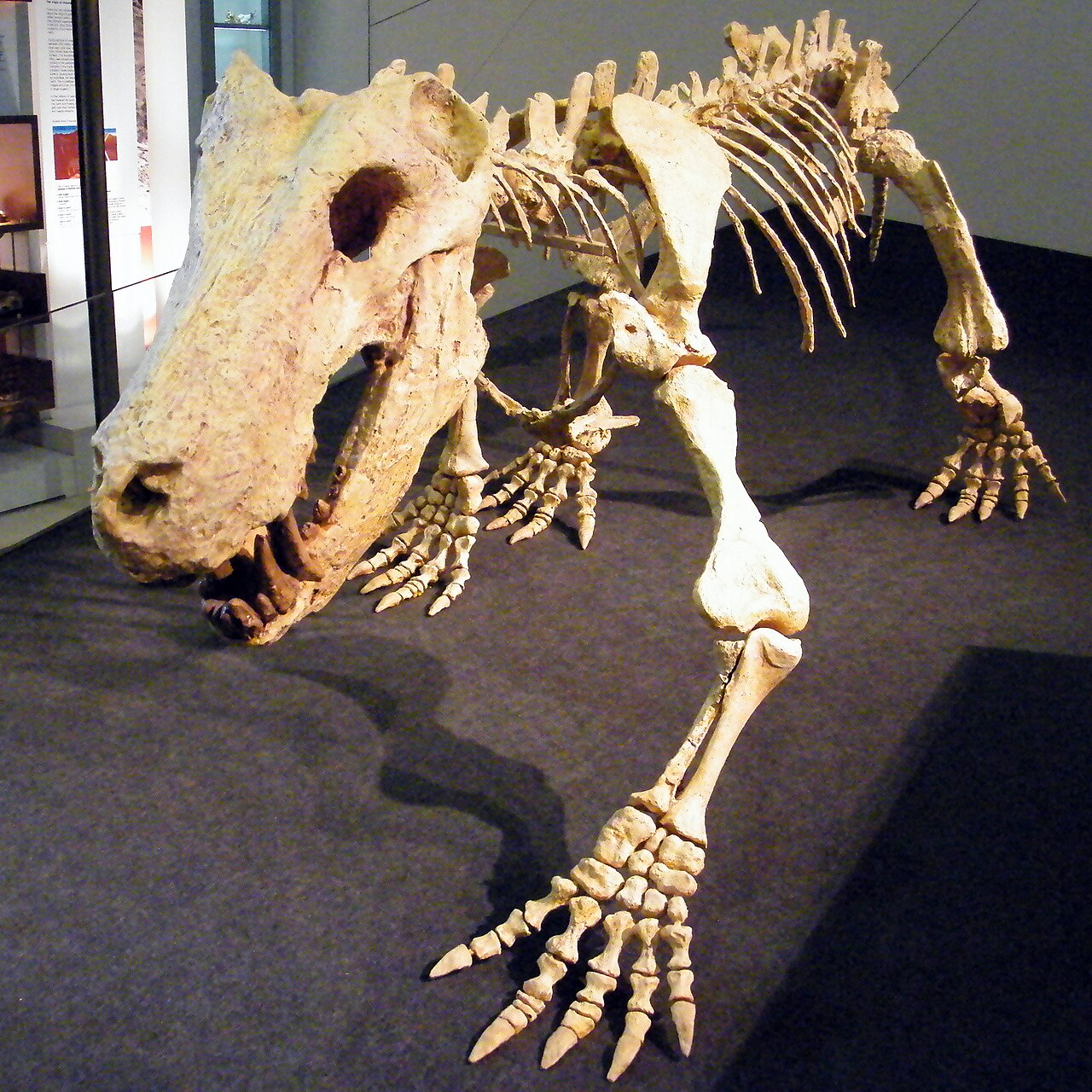
Image context: the lead image uses a real photographed skeletal mount of Inostrancevia from Wikimedia Commons. It belongs here because the visible canines explain why the animal is memorable, while the whole mounted body keeps the article from shrinking into tooth spectacle. This is a post about a predator's position in time, geography, and extinction dynamics.[5]
1) Gorgonopsians make the saber tooth older than the cats
The first useful reset is taxonomic. Inostrancevia was a gorgonopsian, part of a group of predatory therapsids on the mammalian side of amniote history rather than the dinosaur or lizard side.[2][3] Calling it a "saber-toothed mammal ancestor" can work as a headline if handled carefully, but it can also smuggle in the wrong picture. This was not a cat before cats. It belonged to a much older synapsid world, where the mammalian line was still far from crown mammals and where late-Permian terrestrial ecosystems were organized around herbivorous dicynodonts, therocephalians, cynodonts, and gorgonopsian predators.[1][3]
That older setting matters because the saber tooth is a recurring solution, not a single inheritance. The Natural History Museum's summary of the 2023 work emphasizes that gorgonopsians were among the first known saber-toothed animals, long before unrelated mammalian saber-tooth experiments appeared later in the Cenozoic.[2] The canines therefore show convergence before they show familiarity. Long stabbing teeth can evolve wherever predator-prey mechanics reward a wide gape, controlled strike, and a skull built around canine deployment. In Inostrancevia, those teeth sit in a late-Permian therapsid package, not in a modern carnivoran one.[1][2]
This prevents a common mistake. If the animal is treated as a prehistoric big cat substitute, its real significance gets flattened. The better question is why a gorgonopsian with such a northern phylogenetic signal turns up in the latest Permian of southern Africa. That is where anatomy stops being the whole story and biogeography takes over.[1][3]
2) The Karoo record turned a Russian-looking predator into a crisis signal
Before the 2023 paper, Inostrancevia was strongly associated with Russia.[1][2] The Karoo fossils changed that geography. Kammerer, Viglietti, Butler, and Botha identified gigantic latest-Permian gorgonopsian material from Nooitgedacht 68 in South Africa as Inostrancevia, a taxon the paper describes as previously thought to be Russian endemic.[1] The important part is not only that the range expanded. The important part is when the expansion becomes visible.
The paper's argument is ecological. The largest African gorgonopsians, the rubidgeines, appear to have been early victims of ecosystem disruption before the main Permian-Triassic boundary interval, leaving an apex-predator role open in the Karoo.[1] Inostrancevia then appears as an immigrant inostranceviine filling that role for a short interval.[1][2] In other words, the fossil does not document a stable predator radiation marching confidently across Pangaea. It documents replacement under stress.
That makes the animal a much better extinction fossil than a trophy fossil. The dramatic canines are visible in the mount, but the deeper evidence comes from stratigraphy and faunal context. A top predator is normally expected to be vulnerable when prey bases, climate, vegetation, and habitat structure are all shifting. The 2023 study reads the Karoo sequence in exactly that register: large predators were early indicators of ecosystem destabilization, and the apex niche itself became unstable.[1]
3) The "global" turn was real, but the map now looks messier
The 2025 Mozambique paper complicates the story in a productive way. Macungo, Benoit, and Araujo described diagnosable gorgonopsian remains from the K6a2 Member of the K6 Formation in the Metangula graben of northern Mozambique and referred the specimen to Inostrancevia africana.[3] Their paper emphasizes that this was the first diagnosable gorgonopsian from that basin and that the new occurrence helps correlate the member with the Daptocephalus Assemblage Zone of the Karoo Basin.[3]
For the lineage story, the most useful point is broader. The authors argue that inostranceviines were long unrecognized on the African continent and that Inostrancevia may have reached southern Africa earlier than the 2023 turnover model originally suggested.[3] That does not make the 2023 predator-turnover argument collapse. It makes it more textured. Instead of a single dramatic arrival exactly when a niche opened, the evidence now permits a wider African presence whose ecological visibility sharpened during crisis.
This is how paleontology often improves. A clean narrative appears first because the available record is thin. Then a new partial skull, a new basin, or a better correlation adds grain. The strongest current reading is therefore layered: Inostrancevia connects northern and southern faunas; its African record is broader than first recognized; and its late-Karoo prominence still matters because the top-predator role was being repeatedly vacated and refilled near the end of the Permian.[1][3]
4) The predator seat changed faster than the predators could stabilize it
The most striking claim in the 2023 work is not the migration by itself. It is the pace of role replacement. The paper identifies a succession around the Permian-Triassic mass extinction in which rubidgeine gorgonopsians, inostranceviine gorgonopsians, akidnognathid therocephalians, and proterosuchid archosauriforms passed through large-predator roles in a short geological span.[1] The Natural History Museum's account quotes the authors' framing of multiple apex-predator shifts in less than two million years.[2]
For a human reader, two million years sounds immense. In deep-time ecosystem terms, repeated turnover of the top carnivore slot across major clades is a sign of violence in the system. Apex predators require prey supply, territory, reproductive continuity, and enough environmental predictability for specialization to pay. When that role keeps changing hands, the food web is not merely losing species. It is losing its ability to keep a stable hierarchy.
This is the best way to read Inostrancevia. The animal's presence in South Africa is not a happy tale of cosmopolitan success. It is evidence that Pangaea could still move bodies and lineages across large distances, while the end-Permian world was making those movements look less like expansion and more like scramble. The predator could reach the opening. The opening could not remain durable.[1][2][3]
5) The extinction boundary remains part of the caution
Gorgonopsian survival into the earliest Triassic has been debated because a few South African specimens were historically reported from Triassic Lystrosaurus assemblage contexts.[4] That debate matters because it changes the ending. If gorgonopsians lingered after the boundary, then Inostrancevia would be part of a battered clade with a short post-extinction shadow. If those reports fail under reappraisal, then the clade's disappearance remains more tightly tied to the end-Permian crisis itself.
The 2024 reappraisal by Benoit and colleagues is useful here because it keeps the boundary disciplined. It revisits three reported Triassic gorgonopsian specimens from the Karoo and treats the survival claim as a specimen-by-specimen problem rather than as folklore about "dead clades walking."[4] For this article's purpose, the caution is enough: Inostrancevia should not be turned into a survivor myth. The strongest evidence still places it inside the late-Permian turnover story, where gorgonopsians briefly reshuffled before vanishing from the terrestrial predator record.[1][3][4]
That boundary also protects the animal from the opposite simplification. Inostrancevia was not irrelevant because it lost. Extinction does not erase ecological meaning. The fossil is important precisely because it records a top predator in a fragile interval: large enough to occupy the apex role, mobile or widespread enough to complicate old provincial maps, and doomed enough to show how severe the crisis had become.[1][3]
6) What Inostrancevia can now carry
The best current reading of Inostrancevia keeps three scales together. At body scale, it was a large saber-toothed gorgonopsian, part of a much older synapsid experiment in predatory anatomy.[1][2] At map scale, it links Russian, South African, Tanzanian, and Mozambican evidence into a broader late-Permian inostranceviine distribution than older accounts allowed.[1][3] At ecosystem scale, it marks a period when the apex-predator role in African terrestrial faunas changed hands rapidly as the Permian-Triassic crisis unfolded.[1][2][4]
That combination is why the mounted skeleton should be read with restraint. The canines make Inostrancevia spectacular, but spectacle is only the entry point. Its real force is contextual. The animal shows that the end-Permian crisis did not merely remove old lineages at a final boundary. It destabilized roles before the last cut arrived. A predator could look perfectly equipped and still be standing in a collapsing job.
Sources
- Christian F. Kammerer, Pia A. Viglietti, Elize Butler, and Jennifer Botha, "Rapid turnover of top predators in African terrestrial faunas around the Permian-Triassic mass extinction," Current Biology 33:11 (2023).
- James Ashworth, "New sabre-tooth reveals 'unprecedented' impact of largest ever extinction," Natural History Museum, 26 May 2023.
- Zanildo Macungo, Julien Benoit, and Ricardo Araujo, "Inostrancevia africana, the first diagnosable gorgonopsian (Therapsida, Synapsida) from the Metangula graben (Mozambique)," Swiss Journal of Palaeontology 144:12 (2025).
- Julien Benoit et al., "Did gorgonopsians survive the end-Permian 'Great Dying'? A re-appraisal of three gorgonopsian specimens..." Palaeogeography, Palaeoclimatology, Palaeoecology 638 (2024).
- Wikimedia Commons file page for the photographed Inostrancevia skeletal mount used as the lead image.