Dinosaur footprints are seductive because they look like signatures. A skeleton usually arrives broken, incomplete, and anatomically mediated; a footprint seems to arrive as contact, one instant in which an extinct animal touched the ground and left a direct message behind. That intuition is partly right, but only partly. A footprint is direct evidence of motion, yet it is not a perfect stamp of anatomy. It is an interaction between a moving foot and a changing surface, and that surface can record, blur, exaggerate, or redistribute the signal before the rock hardens.[1][3][4]
That is why trackways are often more informative than a single spectacular print. The strongest paleontological value of footprints usually lies in sequence, spacing, depth pattern, and substrate context. Tracks can tell us about gait, pace, posture, and directional change because they preserve motion in progress, but they are often weaker than museum labels imply when asked to identify an exact species from one impression alone.[1][4] Good ichnology begins by lowering the temperature of the species question and raising the temperature of the sediment question.
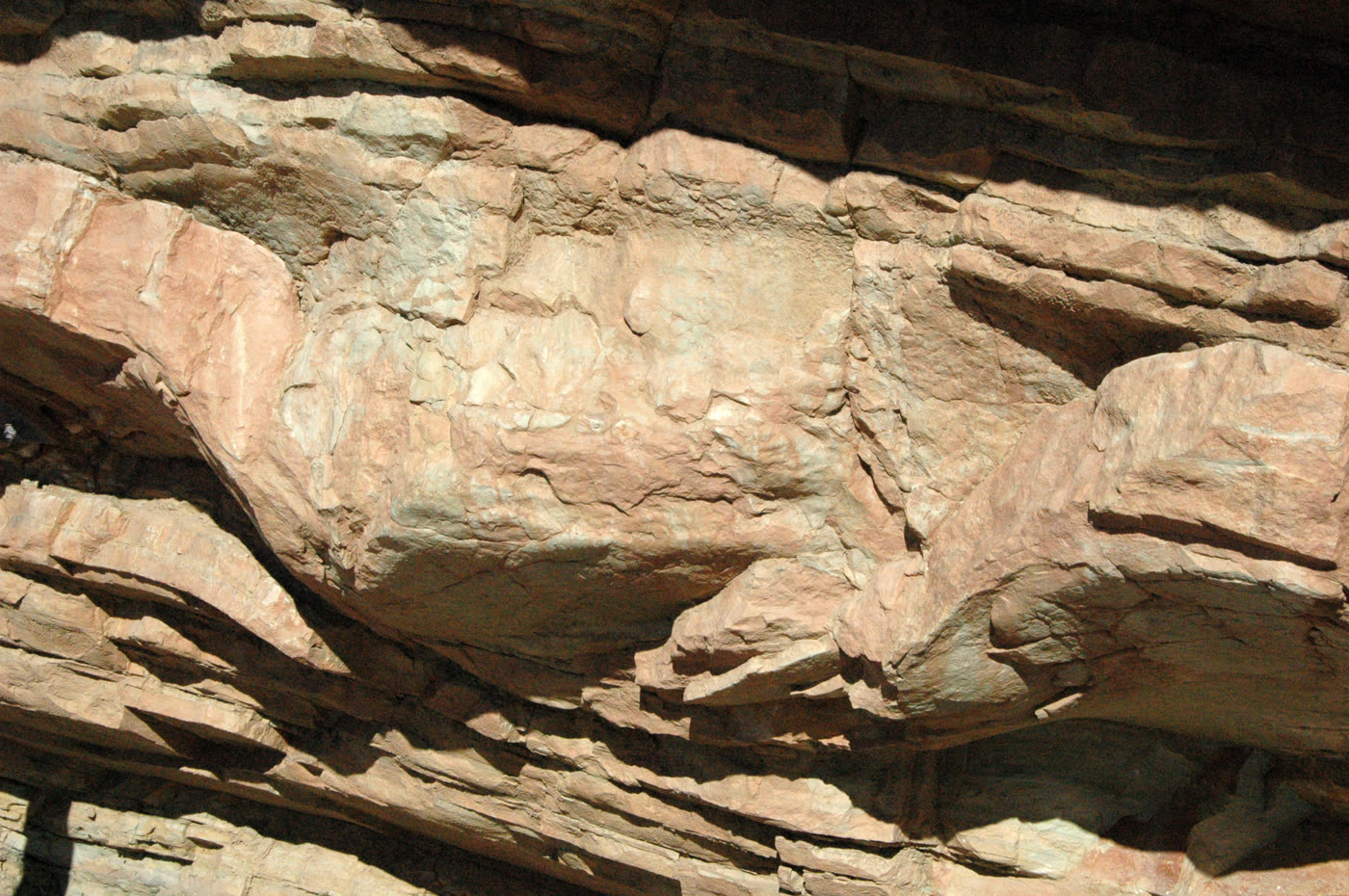
Image context: the cover image is a real photograph of a sauropod footprint from Dinosaur Ridge in Colorado, hosted on Wikimedia Commons. It fits this article because the point is not to use the print as a mascot for a named dinosaur. It is to keep the surface itself in view long enough to ask what part of the mark belongs to the foot, what part belongs to the substrate, and what part belongs to the whole step sequence around it.[6]
A footprint is a surface event with depth underneath it
The Natural History Museum's footprint explainer makes the first distinction clearly: the place where the foot directly impacts the ground is the true track, while sediment compression below that level can produce undertracks or transmitted structures that echo the step without preserving the same anatomy.[1] That sounds technical, but it changes how a reader should look at almost every famous dinosaur print. What appears to be a clean outline may already be a layered product of pressure, slumping, and transmission through wet sediment.
This is why footprints are not just fossils of shape. They are fossils of deformation. Ellis and Gatesy's 2013 X-ray study states the problem directly: tracks arise through a complex interplay between animal and substrate, and the ichnological record preserves only the final snapshot of that process.[3] A foot plunges in, moves through mud, withdraws, and leaves the sediment to settle afterward. The finished rock is therefore the end state of a dynamic event, not a freeze-frame cut straight from the animal's skin.
That boundary matters most when tracks are deep. Under those conditions, the relationship between foot motion and final morphology becomes harder, not easier, to read.[3] A dramatic print can look more informative than a shallow one because it shows more relief. In methodological terms, the opposite may be true. Deep tracks often record more substrate behavior, which means the anatomy-to-impression link becomes less straightforward.
The trackway usually tells the stronger story
A single footprint can be ambiguous. A trackway can start to sort the ambiguity. The NHM page defines a trackway simply as more than one consecutive footfall from the same animal, but that simple shift from one print to a sequence is where interpretation becomes much stronger.[1] Once there are repeated steps, paleontologists can compare stride length, pace angulation, gauge, depth variation, manus-pes relationships in quadrupeds, and changes in orientation across a surface.
Peter Falkingham's 2025 review of dinosaur locomotion frames the logic well. Fossilized footprints are the only direct record of motion and can provide snapshots of speed, gait, and posture, but confident locomotor reconstruction works best when tracks are read alongside extant animals, skeletons, and biomechanical models rather than in isolation.[4] In other words, tracks are uniquely direct evidence for movement, yet they are not self-sufficient evidence for everything.
That is also why trackways often outperform bones for certain questions. A skeleton can tell you what joints existed and what gross ranges may have been possible. A trackway can show how one individual actually distributed its steps on one surface at one moment. If the question is "How was this animal moving here?" a good trackway may be better evidence than a beautiful mounted skeleton. If the question is "Exactly which species made this print?" the hierarchy often reverses.
Substrate can rewrite morphology without changing the animal
The sharpest recent reminder comes from Díaz-Martínez and colleagues' 2026 Scientific Reports paper on running theropod trackways from La Rioja, Spain. Their study compares two trackways made by similar theropod trackmakers on the same surface and finds markedly different footprint morphologies, which they interpret as reflecting different phases of running locomotion rather than two neatly separate anatomical identities.[5] The key point is methodological. Even when the surface is shared, footprint form can shift with posture, force distribution, and the exact phase of the run.[5]
That finding should make anyone cautious about reading a lone print as a taxonomic passport. Subtle differences in metatarsophalangeal impressions or digitigrade versus more elongated contact do not automatically mean a different species stepped there.[5] They may mean the same broad kind of animal loaded the foot differently, accelerated differently, or met the ground at a different moment in the stride.
Ellis and Gatesy's X-ray work pushes the same lesson deeper into the sediment. Because their method tracked foot and sediment movement in three dimensions, it showed why final morphology can diverge from naive expectations based on surface outline alone.[3] Once hidden displacement and subsurface motion are acknowledged, the print stops behaving like a simple ink stamp. It becomes a small sedimentological event.
Oxfordshire's dinosaur highway is exciting because it is a surface, not because it is one print
The Oxfordshire quarry discoveries are useful here precisely because they are large track-bearing surfaces rather than isolated trophy prints. Oxford University Museum of Natural History reports that the 2025 Dewars Farm excavation documented hundreds of additional prints from four trackways, including a sauropod trackway extending roughly 220 metres across the exposed site.[2] The same report places the surface at about 166 million years old and interprets it as a mudflat on the edge of a lagoon in the Middle Jurassic.[2]
That context is the real prize. A broad surface lets researchers compare trackway geometry across the same depositional setting, ask how repeated giant steps relate to one another, and distinguish local sediment quirks from recurring locomotor signals. It also reminds us that preservation is environmental luck as much as biological drama. The article even notes that the 2025 team had to work across a drier, harder surface than the year before, which is a fieldwork detail with interpretive force: surfaces behave differently, and those differences matter before any footprint becomes a paper figure.[2]
This is why "dinosaur highway" is a useful public phrase if it is read carefully. The highway is not exciting only because it contains dinosaurs. It is exciting because it preserves a traffic surface. That is the scale at which behavior becomes legible.
What footprints can support, and what they should not be forced to say
The robust claims are these. Footprints are direct evidence that an animal moved through a substrate. Trackways can constrain pace, gait, posture, turning, and other aspects of locomotion more directly than bones can.[1][4] Sediment mechanics matter at every stage, which means true tracks, undertracks, and depth effects have to be separated before anatomical claims are pushed too far.[1][3] And recent work shows that even similar theropod trackmakers on the same surface can produce meaningfully different footprint morphologies during different running phases.[5]
The limits are equally important. A footprint is rarely a species label by itself. It is more often an interaction record: anatomy filtered through kinematics and substrate. That does not make footprints weak evidence. It makes them specialized evidence. They are strongest when paleontologists ask behavioral and mechanical questions that the rock is actually built to answer.
That is the better way to read dinosaur tracks in 2026. Start with sediment, then motion, then anatomy, and only then ask how far identity can safely travel. A footprint is wonderfully direct evidence, but its honesty comes from being more complicated than a signature.
Sources
- Natural History Museum, "Dinosaur footprints: how do they form and what can they tell us?"
- Oxford University Museum of Natural History, "Return to Oxfordshire's dinosaur highway."
- Richard G. Ellis and Stephen M. Gatesy, "A biplanar X-ray method for three-dimensional analysis of track formation," Palaeontologia Electronica 16, no. 1 (2013).
- Peter L. Falkingham, "Reconstructing dinosaur locomotion," Biology Letters 21, no. 1 (2025).
- Ignacio Díaz-Martínez, Pablo Navarro-Lorbés, Erik Isasmendi, et al., "Footprint morphology sheds light on running strategies in non-avian theropods," Scientific Reports 15 (2026).
- Wikimedia Commons file page for the cover photograph, "Sauropod dinosaur footprint in sandstone (Morrison Formation, Upper Jurassic, western side of Dinosaur Ridge, Colorado, USA) 33.jpg."