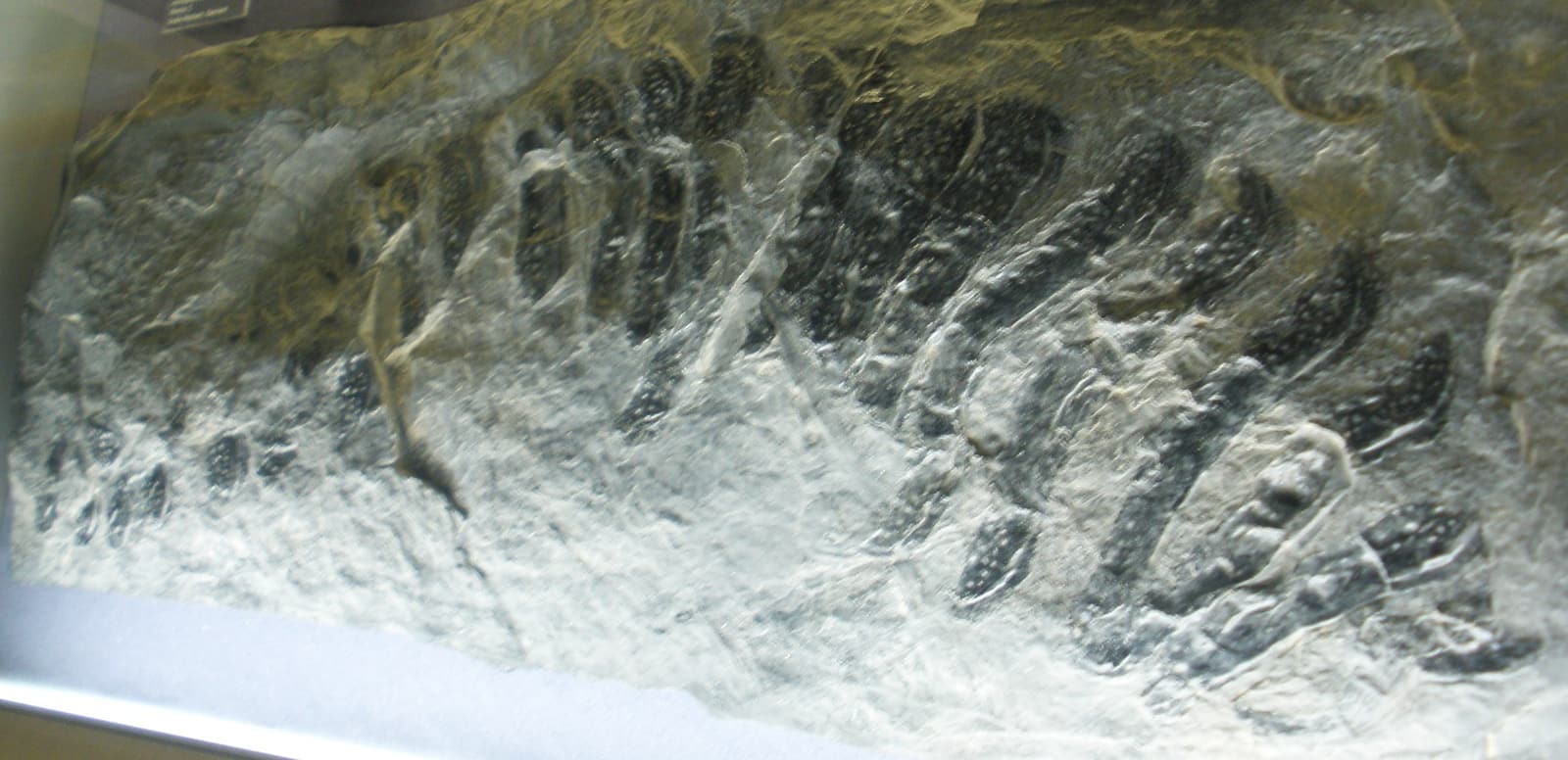
Arthropleura is one of those fossils that popular culture flattens almost on contact. The animal enters as a headline about a car-sized millipede, an oxygen-era horror prop, or a reminder that the Carboniferous once allowed oversized everything. The stronger profile is narrower and better. Arthropleura matters because body fossils are rare, because trackways outnumber complete anatomy, and because the recent discovery of a complete head finally lets paleontologists connect scale, locomotion, and evolutionary placement without leaning so hard on myth.[1][2][3][4]
That shift changes what kind of species profile this can be. The useful question is no longer just how long Arthropleura got. It is what sort of terrestrial arthropod could carry that size, where it moved, and how much of its identity can be read from actual anatomy rather than from analogy with living millipedes or centipedes.[1][2][4] Across roughly 346 to 290 million years ago, in equatorial Carboniferous and early Permian settings, Arthropleura was the largest land invertebrate known. But the profile becomes scientifically durable only when that fame is tied back to preserved segments, head limbs, mouthparts, and track-bearing sediments.[2][3][4]
Image context: the lead image is a real Arthropleura fossil photograph from the Senckenberg Museum, sourced via Wikimedia Commons. It suits this article because the key move is to keep the animal as fossil evidence rather than as paleoart spectacle. The repeating dorsal plates make the profile feel mechanical and segmented before any discussion of gigantism begins.[5]
1) The size story sharpened when the Northumberland fossil turned up
For years, Arthropleura was famous partly because it was so difficult to pin down anatomically. Full body fossils are rare, and much of the record comes from isolated remains or trackways rather than from pristine articulated specimens.[1][2][3] The 2021 Northumberland discovery mattered because it forced the scale discussion back onto a real body segment. Davies and colleagues described multiple articulated exoskeletal segments from the Serpukhovian Stainmore Formation and argued that the specimen belonged to the largest arthropod yet known from land, with the original animal estimated at around 2.7 meters long and roughly 50 kilograms.[2]
That fossil did more than enlarge the silhouette. It also complicated the usual habitat shorthand. In the Cambridge summary of the paper, the specimen came from a fossilized river channel and helped shift Arthropleura away from the lazy default of an all-purpose coal-swamp giant.[6] The authors argued instead for open woodland near the coast rather than a permanently closed, waterlogged swamp interior.[6] Even if that specific habitat picture remains open to refinement as more body fossils turn up, it is already a better starting point than the generic monster-marsh backdrop. The animal belongs in real lowland landscapes with rivers, vegetation, and sedimentary context, not in an undifferentiated "prehistoric giant bug" fog.
The Northumberland specimen also weakened one of the simplest public explanations for Arthropleura's size. Because the remains predate the late Carboniferous oxygen peak often invoked to explain arthropod gigantism, the Cambridge team explicitly argued that oxygen cannot be the whole answer.[6] That is an important boundary. High oxygen may still matter as background physiology, but the fossil record no longer supports turning it into a one-variable explanation that makes the rest of the anatomy dispensable.
2) The 2024 head material made the lineage problem more precise
The most important recent reset came from France. In 2024, Lheritier and colleagues used microCT on exceptionally preserved material from Montceau-les-Mines to recover unprecedented details of Arthropleura head anatomy and mouthparts.[1] That matters because the animal's body had long pushed it toward a giant-millipede reading: two pairs of legs per segment strongly resemble diplopods. Yet the newly resolved head showed traits also characteristic of centipedes, including enclosed mandibles and two pairs of head limbs behind them, making the old easy classification feel too simple.[1][4]
This is where the profile becomes more interesting than the slogan. The total-evidence phylogeny in the 2024 paper placed Arthropleura alone as a stem-group millipede, while also showing how incomplete older taxa can pull the broader arthropleurid story deeper into the myriapod stem.[1] In other words, the head did not turn Arthropleura into a modern millipede scaled up to absurd size. It clarified that the animal carried a transitional mixture of traits near the millipede-centipede split, exactly the sort of mosaic that disappears when the fossil is treated only as a length record.[1][4]
The same paper also changed how growth is imagined. The juvenile French specimens showed that segment number appears to have increased through development, more in line with millipede-style addition than with the fixed segment count typical of many centipedes.[4] That does not solve every life-history question, but it gives the species profile a developmental frame. Arthropleura was not merely large; it seems to have become large through a particular way of building the body over time.
3) Trackways keep the animal on the ground
If the head clarifies lineage, the tracks clarify presence. Arthropleura is one of those animals whose trace-fossil record does real interpretive work rather than serving as a decorative extra. Buckman and colleagues' Glasgow trackway paper on Diplichnites cuithensis describes a Serpukhovian example from Linn Park laid down in a fluvial sandbar or plain environment, possibly of estuarine origin, locally colonized by plants.[3] That may sound like a modest sedimentological detail, but it matters because it gives the animal somewhere specific to walk.
Trackways do not tell you everything. They do not reveal mouthpart shape, respiratory structures, or exact taxonomic placement. But they do anchor behavior and environment in a way that body fossils alone often cannot. Here the signal is consistent: Arthropleura was moving across wet lowland surfaces where plant matter, channel migration, and episodic burial all shaped the ground beneath it.[2][3] This is a better ecological frame than the cartoon image of a forest-floor ambush predator.
The track record also helps separate secure claims from exciting guesses. You can say the animal was a large terrestrial walker that crossed muddy to sandy surfaces and left broad myriapod-style traces.[3] You should be slower to turn those traces into aggressive behavior, hunting strategy, or cinematic speed. The profile improves when movement is kept inside the limits of the substrate evidence.
4) What the strongest 2026 profile can actually say
The secure core of the species profile is now fairly strong. Arthropleura was a giant terrestrial myriapod that lived in equatorial Carboniferous and early Permian environments, reached lengths well above two meters in some species, and combined a diplopod-like segmented trunk with newly documented head features that bridge the millipede-centipede divide.[1][2][4] It belonged to the history of land arthropods becoming ecologically large, not to some failed branch of vertebrate-style gigantism.
The more interesting boundary is diet and daily life. The Natural History Museum summary is appropriately careful: definite gut contents remain disputed, but the fossils lack obvious venom fangs or prey-catching legs, and the limbs look better suited to slow movement than to active predation.[4] That makes a detritus-feeding or plant-processing lifestyle more plausible than the horror-movie predator version, but it does not grant a fully solved menu.[4] The article profile is strongest when it preserves that difference between likely ecological role and direct evidence.
That is also the right way to treat gigantism. The 2021 Northumberland remains mean oxygen cannot be treated as the sole explanatory switch, while the 2024 head material means anatomy can no longer be waved away behind a generic "giant millipede" label.[1][2] Put together, those findings make Arthropleura feel less like a prehistoric exaggeration and more like a real terrestrial experiment: a slow, armored, segment-building myriapod that occupied wet lowland ecosystems and became enormous through a combination of evolutionary history, developmental strategy, and Carboniferous ecology still being worked out in detail.
That is a stronger ending than the old myth gives it. Arthropleura does not need to be remembered only as the biggest bug. It deserves to be remembered as one of the clearest cases where new anatomy rescued a famous fossil from its own legend.[1][2][3][4]
Sources
- Mickael Lheritier et al., "Head anatomy and phylogenomics show the Carboniferous giant Arthropleura belonged to a millipede-centipede group," Science Advances 10, no. 41 (2024).
- Neil S. Davies et al., "The largest arthropod in Earth history: insights from newly discovered Arthropleura remains (Serpukhovian Stainmore Formation, Northumberland, England)," Journal of the Geological Society (2021).
- James O. Buckman, Simon J. Cuthbert, and Paul G. Polson, "Arthropleura trackway (Diplichnites cuithensis) from the Carboniferous, Serpukhovian, Limestone Coal Formation, Clackmannan Group, Linn Park, Glasgow," Scottish Journal of Geology (2024).
- James Ashworth, "Largest ever millipede's head revealed by 300-million-year-old fossils," Natural History Museum (2024).
- Wikimedia Commons file page for the photographed Arthropleura fossil used as the lead image.
- University of Cambridge Department of Earth Sciences, "Largest-ever fossil millipede found in Northern England" (2021).