Drepanosaurus unguicaudatus looks like a warning against tidy body-plan expectations. The animal was a small Late Triassic diapsid, not a dinosaur and not a lizard in the everyday sense, but its anatomy borrows the visual grammar of several familiar animals at once: a climbing body, grasping extremities, a tail ending in a claw-like structure, and a forelimb so modified that the normal tetrapod wrist-to-hand sequence almost stops being recognizable.[1][2][4]
That is why the strongest profile is not simply "strange reptile with a big claw." The better reading is anatomical and methodological. Drepanosaurus matters because it shows how much functional novelty can hide inside a fossil that was first known from a crushed Italian slab. Pinna's original 1980 description named the animal from Triassic Alpine material, but the major interpretive work came afterward: first through re-reading the distorted holotype, then through three-dimensionally preserved New Mexico fossils that let paleontologists test whether the bizarre forelimb was real anatomy or a taphonomic illusion.[1][2][3][4]
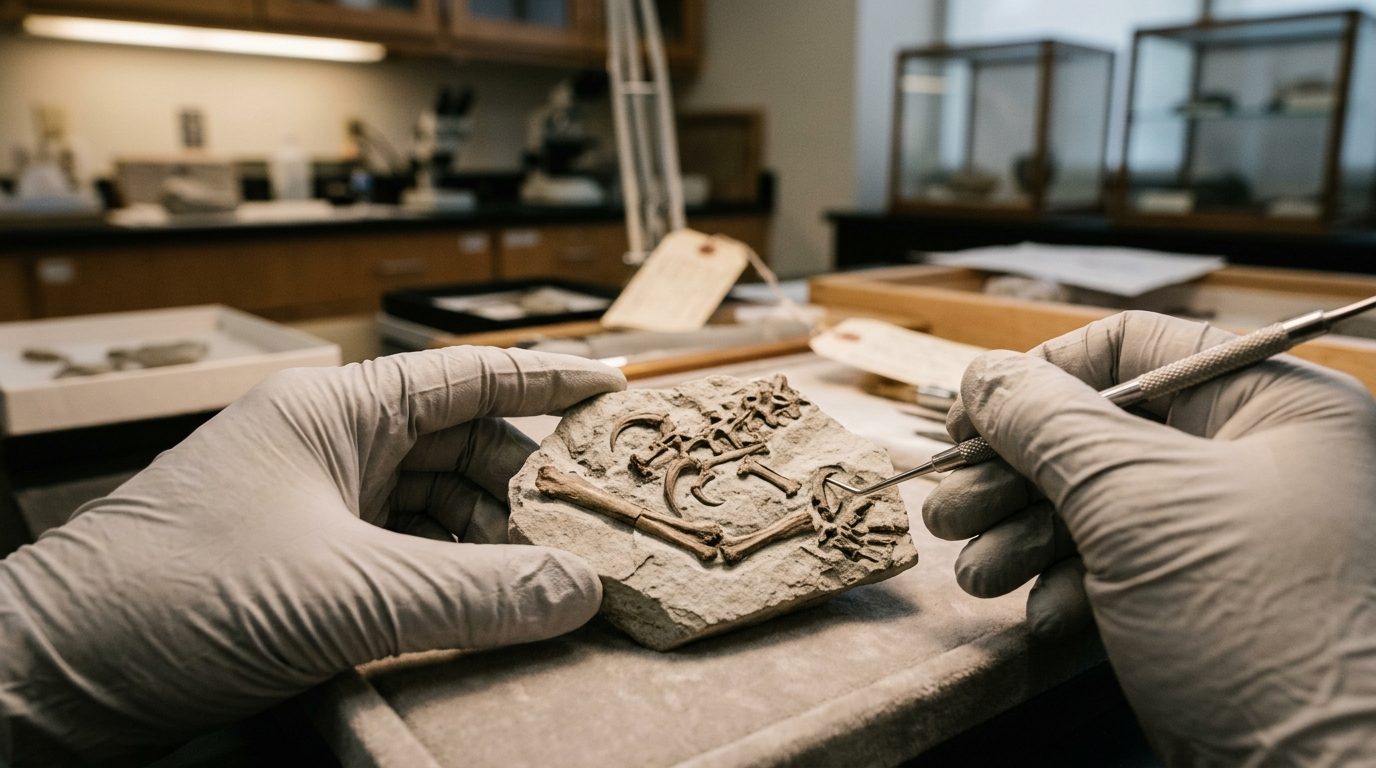
Image context: the cover keeps the article at the fossil workbench rather than in an anatomy diagram. That choice matters because the argument depends on method: shoulder, forelimb, hand, and tail only become legible when fragment, tool, preservation noise, and anatomical inference are held together.
1) The first lesson is preservation: the Italian slab made the animal famous and difficult
The name Drepanosaurus unguicaudatus starts with Giovanni Pinna's 1980 Italian description, which formally introduced the taxon from Triassic Alpine material.[3] That origin matters because the fossil did not arrive as an ideal teaching skeleton. It was a largely complete but flattened and distorted body, the sort of specimen that can preserve an extraordinary animal while also scrambling the relationships among bones.
Renesto's 1994 reinvestigation is the crucial correction. The paper argued that earlier descriptions had misread parts of the shoulder girdle and anterior limb because the bones were crushed and because taphonomic distortion had not been handled carefully enough.[2] The supposed interclavicle, for example, was reinterpreted as the right scapula, while some elements previously identified as shoulder bones were instead reassigned to the anterior limb.[2] This is not bookkeeping. It is the difference between treating the animal as a weird silhouette and reconstructing how the front of the body actually worked.
That methodological reset gives Drepanosaurus its lasting value. A crushed slab can make anatomy look more conservative than it was, or more bizarre than it was, depending on which pieces get forced into the wrong positions. The 1994 paper's strength was that it made preservation part of the argument rather than a footnote. Before asking what the animal did, it asked which bones were really shoulder, which bones were really forelimb, and how much of the apparent oddity survived a stricter reading of the slab.[2]
2) The New Mexico fossils changed the forelimb from suspicion into structure
The 2016 Current Biology paper turned the forelimb into a much stronger case because it added three-dimensionally preserved fossils from the Chinle Formation of New Mexico.[1] That mattered immediately. Three-dimensional material is not automatically easy, but it frees key anatomical relationships from the worst ambiguities of a compressed slab. The authors could compare the new material with the Italian type specimen and ask whether the strange forelimb configuration was repeated, functional, and internally coherent.[1][4]
The answer was emphatically yes. Pritchard and colleagues described a forelimb that departs sharply from the usual tetrapod pattern, in which radius and ulna are normally elongate, parallel shafts leading into shorter wrist bones.[1] In Drepanosaurus, the radius and ulna are unequal in length; the ulna is flattened and crescent-shaped; and two shaft-like carpal elements are so elongated that they are longer than the radius.[1] The second digit then carries the huge hooked claw that makes the animal visually memorable.[1][4]
The Stony Brook release is useful because it explains why the new fossils were decisive rather than merely additive. It notes that the New Mexico material came from about 212-million-year-old rocks at Hayden Quarry in the Ghost Ranch area and that the specimens were fragile but preserved in three dimensions, making high-resolution imaging and microCT central to understanding the forelimb.[4] In other words, the modern claim about Drepanosaurus depends on both new fossils and new ways of reading them. The animal became stranger because the evidence became less flattened.
3) The hook-and-pull interpretation is powerful because it is mechanical, not theatrical
The giant claw is easy to oversell. A hook nearly as large as the arm invites monster language, but the scientific point is narrower and better. The 2016 paper argued that the forelimb's range of motion, unusual carpals, and large second-digit claw support a specialized hook-and-pull digging or ripping action.[1] The comparison is not to a generalized predator slashing at prey. It is to living mammals that use powerful claws to tear into substrates, exposing insects or other food hidden under bark or inside nests.[1][2][4]
That distinction matters. A claw can be a display feature, a climbing aid, a prey-capture weapon, or a tool for manipulating a physical surface. Drepanosaurus becomes most convincing when the entire limb is read as a machine: compact body position, modified forearm, elongated carpals, heavy claw, and a motion path suited to pulling rather than rapid grasping.[1][4] The structure is not just "big." It is arranged.
Renesto had already suggested an arboreal animal using enormous claws to scrape bark, perhaps in search of insects, comparing the behavior in broad functional terms to the pygmy anteater.[2] The 2016 material did not simply repeat that old idea; it gave the forelimb architecture a stronger anatomical basis. A crushed Italian skeleton could suggest the behavior. Three-dimensional New Mexico forelimbs made the functional package harder to dismiss.[1][2][4]
4) The tail and feet keep the animal out of a one-claw caricature
The forelimb is the headline, but the whole body matters. Stony Brook's summary notes grasping feet and a claw-like structure at the end of the tail, both of which fit an animal spending much of its life in trees.[4] Renesto's 1994 paper also tied caudal vertebral morphology and the reconstructed shoulder-and-limb complex to a climbing or bark-scraping mode of life rather than treating the claw as an isolated oddity.[2]
That whole-body framing is the safeguard against caricature. If the second digit is treated alone, Drepanosaurus becomes a Triassic gimmick: one spectacular claw attached to a vague reptile. If the forelimb stays connected to the feet, tail, shoulder girdle, and preserved body proportions, the animal becomes a more coherent ecological experiment. The claw is part of a station-holding and pulling system, not a decorative special effect.[1][2][4]
The tail hook is especially useful because it changes how the forelimb should be imagined. A hook-and-pull forelimb works better if the body can brace against the substrate. Grasping feet and a specialized tail tip give the animal more ways to anchor itself while the forelimb does forceful work.[2][4] The fossil evidence does not let us watch a Drepanosaurus feed, and it does not prove every detail of posture. But it strongly favors a life habit in which climbing, bracing, and ripping surfaces belonged to the same behavioral envelope.[1][2][4]
5) The bigger lesson is that tetrapod limb evolution had more room than the standard template suggests
The 2016 paper's broadest claim is not only about one Triassic reptile. It argues that the forelimb bones in Drepanosaurus represent previously unknown tetrapod morphologies and expand known forelimb morphospace.[1] That is the sentence that makes the animal more than a curiosity. Tetrapod forelimbs have been modified into wings, paddles, hooves, digging tools, and grasping hands, but those transformations usually still preserve a familiar underlying relationship among radius, ulna, carpals, and digits. Drepanosaurus disrupts that expectation at the architecture level.[1]
The timing sharpens the point. More than 200 million years ago, Late Triassic reptiles had already produced a highly specialized ecological tool, not by gradually exaggerating one ordinary finger but by rearranging the whole forearm-wrist-hand complex into something outside the standard comparative comfort zone.[1][4] That does not make Drepanosaurus a direct ancestor of later specialized climbers or diggers. It makes it evidence that tetrapod limbs were capable of more structural experimentation than a simple survey of living animals might suggest.
The best boundary is therefore clear. Drepanosaurus should not be reduced to a chameleon, an anteater, a reptilian woodpecker, or any modern analogy too literally. Those comparisons are useful only because they help translate a mechanical problem: how an animal anchors itself and pulls hard against a surface.[1][2][4] The fossil's real lesson is older and stricter. Anatomy can break a pattern without breaking function. In Drepanosaurus, the tetrapod forelimb did exactly that.
Sources
- Adam C. Pritchard, Alan H. Turner, Randall B. Irmis, Sterling J. Nesbitt, and Nathan D. Smith, "Extreme Modification of the Tetrapod Forelimb in a Triassic Diapsid Reptile," Current Biology 26, no. 20 (2016).
- Silvio Renesto, "The shoulder girdle and anterior limb of Drepanosaurus unguicaudatus (Reptilia, Neodiapsida) from the upper Triassic (Norian) of Northern Italy," Zoological Journal of the Linnean Society 111, no. 3 (1994).
- Giovanni Pinna, "Drepanosaurus unguicaudatus, nuovo genere e nuova specie di lepidosauro del Trias alpino (Reptilia)," Biodiversity Heritage Library record for the 1980 original description.
- Stony Brook University, "New Research Reveals an Ancient Reptile Had Bizarre Forelimb Evolution" (2016).