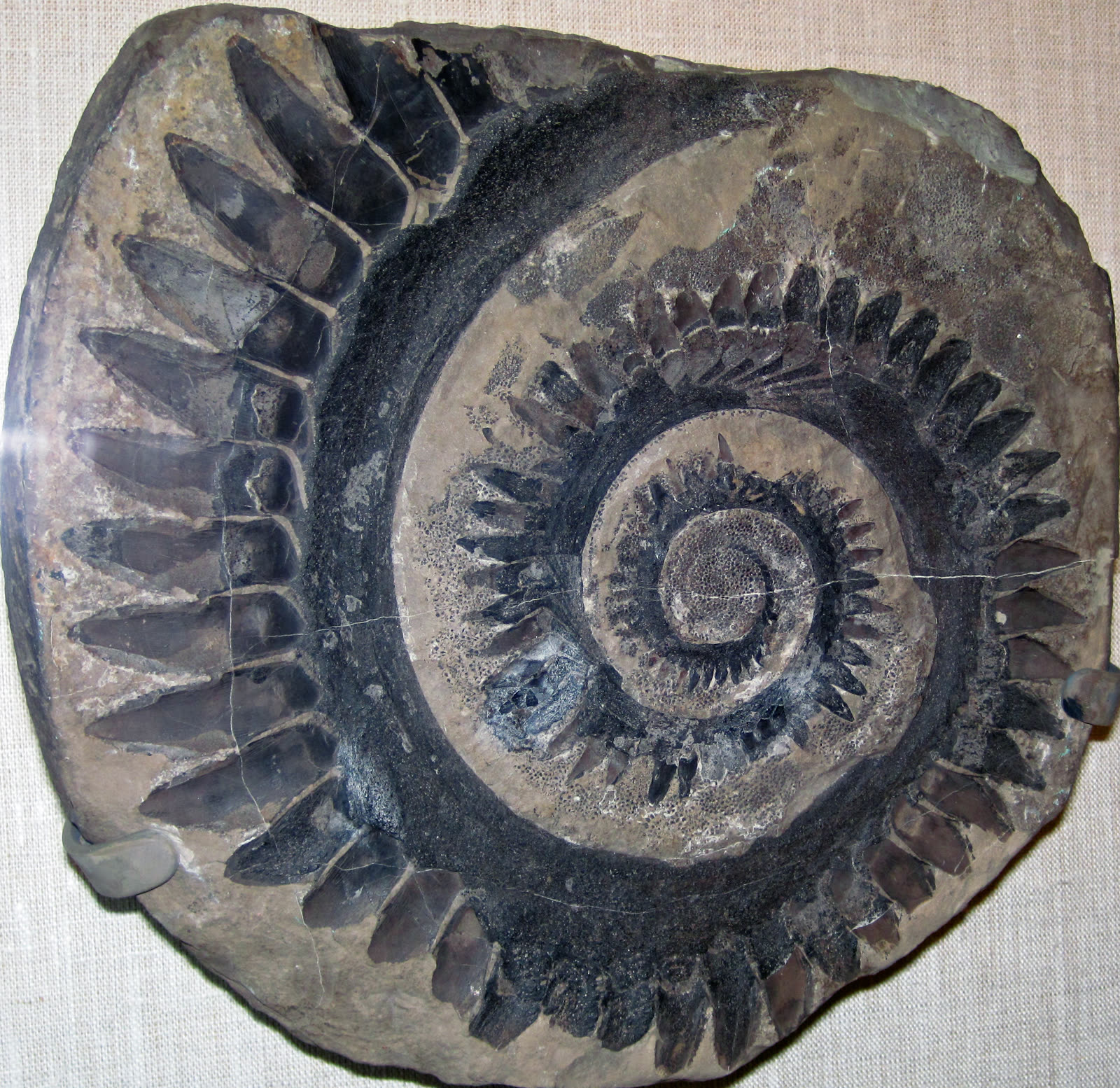
Helicoprion became famous before it became anatomically legible. The spiral of teeth looked too strange to ignore and too strange to place. For decades it invited drawings in which the whorl sat on the snout, hung outside the mouth, or behaved like a rotating circular saw.[1][5] The modern correction is more interesting than the old spectacle. Once computed tomography placed the whorl inside the lower jaw, the fossil stopped being an emblem of paleontological weirdness and became a solvable engineering problem.[1]
That shift matters because the tooth spiral is not an optional flourish on the animal. It is the center of the feeding apparatus. Tapanila and colleagues used CT data from specimen IMNH 37899 to show that the spiral occupied the symphyseal region of the lower jaw and that the jaw itself belonged to a eugeneodont fish on the holocephalan side of cartilaginous-fish evolution rather than to a conventional shark template.[1] Ramsay and colleagues then tested how that arrangement could function during feeding and concluded that the system fit soft-bodied prey better than the old shell-crushing legend did.[2]
Image context: the cover image is a real museum photograph of a Helicoprion tooth whorl from Wikimedia Commons. It fits this article because the point is not to imagine the whole animal first. It is to keep the preserved spiral in view long enough to ask where it belongs and what kind of bite that geometry can actually support.[5]
The first problem was not function. It was placement.
Older reconstructions drifted because paleontologists often had the whorl before they had the jaw around it. The spiral is visually complete enough to feel self-explanatory, but isolated tooth whorls do not tell you by themselves whether the structure sat at the front of the mouth, rose from the snout, or projected below the head.[1][5] In Helicoprion, that ambiguity was amplified by the fact that new teeth were added continuously while older teeth were retained in the spiral rather than shed away like the tooth files of most living sharks.[1][3]
That growth pattern made the fossil easy to admire and hard to read. Species-level naming often relied on whorl form, curvature, and degree of coiling, yet Tapanila and Pruitt argued that morphology changes substantially as the spiral grows and that many historic species distinctions collapse once ontogeny and incomplete preservation are taken seriously.[3] In practical terms, the famous spiral encouraged overconfidence: one striking fossil structure kept tempting researchers to treat one stage of growth as if it were a whole adult design.
This is why the CT result changed more than one anatomical detail. It changed the method. The question stopped being "What can we imagine this spiral doing?" and became "What space inside the jaw can this structure actually occupy without breaking the rest of the head?" That is a much better paleontological question.[1]
CT turned the whorl from icon into jaw hardware
The 2013 Biology Letters paper centered on an exceptionally preserved specimen from Idaho, roughly 270 million years old, whose spiral reached about 23 centimeters in diameter and preserved 117 tooth crowns.[1] Those numbers mattered because they pushed the whorl past the scale of a decorative oddity. A structure that large had to be integrated with the head in a mechanically coherent way.
CT scans showed that it was. Tapanila and colleagues reconstructed the whorl as occupying the entire mandibular arch, with the oldest teeth at the center of the spiral and progressively younger teeth added labially as the whorl expanded.[1] In that arrangement, the spiral is not floating free and it is not mounted on the snout. It is the lower jaw's median working edge. The paper also placed Helicoprion among eugeneodonts, outside the crown-shark image that had shaped many popular reconstructions.[1]
That placement does two useful things at once. First, it removes the false problem of explaining how a nose-mounted buzzsaw could ever be fed, supported, or aligned during a bite. Second, it gives the spiral a developmental logic. The tooth whorl becomes a retained conveyor system: new teeth are added, older ones are carried forward in the coil, and the active cutting region sits on the outer arc rather than in the compressed center.[1][3]
The spiral worked as a conveyor, not as a circular saw
Once the whorl is inside the lower jaw, its geometry stops looking absurd. What looked like a carnival blade from the outside starts behaving like a record of continuous tooth production. The center of the spiral is not the business end. It is the archive. The outer teeth are the ones positioned to meet prey during closure, while the tightly coiled inner teeth preserve the earlier growth history of the jaw.[1][3]
That distinction matters because it clears up one of the oldest public misunderstandings about Helicoprion. The whorl did not need to spin independently through flesh like a powered blade. It only needed to rotate as part of the lower jaw's motion and tooth progression. Ramsay and colleagues modeled that system and found that mandibular closure would have drawn prey against the outer teeth while the whorl rotated through a controlled slicing path.[2] The point is not speed for its own sake. The point is guided contact.
This is also why the whorl can look so excessive in a museum case and still make biological sense. Much of what you see in the fossil is accumulated history, not simultaneously active cutting surface. The spiral preserves old teeth because the animal did not discard them in the standard shark way.[1][3] That is bizarre only if you expect a modern shark mouth. It becomes legible once you treat Helicoprion as its own eugeneodont experiment.
Feeding mechanics narrow the menu
Ramsay and colleagues took the next step by asking what sort of prey the jaw could actually handle.[2] Their functional analysis suggested that the closure path and mechanical advantage of the system fit repeated slicing on softer prey better than blunt-force handling of hard armored animals.[2] The widely repeated image of Helicoprion as an indiscriminate crusher of shelly prey therefore weakens under mechanical testing.
That does not make the fish less formidable. It makes it more specific. The Australian Museum's synthesis follows the same direction, describing the whorl as a slicing apparatus more consistent with soft-bodied prey such as cephalopods than with routine shell-breaking durophagy.[4] In other words, the spiral still marks a predator. It just marks a predator whose feeding surface had to stay within the material and geometric limits of its own jaw.
This is the pattern worth keeping from the whole Helicoprion story. Paleontology did not solve the animal by making it less strange. It solved it by forcing the strangeness into a tighter anatomical frame. The whorl remained spectacular; the explanation became narrower.
What the fossil can support, and what it should not be forced to say
The robust claims are now fairly clear. Helicoprion carried a retained spiral tooth whorl in the lower jaw, added new teeth continuously without standard shedding, and used the outer arc of that spiral in a bite system better suited to slicing soft prey than smashing heavily mineralized shells.[1][2][3][4] That is already an extraordinary feeding design.
The limits are clear too. We still do not have the kind of full-body preservation that would make every aspect of locomotion or ecology equally secure, and no single whorl should be asked to answer every question about eugeneodont diversity or life habit.[1][3] The old mistake was to treat the spiral as self-explanatory. The newer mistake would be to treat it as fully exhaustive.
The better reading sits between those extremes. Helicoprion matters because one impossible-looking fossil stopped being impossible once anatomy, development, and mechanics were forced to agree. That is the deep value of the tooth whorl. It is not only a famous shape. It is a reminder that paleontology gets stronger when spectacular structures are made to live somewhere real.
Sources
- Leif Tapanila, Jesse Pruitt, Ralph C. Pradel, et al., "Jaws for a spiral-tooth whorl: CT images reveal novel adaptation and phylogeny in fossil Helicoprion," Biology Letters 9, no. 2 (2013).
- Jay B. Ramsay, Leif Tapanila, John A. Dankoski, and Carlos A. Parras, "Eating with a saw for a jaw: functional morphology of the jaws and tooth-whorl in Helicoprion davisii," Journal of Morphology 276, no. 1 (2015) abstract via PubMed.
- Leif Tapanila and Jesse Pruitt, "Unraveling species concepts for the Helicoprion tooth whorl," Journal of Paleontology 87, no. 6 (2013).
- Australian Museum, "Helicoprion" species overview and feeding interpretation.
- Wikimedia Commons file page for the photographed Helicoprion tooth whorl used as the lead image.