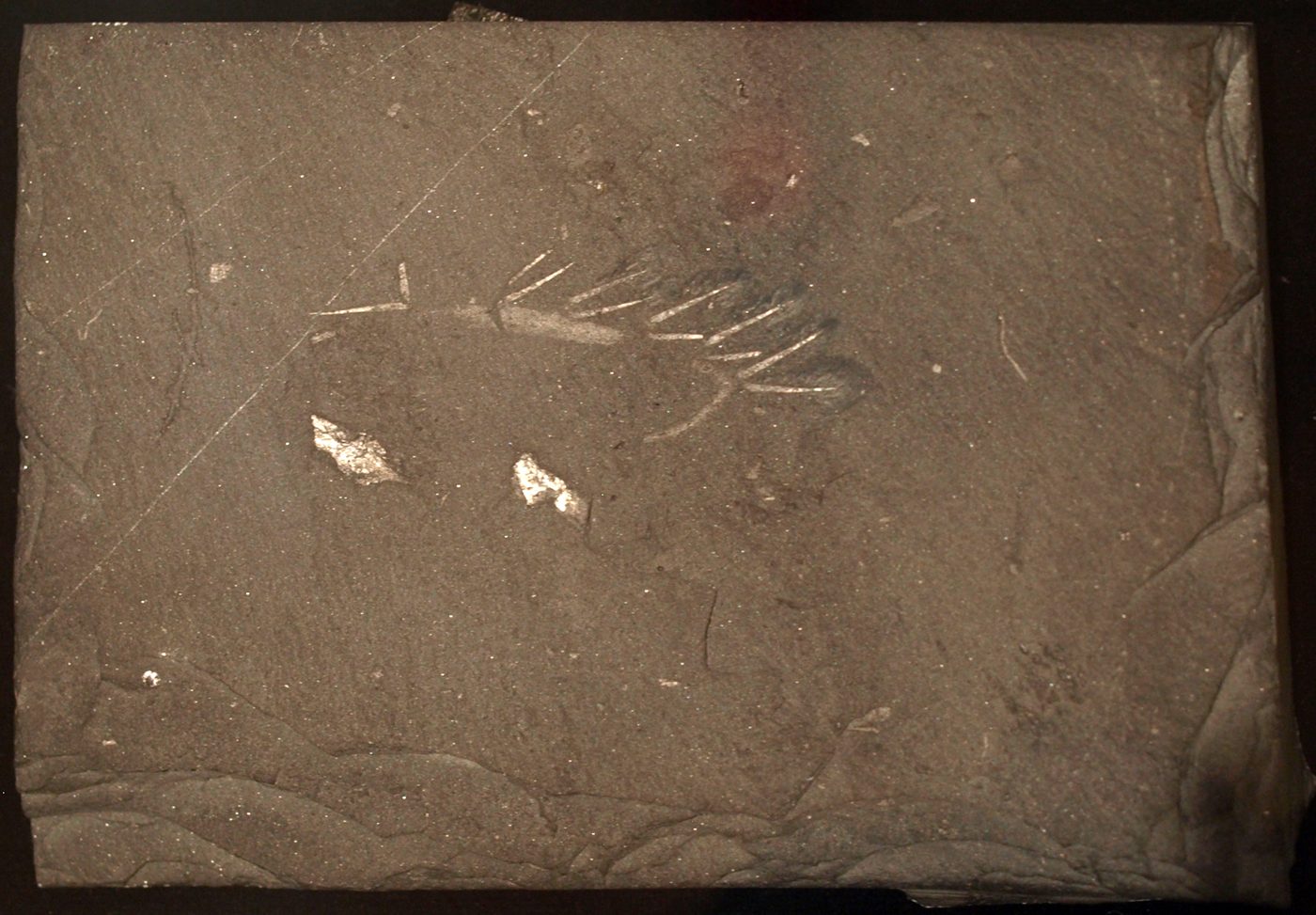
Hallucigenia sparsa is still one of the easiest Cambrian animals to turn into a punchline. The name itself invites it. The classic image is a thin worm balanced on stilts, with soft tentacles waving from its back and no obvious front end worth trusting.[1] That image survives in popular memory because it is memorable, not because it is the best scientific reading. The stronger reason Hallucigenia matters in 2026 is methodological. Few fossils show more clearly how paleontology improves when orientation, homology, and soft-part interpretation are tightened step by step.[1][2][3][4]
That sequence is what turns the animal from a curiosity into evidence. In 1977, Simon Conway Morris redescribed Burgess Shale material and isolated Hallucigenia as something so strange that it seemed to stand outside ordinary animal architecture.[1] Later comparative work on Cambrian lobopodians pulled it back toward legible anatomy by arguing that the soft appendages belonged underneath the body and the rigid elements belonged above it.[2] Then the argument sharpened again. In 2014, the claws turned out not to be generic tips but nested, onychophoran-like structures.[3] In 2015, the head finally resolved, complete with a terminal mouth, simple eyes, and a pharynx lined with teeth.[4] The result was not just a corrected silhouette. It was a very different evolutionary claim.
Image context: the cover uses a real Wikimedia Commons photograph of a Royal Ontario Museum specimen.[5] That choice matters because the argument here depends on seeing two tissue regimes separated in the fossil itself. The stout spines read as dorsal armor; the slimmer lobopods below them read as the contact limbs. A reconstruction drawing would already presuppose the answer. The fossil keeps the correction visible.
1) The first lesson is that weirdness can be a preservation problem before it is a biology problem
Conway Morris's 1977 paper deserves respect precisely because it made the problem visible.[1] Looking at Burgess Shale compression fossils, he recognized that this was not an annelid or an ordinary arthropod and gave it a name that reflected its dreamlike quality.[1] But the reconstruction that made Hallucigenia famous also shows the cost of reading a soft-bodied fossil before enough comparisons exist. Spines were treated as walking stilts, the fleshy lobes were placed above the back, and the body seemed to end in uncertainty.[1]
That early arrangement was not irrational. Burgess Shale fossils are flattened, incomplete, and governed by what survives in carbon films and mineral halos. When the head is obscure and the appendages are unlike those of familiar living animals, orientation itself becomes an inference rather than a given. Hallucigenia became iconic because the inference was wrong in a revealing way.[1][2]
The later review by Hou and Bergstrom is important because it shows what changed.[2] Once more Cambrian lobopodians entered the frame and the anatomy of related forms became easier to compare, the animal no longer needed to balance on spines. The rigid structures made better sense as dorsal sclerites, while the softer paired appendages below became locomotory lobopods.[2] That correction does more than tidy up an embarrassment. It moves Hallucigenia from "impossible beast" territory into a comparative body-plan discussion with other early panarthropods.[2]
2) The claws mattered because they turned vague resemblance into homology
Even after the body was turned right-side up, the animal could still have remained merely odd.[2] The 2014 Nature paper is what made the next step much stronger.[3] Smith and Ortega-Hernandez showed that the terminal claws of Hallucigenia were built from nested internal elements in a way closely comparable to the claws of living onychophorans, or velvet worms.[3] That sounds like a small detail. It is not. Claws are one of the structures least likely to be improved by storytelling alone. Either the construction matches a plausible homology or it does not.
This is where the article's title earns its second clause. Once the claws matched onychophorans, Hallucigenia stopped being a free-floating Cambrian eccentric and began reading as part of a stemward panarthropod history.[3] The paper used that microanatomy to argue for Tactopoda, a grouping linking onychophorans and arthropods through shared appendicular traits rather than through broad visual resemblance.[3] In practical terms, the fossil's value tightened. The animal was no longer interesting because it looked bizarre. It was interesting because a hard-to-see structure inside the appendage tip linked it to a real evolutionary neighborhood.
That is also why the spines become easier to interpret once the claws are understood. Dorsal armor above and clawed walking limbs below form a coherent animal. Spines below and tentacles above do not. The reconstruction starts obeying anatomical logic rather than just accommodating available shapes.[2][3]
3) The head changed the whole reading because it solved both orientation and feeding anatomy at once
The 2015 Nature paper by Smith and Caron delivered the final major correction.[4] By re-examining Burgess Shale material in detail, they identified the head at the narrower end of the body and showed that the previously suspected front end was not the front at all.[4] More importantly, the animal turned out to have a simple pair of eyes, a terminal mouth, circumoral structures, and a pharyngeal armature lined with teeth.[4]
That finding matters at two levels. First, it resolves the practical question of how the animal was facing. Paleontologists were no longer just flipping the body based on general similarity; they had a head with identifiable sensory and feeding structures.[4] Second, the mouth and throat anatomy connected Hallucigenia to deeper ecdysozoan history. The pharyngeal teeth were not a random flourish. They tied the animal into a broader conversation about the early evolution of moulting animals and the anatomical toolkit from which later ecdysozoan lineages diversified.[4]
This is the point where the fossil becomes genuinely instructive. A body that once looked absurd becomes legible because three different categories of evidence start pointing the same way: dorsal armature, ventral clawed lobopods, and a definable anterior feeding apparatus.[2][3][4] The fossil did not become less interesting when the weirdness was reduced. It became more exact.
4) Why Hallucigenia still matters
The easiest modern misuse of Hallucigenia is to treat it as proof that the Cambrian explosion simply produced monsters and then cleaned them up later. The anatomy supports a better lesson. Hallucigenia matters because it records how early panarthropod design was assembled before later phyla hardened their familiar outlines.[2][3][4] The body is narrow, the dorsal armature is strong, the lobopods are simple, and the head remains small compared with the defensive and locomotor apparatus.[4] That is not a failed experiment. It is a stem-level solution whose parts still connect to living lineages.
There is also a disciplinary lesson in the fossil's afterlife. Paleontology does not get stronger by celebrating weirdness for its own sake. It gets stronger by asking which features are preservational artifacts, which are reconstruction choices, and which survive repeated testing as anatomical signal. Hallucigenia is one of the best case studies for that difference. It began as a Burgess Shale hallucination.[1] It endured as a real evolutionary document because later work kept forcing the anatomy into sharper agreement with itself.[2][3][4]
Sources
- Simon Conway Morris, "A new metazoan from the Cambrian Burgess Shale of British Columbia" (1977), Palaeontology 20(3): 623-640.
- Xiangguang Hou and Jan Bergstrom, "Cambrian lobopodians-ancestors of extant onychophorans?" (1995), Zoological Journal of the Linnean Society 114(1): 3-19.
- Martin R. Smith and Javier Ortega-Hernandez, "Hallucigenia's onychophoran-like claws and the case for Tactopoda" (2014), Nature 514: 363-366.
- Martin R. Smith and Jean-Bernard Caron, "Hallucigenia's head and the pharyngeal armature of early ecdysozoans" (2015), Nature 523: 75-78.
- Wikimedia Commons file page for the photographed Royal Ontario Museum specimen, "File:HallucigeniaSparsa-ROM-June11-10.jpg".