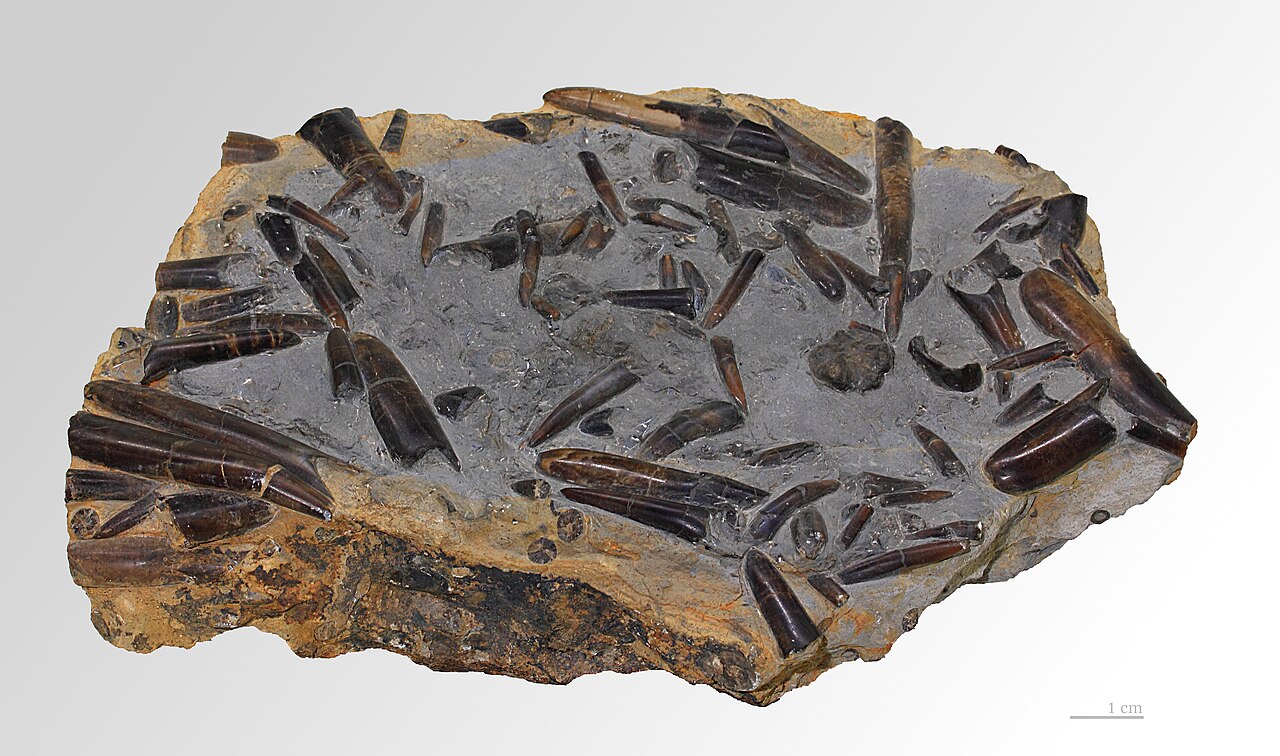
Most readers meet belemnites in their most misleading form: a hard, smooth, bullet-shaped fossil picked up on a beach or split out of marine sediment. The object feels complete because it is tidy. It fits in the hand. It already looks designed.[1][2] But the familiar fossil is only the preservational winner, not the whole animal.
That mismatch matters because belemnites were not little stone bullets waiting in Jurassic mud. They were squid-like Mesozoic coleoids with internal hard parts, active enough to leave behind a hydrodynamic rear guard, arm hooks, and in rare cases soft-part traces such as ink sacs.[1][2][4] Once those pieces are held together, the animal stops looking like a generic fossil token and starts behaving like a real marine body with anatomy, ecology, and lineage-specific constraints.
This is the reading discipline the guard itself tends to erase. The rostrum is abundant, durable, and visually memorable, so it often stands in for the rest of the belemnite too quickly. A better theme essay starts by treating that dominance as a problem to solve rather than as a convenient summary.
Image context: the cover uses a real museum specimen photograph from Wikimedia Commons.[6] It belongs here because the article is about what preservation does to attention. The clean isolated guard is exactly the object that made belemnites famous, and exactly the object that can make the living animal recede if the rest of the evidence is not pulled back in.
1. The fossil most people know is a counterweight
The British Geological Survey's overview remains useful because it names the basic asymmetry clearly. The fossil people usually call a "belemnite" is the bullet-shaped rear structure often called the guard and more correctly termed the rostrum, the part most likely to survive fossilization.[1] The National Park Service makes the same point in plainer terms: belemnites were squid-like animals with internal hard parts, and the elongated guard extending behind the body cavity is the piece most likely to be preserved.[2]
That immediately changes how the object should be read. A loose rostrum is not the animal; it is the densest, most mineralized part of the animal's back end. BGS adds a functional hint that helps make sense of the shape: the rostrum probably acted as a counterbalance to the head and arms during swimming, and its fibrous calcite construction records growth in layered form.[1] So even the most ordinary belemnite fossil already contains three stories at once: locomotor design, skeletal growth, and preservational bias.
The hard lesson is that everything else disappears faster. Tentacles, soft tissue, and most of the body decay quickly. The fossil that ends up in a drawer or on a shoreline therefore arrives after a severe anatomical filter. If that filter is forgotten, the rostrum begins to masquerade as a complete portrait.
2. Hooks and soft parts pull the animal back together
The fastest way to repair that distortion is to bring back the parts that almost never survive. BGS notes that strongly curved chitinous hooks are sometimes preserved with belemnites, that they were attached to the tentacles, and that they were likely used to grasp prey such as small fish, crustaceans, and other mollusks.[1] The same page adds a more vivid number: the animals had 10 tentacles, each carrying roughly 30-50 pairs of hooks.[1]
That is already enough to shift the mental picture. The classic beach fossil is no longer a blunt stone projectile. It belongs to an armed coleoid predator with a grasping crown at the other end of the body. Rare soft-part preservation sharpens the picture further. BGS points to Jurassic examples from southern England and southern Germany where even ink sacs survived, making the animal feel much closer to living squid and cuttlefish than the isolated rostrum usually suggests.[1]
The 2021 review by Fuchs, Hoffmann, and Klug gives that intuitive correction a firmer evolutionary frame. Their synthesis treats extinct belemnitids and diplobelids as stem decabrachians and argues that belemnoid hooks are best understood in continuity with primitive sucker structures rather than as wholly unrelated inventions.[4] That placement matters because it keeps belemnites inside the longer history of coleoid armature. The hooks are not decorative extras attached to an otherwise simple fossil. They are part of the argument for what sort of cephalopod the animal was.
Once that evidence is admitted, the belemnite becomes harder to flatten. The guard still matters, but it now sits inside a body plan that includes arms, prey capture, rare soft-part preservation, and a real phylogenetic position.
3. Time and basin matter as much as outline
A second distortion comes from treating every rostrum as though it floated free of place. In reality, belemnites belong to particular marine worlds. The Katmai National Park fossil guide is useful here because it pins some of that context down: many Katmai fossils come from the Naknek Formation, dated to about 160-146 million years ago, and belemnites are part of that late Jurassic marine record.[3] A belemnite from that setting is already tied to one slice of basin history, not to a generic "ancient sea."
The 2025 phylogeochemistry paper by Pohle, Stevens, Hoffmann, and Immenhauser broadens that view. It describes belemnites as stem decabrachian coleoids that were especially abundant and diverse in mainly open-marine Jurassic and Cretaceous waters, while also stressing that their calcitic rostra became one of paleontology's standard carbonate archives.[5] This combination is precisely why context matters so much. The same fossil group is doing taxonomic work, environmental work, and proxy work at the same time.
That means a rostrum's outline alone is never enough. Shape and grooves help sort genera, but locality, age, and the exact part of the rostrum being sampled or described matter just as much.[1][5] A belemnite from one basin cannot automatically stand in for another, and a chemical signal from one lineage cannot be treated as biologically transparent simply because the fossil looks familiar.
4. A climate archive is still an animal-made object
This is where the modern belemnite becomes especially interesting. Pohle and colleagues show how far rostrum chemistry has traveled from old shell collecting. Belemnite calcite has been used to reconstruct seawater temperature, oxygenation, and other palaeoenvironmental parameters, and a belemnite from the Peedee Formation even anchors the historical lineage of the Pee Dee Belemnite isotopic standard behind today's VPDB convention.[5]
But the same paper is a warning against naive proxy reading. Their large dataset and phylogenetic analysis argue that belemnite geochemistry is shaped not only by environment, but also by biomineralization pathways, ontogeny, taxonomy, and diagenesis.[5] In their summary, Mn/Ca and Fe/Ca look more taxon-independent and more likely to reflect environmental or post-depositional overprints, while Mg/Ca and Sr/Ca show stronger taxon-specific structure even when the interpretation remains complicated.[5]
That is a high-value correction because it restores animality to the proxy. A belemnite rostrum is not a neutral marine thermometer passively sitting in seawater. It is a hard part secreted by a particular lineage, through a particular growth process, inside a living coleoid body. The fossil becomes scientifically stronger once that biological mediation is kept in view rather than stripped away.
The best way to think about belemnites, then, is cumulative. The guard is real evidence. The hooks are real evidence. Rare soft parts are real evidence. Geochemistry is real evidence. What fails is the habit of asking any one of those layers to substitute for all the others. Belemnites become clearer when the bullet-shaped fossil goes back to being what it actually is: one durable part of a fast marine animal whose history survives in fragments, and whose fragments only become fully legible when they are made to work together.
Sources
- British Geological Survey, "Belemnites" - overview of the rostrum, growth structure, hooks, rare soft-part preservation, and belemnite classification.
- National Park Service, "Fossil Mollusks" - overview of belemnites as squid-like Mesozoic animals whose elongated internal guard is the part most likely to fossilize.
- National Park Service, "Fossils - Katmai National Park & Preserve" - late Jurassic context for belemnites in the Naknek Formation and a park-level reminder that rostra belong to specific basin histories.
- Dirk Fuchs, Rene Hoffmann, and Christian Klug, "Evolutionary development of the cephalopod arm armature: a review," Swiss Journal of Palaeontology 140 (2021) - review of sucker, hook, and armature homology, including belemnitids as stem decabrachians.
- A. Pohle, K. Stevens, R. Hoffmann, and A. Immenhauser, "Phylogeochemistry: exploring evolutionary constraints on belemnite rostrum element composition," Biogeosciences 22 (2025) - on rostrum chemistry, phylogenetic structure, and the limits of reading belemnite proxies without biomineralization and taxonomy in view.
- Wikimedia Commons, "File:MHNT - Belemnite sp.jpg" - source page for the real specimen photograph used as the article image.