The Great Ordovician Biodiversification Event is easy to flatten into a sequel. First came the Cambrian explosion, with its famous body-plan drama; then came the Ordovician, often described as a second burst that stocked the seas with more familiar Paleozoic life. That shorthand is useful only until it starts doing the thinking. The Ordovician radiation was not simply another explosion. It was a long reorganization of marine ecospace, in which animals already present in broad outline began to occupy more habitats, more feeding positions, more water-column roles, and more regional provinces.[1][2][3]
The National Park Service's broad framing gives the scale: marine fauna increased fourfold during the Ordovician, and the seas filled with life unlike the Cambrian communities before them, including bivalves, gastropods, bryozoans, crinoids, and the first coral reefs.[3] The important word is "communities." This was not only a taxonomic count going up. It was a change in how sea floors and water columns worked. Brachiopods, bryozoans, mollusks, echinoderms, graptolites, conodonts, corals, trilobites, cephalopods, and other groups did not just add names to a list. They thickened food webs and made Paleozoic seas feel structurally different from the Cambrian world before them.[3]
That is why the best current reading begins by weakening the word "event." Servais, Cascales-Minana, and Harper argue directly that the GOBE was not a single event in the simple sense. It was a sum of diversity trends that varied by fossil group, interval, and region.[1] That matters because a single-event story hunts for a single cause: oxygen, temperature, sea level, volcanism, predation, plankton, geography. The Ordovician record keeps refusing that neatness. Different clades diversified at different times. Pelagic and benthic systems did not necessarily move in lockstep. Local basins could record one tempo while global compilations suggested another.[1][2][4]
The "not one event" correction does not make the GOBE smaller. It makes it more biological. A true ecosystem expansion should not look like a switch thrown everywhere at once. It should look like feedback. More plankton can support more suspension feeders. More hard substrates and reefy settings can create more attachment sites. More predators can change defensive strategies. More provincial geography can turn local populations into separate evolutionary experiments. More tiering above the sea floor can let organisms share space vertically instead of only competing across a flat bottom.[2][3]
The old explosion metaphor also hides the Ordovician's most important spatial trick: the seas gained structure. In Cambrian-style popular memory, the ocean floor is often imagined as a stage crowded with strange animals. In the Ordovician, the stage itself became more layered. Suspension feeders could occupy different heights. Reefs and skeletal accumulations created relief. Planktonic and nektonic life became more consequential. Communities began to partition space in ways Britannica compares to tiers, and the result was a more complex marine architecture rather than only a longer cast list.[2][3]
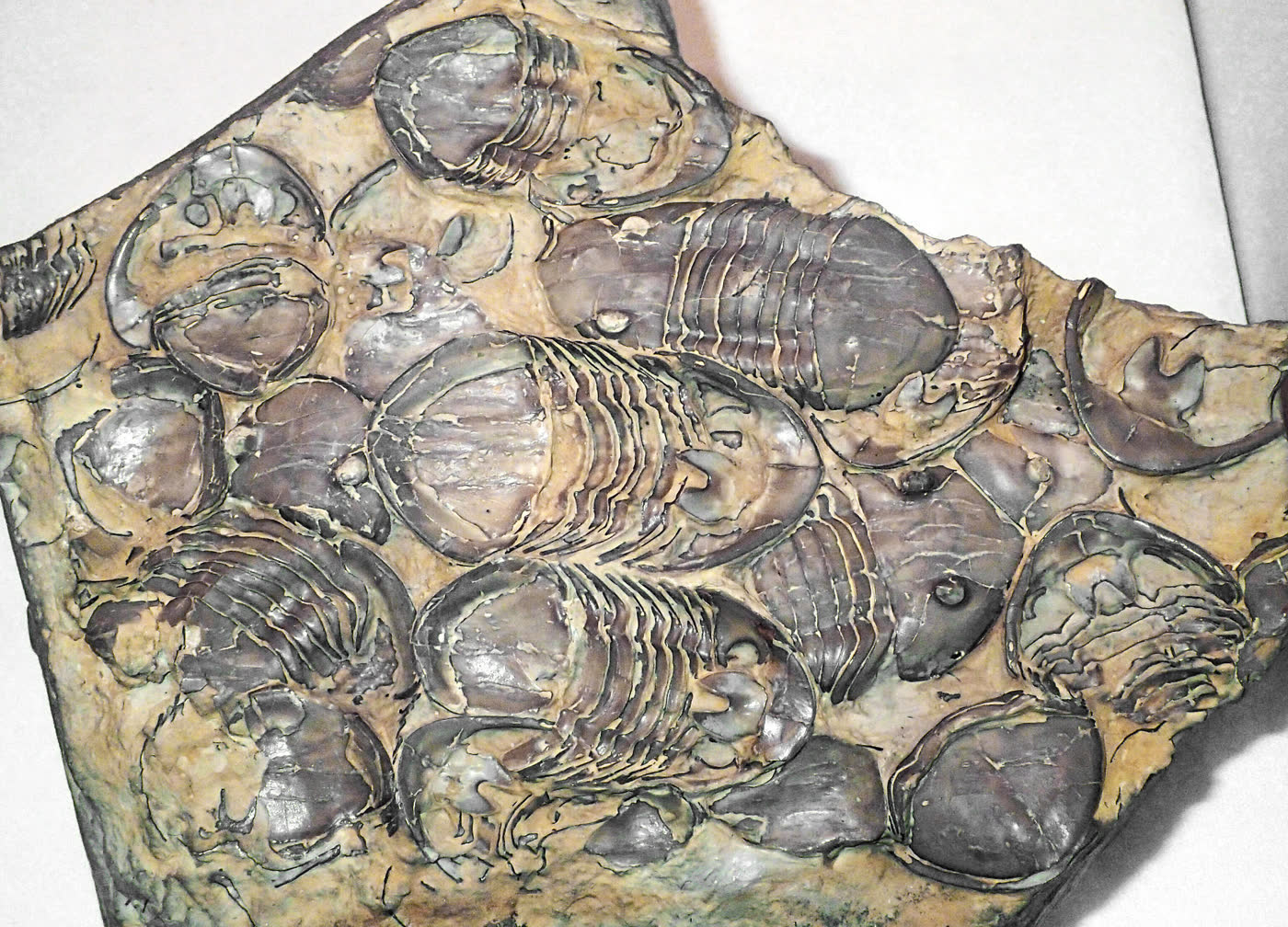
This is where the fossil image earns its place. A slab of complete Ordovician trilobites is vivid, but it also carries a warning. Even a beautiful concentration of bodies is not a whole ocean. The Wikimedia source page for the Homotelus bromidensis slab notes that such Bromide Formation concentrations have been interpreted in several ways: mating congregations, mass mortality surfaces, mass molting surfaces, or mixtures of molts and carcasses.[5] That uncertainty is not a defect. It is the correct scale of paleontology. An Ordovician bed gives abundance, preservation style, orientation, horizon, and taxonomy; turning that into behavior or ecosystem history requires caution.
The same caution applies to causes. A 2009 GSA Today synthesis described the GOBE in terms of interrelated processes: shelf area, tropical habitat, climate and sea-level change, tectonism, volcanism, planktonic change, and feedbacks crossing thresholds rather than abrupt triggers.[2] That is the most useful causal model because it resists a single master key. Diversification can be real and still have many partial engines.
Oxygen is a good example of why the boundary matters. It is tempting to say more oxygen simply permitted more animals. A 2022 Communications Earth & Environment study complicates that story. The authors describe the GOBE as the greatest recorded increase in marine animal biodiversity, but their uranium-isotope work argues that the steepest richness rise occurred during global marine redox stability, while later ocean oxygenation could not have directly driven the main biodiversification pulse.[4] Their conclusion is not "oxygen did not matter anywhere." It is narrower: stable redox conditions may have helped ecosystems become resilient enough for marine life to radiate, while a simple oxygen-up-diversity-up story is too blunt.[4]
That distinction is the essay's core point. The Ordovician radiation was not only a biological response to one environmental gift. It was a long negotiation among environmental stability, geography, evolving food webs, ecological opportunity, and the animals themselves. The organisms mattered. A brachiopod or bryozoan is not a passive beneficiary of sea level. It is a body that filters, attaches, grows, competes, and creates or occupies structure. A graptolite is not just a range chart. It is part of the planktonic and pelagic reorganization. A trilobite slab is not just a fossil crowd. It is a local surface where behavior, preservation, and population structure may intersect.[2][3][5]
The GOBE also changes how the Cambrian explosion should be remembered. The Cambrian did not finish marine life by producing the first recognizable animal body plans. The Ordovician shows that body plans are only the beginning of ecological history. The later work is filling: more forms inside clades, more modes of feeding, more vertical structure, more regional differentiation, more stable communities, and more ways for organisms to make a living in the same ocean.[1][2][3]
That filling is less cinematic than an explosion, but it is arguably more consequential for the Paleozoic world. After the Ordovician radiation, marine ecosystems were no longer merely stocked with evolutionary novelties. They were organized with a density and ecological complexity that would shape the rest of the era.[3] The story is not one instant of invention. It is the seas becoming harder to summarize because they had become fuller, more regional, more tiered, and more alive with interactions.
The strongest way to read the GOBE, then, is as a long marine build-out. It was an event only if "event" can mean a distributed transformation measured across habitats, clades, basins, and feedbacks. A diversity curve can show the rise. A fossil slab can show the local reality. The real achievement is holding both views together without letting either one become too simple.
Sources
- Thomas Servais, Borja Cascales-Minana, and David A. T. Harper, "The Great Ordovician Biodiversification Event (GOBE) is Not a Single Event," Paleontological Research 25, no. 4 (2021), full text.
- David A. T. Harper, "Understanding the Great Ordovician Biodiversification Event (GOBE)," GSA Today 19, no. 4/5 (2009), PDF synthesis of causes, feedbacks, and thresholds.
- National Park Service, "Ordovician Period--485.4 to 443.8 MYA," overview of Ordovician timing, marine-fauna expansion, new species, reefs, trace fossils, and end-Ordovician extinction context.
- Alvaro del Rey et al., "Stable ocean redox during the main phase of the Great Ordovician Biodiversification Event," Communications Earth & Environment 3, article 220 (2022).
- Wikimedia Commons, "File:Homotelus bromidensis fossil trilobites (Bromide Formation, Middle Ordovician; Criner Hills, southeastern Carter County, southern Oklahoma, USA) 2.jpg," source page for the article image.