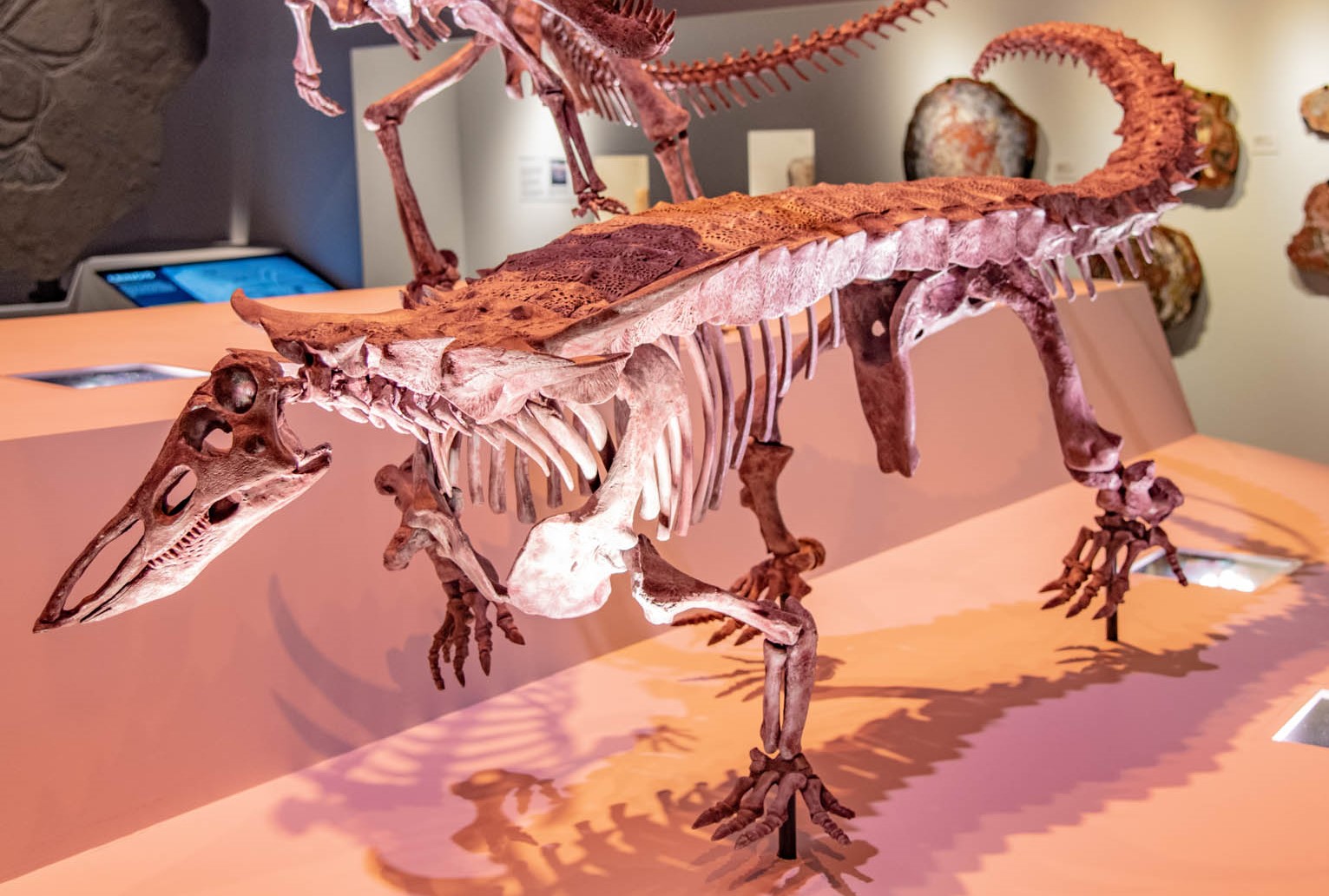
Aetosaurs look familiar in the wrong way. A mounted Desmatosuchus can seem like a low, armored dinosaur with a crocodile tail and a line of shoulder spikes. That is the first trap. Aetosaurs were not dinosaurs. They were pseudosuchian archosaurs, on the crocodile side of the archosaur split, and their scientific value comes from a stranger combination: Late Triassic herbivory, heavy body armor, small heads, shovel-like snouts, and a fossil record that often preserves the armor better than the rest of the animal.[2][3][4]
That combination makes them excellent lineage-context fossils. They sit in the crowded Late Triassic world before dinosaurs became ecologically dominant, when crocodile-line archosaurs were experimenting with large bodies, erect limbs, armor, predation, herbivory, and semi-aquatic or terrestrial lifestyles in many different combinations. Aetosaurs show that the crocodile line was not only a route toward modern crocodilians. It also produced broad, armored, mostly plant-eating animals that occupied a major terrestrial role before the end-Triassic crisis removed them.[2][3]
Armor is the clue and the distortion
The University of California Museum of Paleontology gives the useful public starting point: aetosaurs were Late Triassic reptiles with long bodies, armor over the trunk and tail, and, in some forms such as Desmatosuchus, shoulder or flank spikes.[2] The same overview emphasizes the localities that made the group familiar: Elgin in Scotland, the Chinle Formation in western North America, and other records from Europe and the Americas.[2] Those are not just map points. They explain why the group entered paleontology through pieces.
The most common aetosaur fossils are osteoderms, the bony plates of the armor.[2] That makes sense taphonomically. Plates are durable. Heads, limbs, and ribs are less often preserved as complete, articulated packages. But this creates an interpretive bias. If the fossil record keeps handing paleontologists armor, armor starts doing too much work. It becomes a taxonomic character, a display feature, a defensive signal, a biostratigraphic marker, and a public identity all at once.[3][4][6]
That is why aetosaurs are clearest when the armor is treated as both evidence and risk. Parker's 2016 phylogenetic analysis makes the problem explicit: aetosaur relationships had been difficult partly because of overreliance on osteoderm characters, some of which are poorly constructed or suspected to be highly homoplastic.[3] Homoplasy means similar character states can arise independently, not because they were inherited from one close common ancestor. In a group where the armor is the best-preserved and most eye-catching material, that is a serious warning.
A crocodile-line herbivore is not a contradiction
The second trap is ecological. Crocodile relatives are often imagined as predators by default. Aetosaurs push against that habit. UCMP describes them as primarily herbivorous, with small heads, spoon- or leaf-shaped teeth, and a toothless, shovel-like snout tip that may have helped with roots, rhizomes, or tubers.[2] Parker's abstract gives the technical version at clade scale: Aetosauria was one of only two Late Triassic clades of large herbivorous archosaurs and therefore had a critical ecological role.[3]
That does not mean every detail of diet is settled. The better claim is bounded: aetosaurs were quadrupedal armored pseudosuchians with herbivorous to omnivorous signals, and they occupied large-bodied plant-eater roles in Late Triassic terrestrial faunas.[3][4][5] The Aetosauroides scagliai skull paper is especially useful here because it keeps the earliest parts of the group from looking too specialized. The Brazilian skull preserves an anterior rostrum and shows a shovel-shaped premaxilla, but also recurved, serrated maxillary teeth, which the authors treat as plesiomorphic features within Aetosauria.[4] In plain terms, the plant-eater story should not be flattened into one finished feeding style.
That nuance makes the group more interesting. Aetosaurs were not modern crocodiles that accidentally ate salad. They were crocodile-line archosaurs experimenting with bodies suited to terrestrial plant use: armor instead of speed as a defensive strategy, relatively small heads, broad trunks in some forms, and limb positions that kept the body working on land.[2][3][4] Their ecology belongs to the crocodile side of the archosaur tree, but it does not behave like the living crocodile stereotype.
The snout matters because the animal was not just a shell
The skull is the best antidote to the armor-only aetosaur. In the Aetosauroides paper, the authors stress that the premaxilla is a key element in aetosaur cranial morphology and that the new Brazilian material made the front of the skull more complete.[4] That matters because a shovel-like snout is not just a visual flourish. It connects feeding, substrate interaction, and lineage comparison.
UCMP's older public phrasing imagines a pig-like snout over a shovel-shaped jaw.[2] The image is vivid, but the fossil question is more specific. Which parts of the snout are expanded? Are teeth present in the premaxilla? Are maxillary teeth leaf-like, cylindrical, recurved, or serrated? Does the jaw suggest cropping, digging, omnivory, or a more mixed early condition? Aetosaurs become biologically legible only when those features are read beside the armor, not underneath it.
That point is important for Desmatosuchus too. The photographed mount used here is visually dominated by plates and spikes, but the small skull and forward end of the jaws help explain why the animal should not be read as a predator with armor. Its profile makes more sense as a large armored terrestrial forager whose defenses were built into the outside of the body while feeding mechanics stayed concentrated in a relatively small head.[1][2]
Osteoderms made the fossil record useful, then made it noisy
Aetosaur osteoderms are not only defensive plates. They are also the reason the group is so prominent in Late Triassic continental rocks. The PLOS Aetosauroides paper notes that diagnostic osteoderm morphology allowed authors to diagnose taxa and apply aetosaurs as index fossils for Upper Triassic continental strata.[4] That is the positive side of the armor. A plate can date and correlate a rock unit when more complete skeletons are absent.
The negative side is the same fact turned around. The paper immediately warns that similar ornamentation patterns are shared in several species, and that isolated osteoderms are not sufficient to distinguish species by themselves.[4] Parker's 2016 analysis comes to a related methodological lesson from another angle: character conflict between cranial and postcranial regions helps weaken support for some aetosaur clades.[3] Different anatomical modules can carry different phylogenetic signals.
This is where the lineage context becomes sharper. Aetosaurs do not merely show "armor evolved." They show what happens when armor is abundant enough to become the primary fossil language of a clade. It gives paleontologists a powerful tool, but it also tempts them to over-score the best-preserved surface and underweight the rest of the skeleton.[3][4][6]
Under the armor, the skeleton keeps changing the story
Recent work keeps pushing the group away from armor-only taxonomy. Hoffmann, Heckert, and Zanno's CT reconstruction of Coahomasuchus chathamensis is literally titled "Under the armor," and the premise is the right one: an articulated specimen can hide internal skeletal evidence beneath the carapace.[5] The study used X-ray computed tomography to reconstruct material that was difficult to access externally, tying skeletal anatomy back into a phylogenetic analysis rather than letting the armor speak alone.[5]
Marsh and colleagues' work on Acaenasuchus geoffreyi pushes the same lesson into the origin of the aetosaurian carapace. The taxon had long been unstable: possible aetosaur, possible juvenile of Desmatosuchus, or possible non-aetosaurian pseudosuchian. New cranial, vertebral, appendicular, and osteoderm material changed the assessment. Their analysis recovered Acaenasuchus and Euscolosuchus as sister taxa just outside Aetosauria and concluded that some osteoderm character states once thought exclusive to aetosaurs had a broader distribution.[6]
That is a clean warning. Armor can appear aetosaur-like before an animal is actually an aetosaur. If paleontologists read plates without enough skull and limb context, the tree can wobble. The broader origin story of the carapace therefore has to include near-relatives, juveniles, growth, histology, and non-armor bones, not only the most obvious scutes.[6]
What aetosaurs clarify
Aetosaurs clarify the Late Triassic by making the crocodile line more ecologically varied. They were not side characters waiting for dinosaurs to take over. They were globally distributed, diverse, armored pseudosuchians in terrestrial faunas, and large herbivory was part of their role.[2][3][4] Their extinction at the end of the Triassic removed one of the major plant-eating archosaur experiments before Jurassic ecosystems took a different shape.[2]
They also clarify how paleontology works when the most common fossils are not the whole animal. An aetosaur osteoderm is evidence, but it is not a skeleton. A mounted Desmatosuchus is memorable, but it can turn armor into a costume if the skull and limbs are ignored. A basal Aetosauroides skull can revise the feeding baseline. A CT-scanned Coahomasuchus can recover hidden anatomy. An Acaenasuchus reassessment can show that carapace-like traits spread outside the strict clade.[3][4][5][6]
The strongest version of the aetosaur story is therefore not "armored crocodile" and not "Triassic tank." It is a lineage-context story about a crocodile-side branch that made herbivory, armor, terrestrial posture, and noisy fossil evidence work together. Aetosaurs matter because they make the Late Triassic less dinosaur-centered and because their own record teaches restraint: the plate is the first clue, not the final animal.
Sources
- Evolutionnumber9, "HMNS Desmatosuchus cropped.jpg," Wikimedia Commons file page for the museum mount photograph used as the article image.
- University of California Museum of Paleontology, "Introduction to the Aetosauria" - public overview of aetosaur anatomy, localities, armor, habitat, and herbivory.
- William G. Parker, "Revised phylogenetic analysis of the Aetosauria (Archosauria: Pseudosuchia); assessing the effects of incongruent morphological character sets," PeerJ 4:e1583 (2016), PubMed record.
- Ana Carolina Biacchi Brust et al., "Osteology of the first skull of Aetosauroides scagliai Casamiquela 1960 (Archosauria: Aetosauria) from the Upper Triassic of southern Brazil," PLOS ONE 13, no. 8 (2018).
- Devin K. Hoffman, Andrew B. Heckert, and Lindsay E. Zanno, "Under the Armor: X-ray Computed Tomographic Reconstruction of the Internal Skeleton of Coahomasuchus chathamensis," PeerJ 6:e4368 (2018), PubMed record.
- Adam D. Marsh et al., "Skeletal anatomy of Acaenasuchus geoffreyi Long and Murry, 1995 (Archosauria: Pseudosuchia) and its implications for the origin of the aetosaurian carapace," Journal of Vertebrate Paleontology (2020), PDF hosted by VTechWorks.