
The title of the American Museum of Natural History's short film invites an easy misunderstanding. Finding Trilobites on Anticosti Island sounds like a familiar fossil-hunt format: a remote landscape, a charismatic invertebrate, and a team happy to get wet in the field.[1] The video's real subject is stricter. Melanie Hopkins and her colleagues are not on Anticosti because trilobites are collectible mascots. They are there because the island preserves one of the world's best records of how marine life moved through the end-Ordovician crisis, often described as the first mass extinction of animal life.[1][2][3]
That distinction changes how the whole five-minute film reads. Anticosti is not valuable merely because it yields good specimens. It matters because stratigraphy, fossil preservation, and landscape exposure all line up in one place. The AMNH page for the film states the point plainly: these deposits record how marine invertebrates including trilobites, crinoids, and brachiopods responded to that extinction interval, and Hopkins has been working there since 2017.[2] UNESCO pushes the claim even harder, calling Anticosti the most complete and best-preserved paleontological record of that first mass extinction and describing it as a ten-million-year marine record from the Upper Ordovician into the Lower Silurian.[3]
So the best way to watch the video is not as a travelogue about where trilobites happen to be found. It is an introduction to Anticosti as an extinction transect. The film keeps returning to three linked scales: the island itself as a mapped field area, the fossil assemblages that span extinction and recovery, and the body-size measurements the team is collecting as a proxy for ecological stress and rebound.[1][4][5]
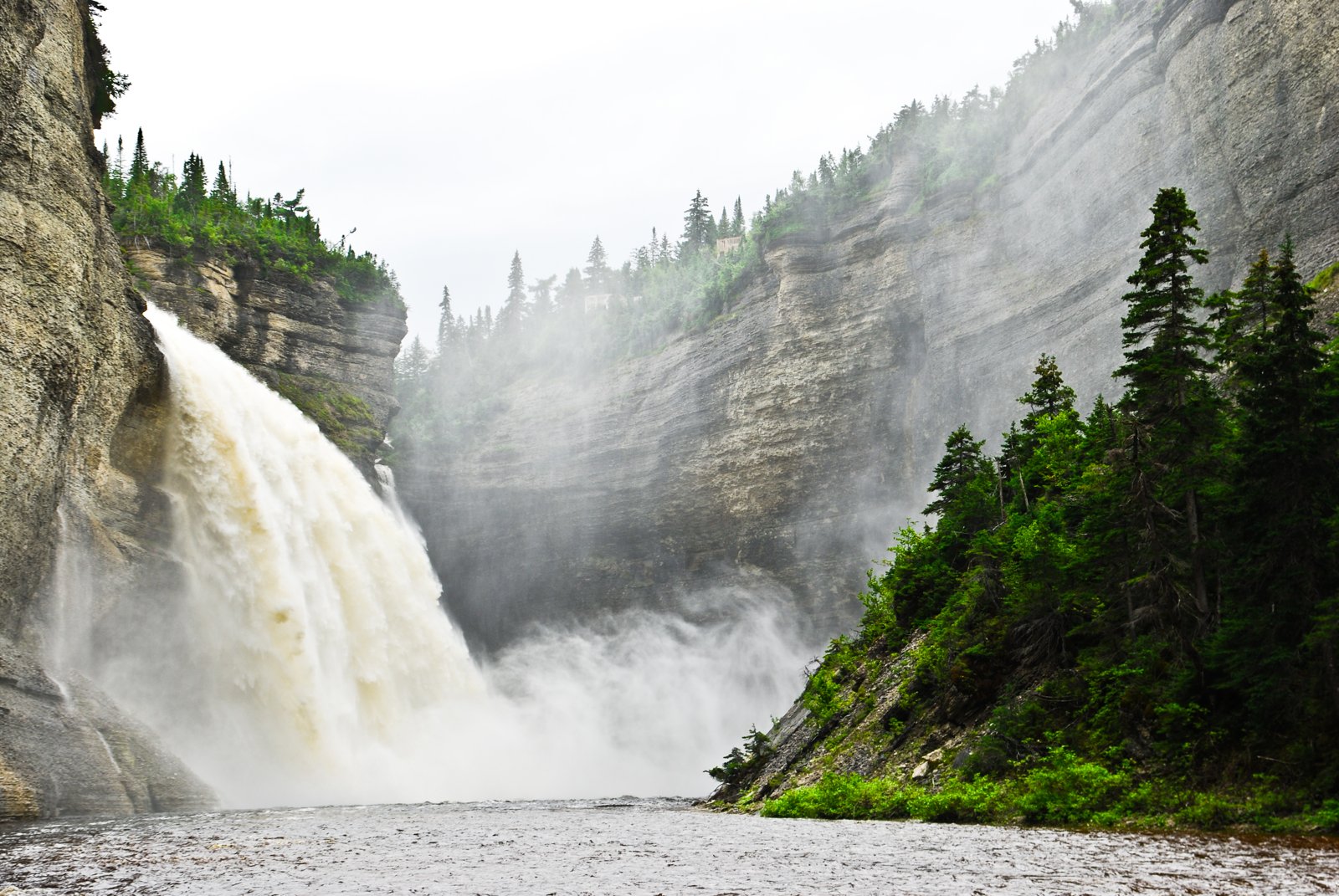
Image context: the cover uses a real Wikimedia Commons photograph of Vauréal Falls on Anticosti Island.[6] That is the right lead image because the article's argument depends on exposure. The island's rivers and coastal cuts are not decorative scenery around the fossils; they are part of the reason the extinction interval can be observed continuously enough to support serious comparison.
Around 0:20, the trilobites are really an entry point into mass-extinction fieldwork
The first important move in the video is verbal rather than visual. Hopkins says extinction happens all the time, but mass extinctions are intervals of drastic environmental change, and the one she cares about took place about 445 million years ago.[1] That framing matters because it keeps the film from shrinking into specimen-chasing. Trilobites are useful here precisely because they sit inside a larger marine community whose disruption and recovery can be traced in the rocks.[1][2][3]
AMNH's own write-up reinforces that wider frame by describing Anticosti as a place where multiple invertebrate groups preserve a record of response to the crisis, not as an island famous for a single fossil taxon.[2] UNESCO's description does the same at a larger scale: Anticosti is a fossiliferous and stratigraphic site where shell beds, soft-bodied traces, and exceptionally preserved marine communities can be read across the extinction interval.[3] That makes the trilobite hunt legible as a pedagogical choice. Trilobites give the viewer a recognizable anchor, but the scientific question is how an entire marine system changed.
Around 1:25, the island matters because it is long enough and structured enough to behave like a map through time
Midway through the film Hopkins explains that Anticosti is about 250 kilometers long and 40 to 50 kilometers wide, with the best exposures along rivers and the coast.[1] She then gives the video's most important geological sentence: the rocks range from the late Ordovician into the early Silurian and form a relatively complete record of the end-Ordovician mass extinction.[1] Once that sentence lands, the whole field site becomes more than a backdrop. It becomes an organized section through extinction and recovery.
The written sources show why that claim is not just outreach shorthand. UNESCO describes the island as the largest stratigraphic record in thickness and the most complete, best-preserved marine fossil record of that transition, explicitly covering the Upper Ordovician to Lower Silurian interval.[3] The stratigraphic revision by Copper and colleagues makes the same point in more technical language, calling western Anticosti one of the most complete tropical carbonate sequences spanning a major Phanerozoic mass extinction and emphasizing that richly fossiliferous faunas record the changeover from late Ordovician communities into earliest Silurian recovery assemblages.[4]
This is why the video's field footage of people wading rivers deserves to be read analytically. The effort is not only about reaching remote outcrops. It is about moving through a record whose spatial layout preserves sequence. By the time Hopkins later explains that the rocks get older to younger from north to south and shift from shallow to deeper environments from east to west, the island starts functioning almost like a walkable diagram of time and setting, except the evidence is in real outcrop rather than a textbook panel.[1]
Around 2:40, body size turns the film from scenic geology into a testable ecological argument
The most revealing moment in the video comes when Hopkins explains what the team is measuring. They are collecting body-size data because size can work as an indirect ecological proxy, and one recurring expectation across extinction intervals is that organisms may become smaller under stress.[1] That is the point where the film stops being simply descriptive and becomes a question-driven piece of paleobiology. The team is not only finding fossils; it is asking whether Anticosti records a size decline across the extinction, and in which groups.[1]
The broader literature shows why that question is a serious one. Borths and Ausich's study of Ordovician-Silurian crinoids describes a Lilliput effect during the end-Ordovician biotic crisis and explicitly identifies Anticosti as a noteworthy case because it preserves a nearly complete shelly record across the boundary.[5] Copper and colleagues likewise note that the earliest Silurian recovery brachiopod fauna on Anticosti is often small-shelled, which fits the video's interest in whether post-crisis communities were physically diminished before fuller recovery.[4]
What makes the video strong is that it does not oversell that hypothesis as already solved. Hopkins presents body size as something to be tested with comparative sampling, not as a slogan attached to climate catastrophe.[1] That restraint is important. The article's claim is not that every lineage on Anticosti shrank in exactly the same way. It is that the island gives paleontologists unusually good conditions for checking whether size, environment, and faunal turnover line up across the extinction boundary.[1][4][5]
Around 3:25 and after, exposure is part of the scientific method
Late in the film Hopkins says interest in Anticosti keeps growing because of the time period it captures and the quality of preservation.[1] The supporting sources make clear that preservation alone is not the whole story. UNESCO stresses that natural erosion along nearly 550 kilometers of coastal outcrop, plus river sections including the Vaureal and Jupiter rivers, keeps revealing new fossil horizons.[3] In other words, the island remains scientifically productive because its geological archive is both rich and readable.
That helps explain the video's tone. It does not romanticize the field as heroic hardship for its own sake. The river crossings matter because exposure is one of the conditions that lets stratigraphy become evidence. Without those cutbanks, bedding planes, and coastal sections, Anticosti would still have buried fossils, but it would be far harder to use the island as a continuous extinction laboratory.[3][4][6]
Read this way, Finding Trilobites on Anticosti Island is less a fossil-hunt clip than a compact argument about how paleontology works when geography cooperates.[1] A single island can hold sequence, environmental gradient, fossil abundance, and testable ecological proxies in the same field season. Trilobites are the invitation. The deeper subject is how an extinction boundary becomes legible when rock record, preservation, and exposure all stay open long enough for paleontologists to ask not only what died, but how communities changed on the way through.[1][2][3][4][5]
Sources
- American Museum of Natural History, "Finding Trilobites on Anticosti Island," YouTube video.
- American Museum of Natural History, "Finding Trilobites on Anticosti Island."
- UNESCO World Heritage Centre, "Anticosti."
- Paul Copper, Jisuo Jin, A. D. McCracken, et al., "The Ordovician-Silurian boundary (late Katian-Hirnantian) of western Anticosti Island: revised stratigraphy and benthic megafaunal correlations."
- Matthew R. Borths and William I. Ausich, "Ordovician-Silurian Lilliput crinoids during the end-Ordovician biotic crisis," Swiss Journal of Palaeontology 130 (2011).
- Wikimedia Commons, "File:Chute Vauréal - Anticosti.jpg" (lead image source page).