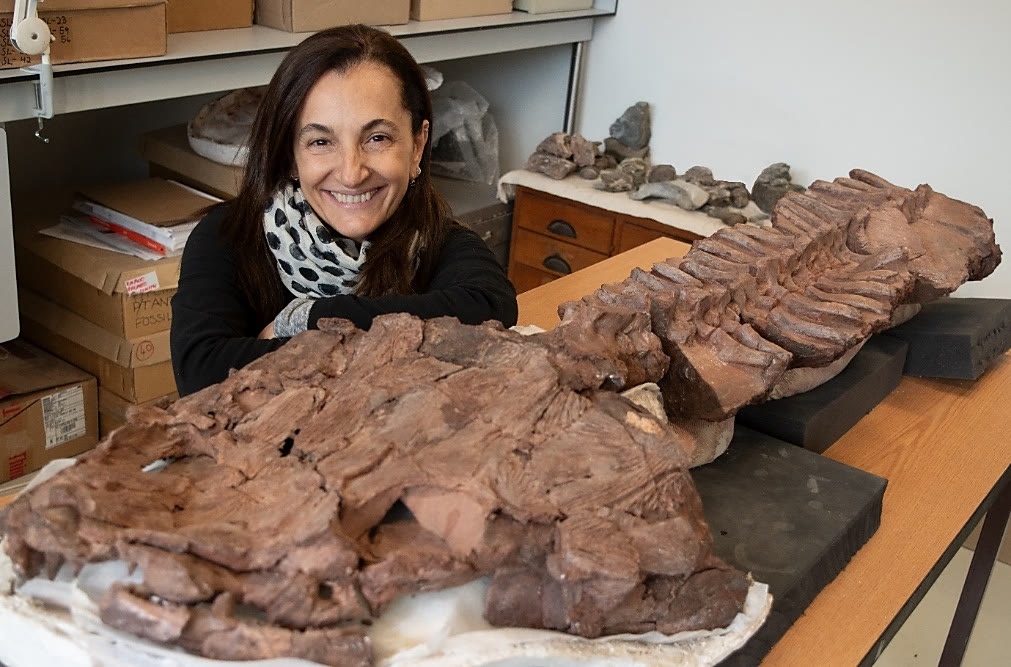
Gaiasia jennyae should not be introduced as a monster first. The fangs are spectacular, the skull is huge, and the animal probably sat high in its freshwater food web, but the more interesting story begins with why such an old-looking stem tetrapod was still there at all. The fossil came from early Permian rocks of Namibia, about 280 million years old, in a region that sat at high southern latitude in late Palaeozoic Gondwana.[1][2]
That geography matters as much as the teeth. Classic early-tetrapod stories lean heavily on Carboniferous equatorial wetlands in Laurussia: coal swamps, northern fossils, and a turnover narrative in which archaic stem tetrapods give way to the lineages that eventually include modern amphibians, reptiles, birds, and mammals.[1] Gaiasia interrupts that map. Its body says that some large, archaic-looking aquatic predators still had ecological room far to the south, in cold-temperate Gondwanan landscapes, after the equatorial story had already moved on.[1][4]
The cleanest way into the animal is anatomical. The formal Nature description identifies Gaiasia as a giant stem tetrapod represented by several large, semi-articulated skeletons, with a skull that was weakly ossified, loosely joined in the palate, and dominated by a broad diamond-shaped parasphenoid.[1] Those are not poster details. They are the features that let paleontologists place the animal and keep it from becoming a generic "giant amphibian" headline.
The front of the mouth is where the fossil first gets its bite. The skull preserves enlarged, interlocking fangs on the dentary and coronoid bones, and the museum account notes enormous backward-curved fangs in both the upper and lower jaws.[1][2] It is tempting to make that a simple predator label: big teeth, big animal, top hunter. The better reading is more disciplined. The teeth define a capture system, not a whole behavior. They support the idea of a strong aquatic predator, but the exact strike, feeding rhythm, and prey handling still have to be inferred from skull shape, jaw construction, associated fauna, and comparison with other early tetrapods.[3][4]
That boundary is useful because Gaiasia looked surprising even to the people who prepared it. Iziko's account says the fossil was first thought to be a large temnospondyl amphibian; preparation then revealed more primitive features associated with older four-limbed animals previously known from northern rocks.[2] This is one reason the article belongs in an anatomy-and-method mode rather than a species-card mode. The claim did not arrive fully formed in the field. It emerged as the skull was cleaned, the palate became legible, and the team could compare the animal against a wider early-tetrapod matrix.[1][2]
The preparation history also keeps the fossil physical. The near-complete skeleton was found in the Ugab River valley of Damaraland, taken to the Iziko South African Museum in Cape Town in 2018, and prepared in the Karoo Fossil Laboratory before the specimen was returned to Windhoek for the Geological Museum of Namibia.[2] The Field Museum's account adds that the team had several specimens, including one with a well-preserved, articulated skull and spine, which is why the comparison could go beyond a single dramatic block.[3] That matters because the polished evolutionary claim rests on a messy chain of recovery: weathered pieces, lab preparation, comparison, and naming.
The name itself is a geographic and intellectual marker. Gaiasia refers to the Gai-As Formation area; jennyae honors Jennifer Clack, whose work helped make early tetrapods readable as real animals rather than ladder rungs between fish and land vertebrates.[2][4] The honor is apt because Gaiasia continues that correction. It is not a direct ancestor placed conveniently on the road to us. It is a large southern survivor on the tetrapod stem, resolved in the Nature paper as sister to the Carboniferous Colosteidae from Euramerica.[1]
That phylogenetic address is the hinge. A sister relationship to colosteids does not mean Gaiasia was a colosteid copied into Namibia, and it does not make the animal a missing link. It says that a lineage close to those northern Carboniferous stem tetrapods had a larger, later, southern expression than the old sampling picture encouraged researchers to expect.[1] The fossil therefore changes the map before it changes the textbook family tree. It tells paleontology to stop treating the northern record as if it were the whole early tetrapod world.
The high-latitude setting sharpens the point. The Nature paper places Gaiasia in deposits around 55 degrees south palaeolatitude during the final phases of Carboniferous-Permian deglaciation, and argues that continental tetrapods were already well established in cold-temperate Gondwana.[1] Field Museum and Smithsonian summaries make the same contrast in plain language: while equatorial regions were changing, far-southern wetland systems could still support large predators from archaic stem-tetrapod branches.[3][4] That is not a minor range extension. It changes the default environment imagined for early tetrapod persistence.
The fossil's scale helps make that inference harder to ignore. Iziko describes a near complete skeleton about three meters long, and the Field Museum release emphasizes a skull more than two feet long.[2][4] Nature Africa summarized the find as the oldest and largest tetrapod then known from south of the equator.[5] Size alone is never enough; paleontology has plenty of oversized animals that are scientifically shallow once the shock wears off. In Gaiasia, scale works because it is paired with place. A large predator requires enough prey, habitat stability, and ecosystem structure to sustain it. The animal is therefore evidence for a functioning Gondwanan freshwater ecosystem, not merely an isolated big skull.[3][4]
The appearance question needs the same care. The fossil justifies a broad, flat skull, large interlocking fangs, a long body, and aquatic predation as strong inferences.[1][3][4] It does not justify treating every published life image as if it were the fossil itself. Soft tissue, exact skin texture, color, posture in the water, and moment-by-moment hunting behavior are reconstruction layers. They may be reasonable when made by scientific illustrators working with the anatomy, but they remain downstream from the bones. The photograph above is useful precisely because it keeps the reader in front of the specimen before imagination fills the swamp.
That is the larger lesson. Gaiasia is not important because it makes early tetrapod evolution simpler. It makes the old simple version less defensible. A giant, fang-bearing stem tetrapod in early Permian Namibia means archaic forms were not merely leftovers in a northern story. Some were large, ecologically serious animals in southern landscapes that the fossil record had barely sampled.[1][2][4]
The strongest reading of Gaiasia is therefore anatomical first and biogeographic second. The skull and fangs make the animal legible as a predator. The semi-articulated skeletons make it a specimen-level claim rather than a loose tooth story. The Gai-As setting makes it a southern Gondwanan data point. Together, they turn one fossil into a correction: early tetrapod history was not a single equatorial handoff. It was a patchier world, with old branches still biting in places the classic map had left cold and blank.[1][5]
Sources
- Claudia A. Marsicano, Jason D. Pardo, Roger M. H. Smith, et al., "Giant stem tetrapod was apex predator in Gondwanan late Palaeozoic ice age," Nature 631 (2024) - formal description, anatomy, phylogeny, age, and high-latitude context.
- Iziko Museums, Roger Smith, "Giant fossil tetrapod from Namibia" (2024) - field recovery, preparation history, captioned fossil photographs, naming context, and museum account.
- Field Museum, "Postdoctoral Fellow Publishes In Nature" (July 12, 2024) - institutional summary of Jason Pardo's co-authored paper, ecology, skull-and-spine material, colosteid framing, and high-latitude interpretation.
- Christian Thorsberg, "Before the Dinosaurs, This Massive Salamander-Like Predator Ruled Earth's Swamps," Smithsonian Magazine (July 5, 2024) - independent coverage of the find, skull scale, ecology, and Gondwanan setting.
- Elsabe Brits, "Giant tetrapod fossil revises extinction era and broadens range," Nature Africa (August 8, 2024) - independent research highlight on the fossil's southern-hemisphere significance.