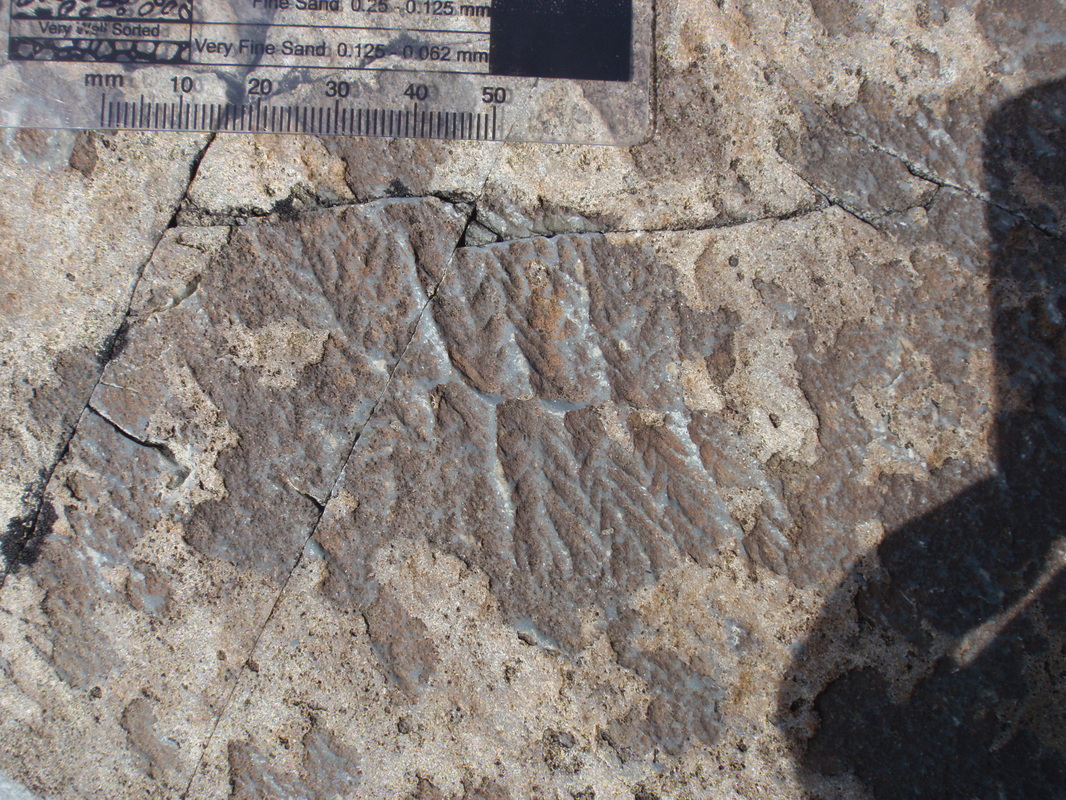
Fractofusus is not the kind of fossil that wins attention by looking like a monster. It is a low, spindle-shaped Ediacaran rangeomorph from Newfoundland: rows of repeated branching units pressed into bedding planes that once formed a deep-marine seafloor. The animal, if that is the right word for the broader group, had no obvious head, mouth, limbs, gut, or shell. Its importance comes from a quieter advantage. Many specimens stayed where they lived closely enough that their positions can be read as biological evidence, not just as scattered shapes on rock.[1][2]
That makes Fractofusus one of the best fossils for asking a problem that usually disappears before paleontologists arrive: how did a soft-bodied organism reproduce? Most deep-time reproduction is inferred from eggs, embryos, brood structures, or later living analogies. Here the evidence is spatial. Individuals cluster, smaller forms sit around larger ones, and some surfaces preserve enough of the original population layout that reproduction becomes a map problem.[2]
Image context: the cover uses a real Ediacaran.org fossil photograph of Fractofusus andersoni from the H14 surface on Newfoundland's Bonavista Peninsula. It is used here because the central claim is not about a speculative life restoration. It is about the preserved bedding-plane expression of a reclining rangeomorph.[1]
The fossil only works if it stays flat
The first discipline is posture. Ediacaran fronds are easy to imagine as upright sea-pen-like bodies waving in current, but Fractofusus has usually been read differently. Ediacaran.org summarizes the key reasoning: the lower surface can be very well preserved, the specimens often lack consistent current alignment, and there is no clear anchoring structure that would force an erect life attitude.[1] The official Mistaken Point fossil guide makes the same practical point for visitors, noting that random orientations on bedding planes are part of the case for Fractofusus reclining on the seafloor rather than standing upright.[4]
That distinction changes the whole close reading. If a fossil was transported, tumbled, or knocked down from the water column, its spacing after burial may tell us mostly about currents and decay. If it was a sessile epibenthic recliner, broadly smothered where it lived, the spacing can retain ecological information. The 2024 hydrodynamic study of Fractofusus misrai starts from that widely accepted reclining interpretation while still keeping the feeding and current questions open. Its computational fluid dynamics work treated the organism as a sediment-reclining body and found flow patterns consistent with nutrient or gas exchange across the upper surface, plus a downstream wake that could affect fine sediment deposition.[5]
In other words, flatness is not a disappointment. It is the condition that makes the fossil unusually useful. A reclining body can turn a bedding plane into a census sheet.
Clusters made reproduction visible
The decisive spatial argument came from Emily Mitchell, Charlotte Kenchington, and Nicholas Butterfield's 2015 study of Fractofusus populations. Using spatial point process techniques, they found recurrent clustering patterns rather than random scatter. More importantly, they described clusters nested inside clusters: smaller individuals grouped around larger ones, with larger-scale distribution suggesting dispersal across a broader surface.[2]
The interpretation was a two-stage reproductive strategy. One stage involved waterborne propagules, which could colonize new space. The other looked stolon-like and asexual, producing local clusters as new individuals developed near earlier ones.[2] The strawberry-runner comparison often appears in public summaries, and it is useful if kept modest. The point is not that Fractofusus was a plant. The point is that the fossil pattern resembles a life history in which local clonal spread and wider dispersal both mattered.[2][6]
That is a much stronger claim than "ancient organism reproduced somehow." It ties the interpretation to measurable positions on specific surfaces. The fossil does not preserve gametes, embryos, or a reproductive organ. It preserves enough neighborhood structure to make a reproductive model testable.
The newer growth work gives the runner a body
The 2025 Nature Communications paper by Frances Dunn, Philip Donoghue, and Alexander Liu sharpened the story from another angle. Instead of starting from population spacing alone, it described a population of Fractofusus andersoni from the Mistaken Point Ecological Reserve and built a growth model from specimen morphology. The paper treats rangeomorphs as among the oldest anatomically complex macroscopic fossil organisms and argues that their morphogenesis matters for understanding early eumetazoan body-plan evolution.[3]
The useful detail is the central axis. In F. andersoni, first-order branches arise from a central line, and in some specimens that axial structure continues beyond the branching part of the body. The authors interpret that continuation as stoloniferous, while also being careful about alternative explanations for truncated or incomplete specimens.[3] That does not turn every surface mark into reproduction. It means the reproductive reading now has an anatomical partner: the same genus that shows clustered populations also preserves body architecture compatible with stolon-like extension.
The growth result is also a warning against treating Ediacaran bodies as vague bags of pre-animal geometry. Dunn and colleagues argue that F. andersoni growth was conserved and predictable enough to imply regulated morphogenesis, not loose inflation into any convenient shape.[3] That is why this fossil matters beyond its own genus. Fractofusus helps make early animal-grade complexity visible before the familiar animal tool kit of heads, guts, muscles, and skeletons dominates the record.
Feeding remains less settled than spacing
A good close reading has to separate the stronger evidence from the looser inference. Reproduction and growth are relatively well served by surfaces and specimens. Feeding remains harder. Rangeomorphs had high-surface-area branching, lived in deep-marine Ediacaran settings, and lack obvious mouths or guts. That invites absorption-based interpretations, but the exact mechanism is still debated.[3][5]
The 2024 hydrodynamic paper is valuable because it resists making Fractofusus a passive symbol. Its models suggest that flow over a reclining F. misrai could have supported dissolved or finely particulate nutrient collection and gas exchange, while oblique orientations may represent a compromise between exposure and drag.[5] Those are plausible physical constraints, not a final meal report. The fossil does not let us watch it eat. It lets us test whether a proposed way of living is compatible with shape, current, sediment, and surface area.
That boundary matters for the reproduction story too. A stolon-like organism lying on the bottom would experience its neighbors differently from a mobile animal searching for food or mates. If local clonal growth created clusters of connected or closely related individuals, then the population pattern itself could reduce direct competition among near neighbors. That idea becomes central in the newer evolutionary interpretation.[6]
The 2026 consequence is bigger, but still model-bound
In June 2026, Cambridge summarized a new study by Mitchell and Andrea Manica on how reproductive mode may have shaped early animal diversity. The paper, reported in Nature Ecology & Evolution, used laser scanning, spatial analysis, artificial intelligence, and Approximate Bayesian Computation to compare fossil diversity patterns with simulated communities. Their argument is that asexual, runner-based reproduction could limit competition and dispersal, helping explain why early Ediacaran animal communities changed slowly before later environmental stress and wider dispersal coincided with greater diversification.[6]
That is a broad evolutionary claim, and it should stay in the article as a model rather than as a finished law. The fossil record is not saying that sex suddenly solved Ediacaran evolution in one clean switch. It is saying something more disciplined: reproductive geometry affects competition, dispersal, and diversity. Fractofusus is powerful because it gives that geometry a fossil address.[2][6]
The final reading, then, is not that Fractofusus was the first animal to reproduce, or that it proves a simple path from asexual calm to sexual innovation. It is better than that. It shows how a soft-bodied, reclining Ediacaran organism can preserve life history indirectly. The body gives branch order and growth. The surface gives spacing. The clusters give a reproductive hypothesis. The hydrodynamics keep the animal inside a real seafloor. The later models ask what that kind of reproduction might have done to evolution's tempo.[2][3][5][6]
Most fossils make paleontology look like a search for bodies. Fractofusus makes it look like a search for relationships between bodies. That is why a low spindle on a Newfoundland bedding plane can carry one of the field's most unusual lessons: sometimes reproduction fossilizes as distance.
Sources
- Ediacaran.org, "Fractofusus" - species page with fossil photographs, morphology, distribution, and reproductive-pattern summary.
- Emily G. Mitchell, Charlotte G. Kenchington, and Nicholas J. Butterfield, "Reconstructing the reproductive mode of an Ediacaran macro-organism," Nature 524 (2015), PubMed record.
- Frances S. Dunn, Philip C. J. Donoghue, and Alexander G. Liu, "Morphogenesis of Fractofusus andersoni and the nature of early animal development," Nature Communications 16 (2025), PMC full text.
- Mistaken Point, "The Fossils" - official visitor page describing Ediacaran fossils and the reclining interpretation for Fractofusus.
- Roberto S. Nicholls and colleagues, "Hydrodynamic insights into the paleobiology of the Ediacaran rangeomorph Fractofusus misrai," iScience 27 (2024), PMC full text.
- Leverhulme Centre for Life in the Universe, University of Cambridge, "A lack of sex held back life's diversity for millions of years" (2026), summary and reference for Mitchell and Manica's Nature Ecology & Evolution study.