A fossil animal rarely comes with a bill for the company it kept. A small passenger might have taken food, occupied space or simply enjoyed a convenient perch. The bodies can survive together while the terms of their arrangement disappear. Calling one a parasite means recovering something less visible than attachment: an advantage purchased at another animal’s expense.[1]
That distinction changes how we look at an ancient ecosystem. Alongside the familiar questions of who ate whom sit quieter ones: who intercepted a meal, who lived inside another body, who made a host spend resources accommodating an intruder? Fossils approach these relationships through fragments that preserve different parts of the story. Three cases show how much can be recovered without pretending that every fragment answers the same question.
A place at someone else’s table
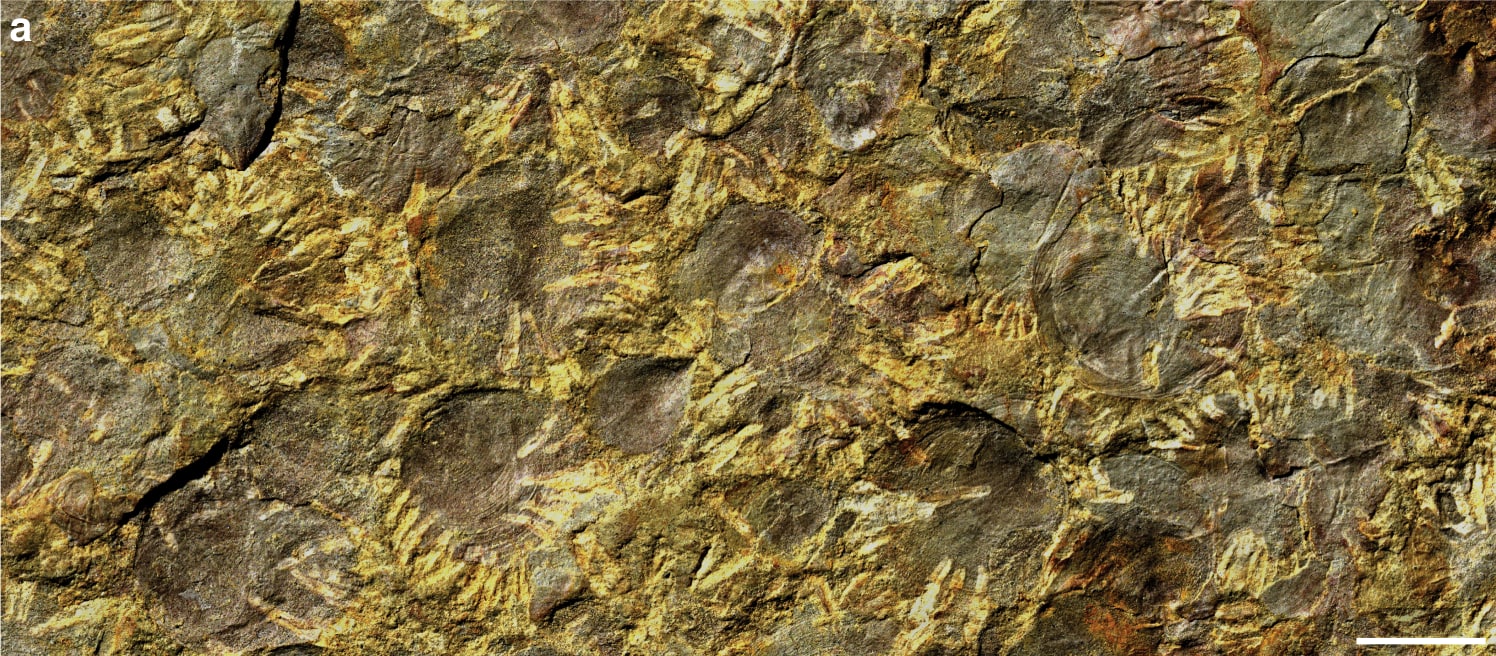
Early Cambrian Neobolus wulongqingensis fossils from China’s Wulongqing Formation carry tapering tubes whose occupants remain poorly known. The openings repeatedly face the shell margin, toward the brachiopod’s inferred feeding currents.[2]
Zhifei Zhang and colleagues’ 2020 study compared 205 tube-bearing individuals with 224 without tubes. Shell dimensions supplied estimates of body mass; the tube-bearing group averaged roughly 26 percent less. Alongside the tubes’ orientation, that difference supported food theft: residents positioned to intercept particles gathered through the brachiopod’s feeding activity.[2]
Preserved shells supplied the measurements; estimated biomass served as a proxy for fitness. Neither reproduction nor stolen meals could be observed directly. Yet the combination made a stronger case than attachment alone: a plausible feeding advantage accompanied a measurable difference between hosts.[2]
The host writes around an intruder
Devonian ammonoids offer another route into the relationship. Some preserve small depressions on internal molds—the stone casts of spaces once enclosed by shells. In their 2011 study, Kenneth De Baets, Christian Klug and Dieter Korn examined material including new specimens from Morocco and connected these pits to shell projections that had pointed inward.[3]
The projections were blister pearls: capsules of shell material, many enclosing tiny tubes. Their internal structure and arrangement, compared with structures in living mollusks, supported a parasitic origin. The host had built around something inside its shell. A pit on a cast could therefore preserve the negative of an animal’s response to an unwelcome presence.[3]
The proposed culprits were trematodes, or flukes, but fossilized soft tissue was missing. Their identity and life cycle remained provisional.[3] A physical response can survive clearly while the organism that prompted it stays uncertain. The shell keeps the accommodation; it does not necessarily keep the tenant’s name.
Eggs where a body has vanished
A third archive begins with material an animal expelled. Paula Dentzien-Dias and colleagues reported a spiral coprolite—fossil feces—from Brazil’s Rio do Rasto Formation in 2013. Described as approximately 270 million years old, the specimen contained fish remains and a cluster of 93 microscopic structures interpreted as tapeworm eggs.[4]
The coprolite’s form and contents supported a shark producer. In thin section, the eggs occupied an elongated group resembling the contents of a tapeworm’s reproductive segment; one preserved a probable developing larva. Their form supported identification as tapeworm eggs without permitting assignment to a particular living group.[4]
This is a surprisingly intimate record from an unglamorous object. The adult parasite is missing, but its reproductive output places it within a digestive history. It still supplies no measurement of how much the host suffered. Recovering an infection and recovering its consequences are separate achievements. The specimen preserves evidence of the former while leaving the latter open.[4]
An ecosystem with inhabitants inside its inhabitants
In a review published online in 2015 and in Biological Reviews in 2017, Tommy Leung emphasized how poorly parasites are represented by fossils despite their ecological importance. Preserved bodies, eggs and host damage offer different opportunities for discovery. He also warned that apparently parasitic features sometimes fit free-living organisms just as well.[5]
That warning gives the subject its discipline. Baumiller and Gahn’s earlier review framed the problem around evidence of a lasting association, a benefit to the supposed parasite and a disadvantage to its host.[1] Those questions remain useful precisely because a beautiful specimen may answer only one. Physical proximity is a starting observation; the ecological relationship requires an argument.
Read together, the tubes, blisters and eggs make extinct animals feel less solitary. Each body could be a feeding opportunity or a place to live. The resulting fossil record is uneven: sometimes it preserves the passenger, sometimes the host’s response, sometimes a statistical trace of the cost. Attending to those differences lets us reconstruct a more crowded past without filling every empty space with certainty.
Sources
- Tomasz K. Baumiller and Forest J. Gahn, “Fossil Record of Parasitism on Marine Invertebrates with Special Emphasis on the Platyceratid-Crinoid Interaction.” The Paleontological Society Papers 8 (2002), 195–210; criteria for identifying parasitic relationships.
- Zhifei Zhang and colleagues, “An encrusting kleptoparasite-host interaction from the early Cambrian.” Nature Communications 11 (2020), 2625; shell measurements, feeding interpretation and specimen photograph in Figure 1a.
- Kenneth De Baets, Christian Klug and Dieter Korn, “Devonian pearls and ammonoid-endoparasite co-evolution.” Acta Palaeontologica Polonica 56 (2011), 159–180; blister structure and limits on parasite identification.
- Paula C. Dentzien-Dias and colleagues, “Tapeworm Eggs in a 270 Million-Year-Old Shark Coprolite.” PLOS ONE 8 (2013), e55007; specimen UFRGS-PV-429-P and evidence for parasite eggs.
- Tommy L. F. Leung, “Fossils of parasites: what can the fossil record tell us about the evolution of parasitism?” Biological Reviews 92 (2017), 410–430; published online in 2015. University of New England repository record.