
Scott Wing's five-minute Smithsonian Education video does something paleontology badly needs every so often: it takes attention away from giant skeletons and puts it on a pile of fossil leaves.[1][2] That sounds modest until the argument becomes clear. The leaves are not filler from a Wyoming field site. They are instruments. Their margins, sizes, and taxonomic turnover let paleobotanists reconstruct how quickly climate changed during the Paleocene-Eocene Thermal Maximum, or PETM, roughly 55.8 million years ago.[1][2]
That shift in emphasis matters because fossil plants are easy to treat as background texture for a hotter, stranger world. Wing's video insists on the opposite order. The Bighorn Basin floras are useful precisely because they register climate in a way vertebrate spectacle cannot. The lesson plan that accompanies the video makes the method explicit: students sort fossil leaves by smooth versus toothed edges, then use leaf-margin analysis to infer average annual temperature.[2] The leaves are evidence before they are atmosphere.
The historical stakes are large enough to justify the simplicity. In the video's opening minute, Wing frames the PETM as one of the best deep-time analogs for a greenhouse perturbation that climate scientists still worry about, not because it duplicates the present in every detail, but because it records a rapid carbon-driven warming event with ecological consequences that can be tracked through real organisms.[1] That is why the clip works so well in annotated-viewing mode. It is short, but it carries a whole paleontological argument about proxy evidence, ecological turnover, and timescale.
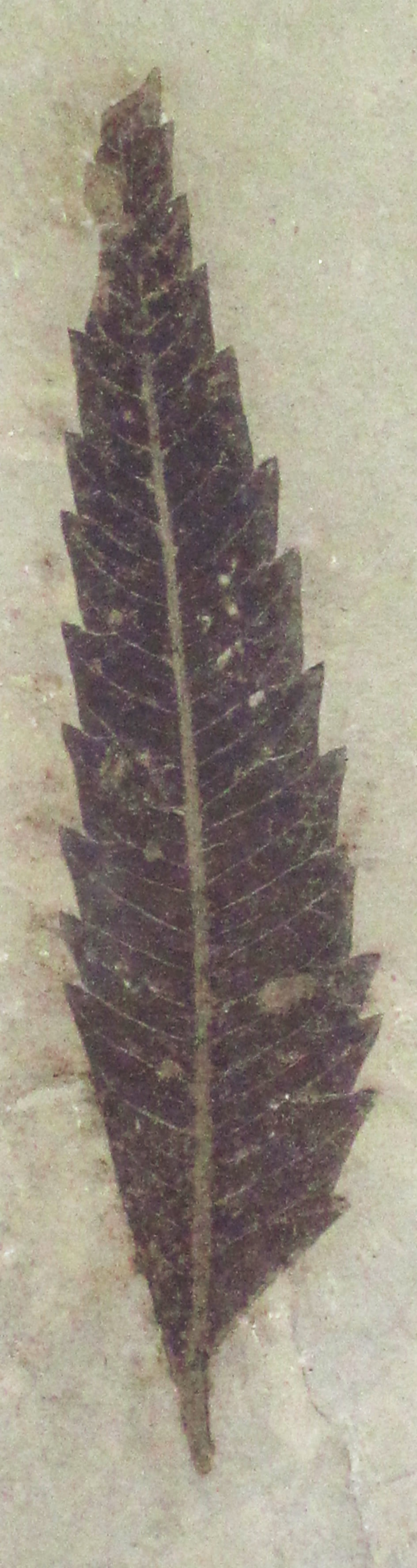
Image context: the lead image uses a real fossil-leaf photograph from Wikimedia Commons. It fits this article because the specimen preserves the outline, veins, and serrated edge clearly enough to show why leaf physiognomy became such a powerful climate tool in paleobotany.[4]
Around 0:20, the video defines the real problem: why should anyone care about 55-million-year-old leaves?
Wing begins with the skepticism built into the subject.[1] Why care about fossil leaves when climate scientists already have models? His answer is the most important line in the piece. Models are powerful, but the past supplies real experiments. The PETM is valuable because it gives paleontologists and climate scientists a physical example of what a rapid greenhouse pulse can do to terrestrial ecosystems.[1]
That opening matters because it changes the status of the leaves immediately. They are not picturesque survivors from ancient forests. They are proxy-bearing objects from one of the best-studied episodes of abrupt early Cenozoic warming. The Smithsonian lesson page sharpens the same point in more classroom language: the fossils were the first plant record from the PETM in the Bighorn Basin, and they showed more clearly than earlier evidence how dramatically living things changed during that warm-up.[2]
Taken together, the video and lesson plan suggest a more rigorous way to read paleobotany. Fossil leaves are not a softer side story next to marine isotopes or mammal evolution. They are part of the main evidentiary chain.
Around 1:20, the Bighorn Basin becomes a time-series, not a romantic field site
Once Wing shifts into the field narrative, the Bighorn Basin stops being scenic backdrop and becomes a stratigraphic machine.[1] He explains that he can compare floras from roughly 55.9, 55.8, and 55.7 million years ago and build what is almost a movie of forest change through time.[1] That phrase is memorable because it captures what fossil assemblages are doing here: not delivering one isolated climate estimate, but preserving sequence.
That sequential logic is what makes the older Bighorn Basin paleobotanical work so durable. Wing and Hickey's classic study of Paleocene-Eocene floral and climatic change in the basin is built on exactly this strength: the leaves make environmental change legible through turnover in species composition and through physiognomic traits that covary with climate.[3] The point is not simply that leaves survived fossilization. The point is that enough leaves survived, in enough stratigraphic order, to let paleontologists compare forest states before, during, and after the PETM pulse.
This is the place where the article's main claim comes into focus. A vertebrate skeleton can tell you much about one animal. A stacked leaf flora can tell you what an entire landscape was doing.
Around 2:10, smooth versus toothed margins stop looking like a classroom trick
The video's most teachable passage is the one most likely to be underestimated. In the lesson materials linked from the video description, Smithsonian Education states the method plainly: count the percentage of leaves with smooth margins rather than toothed ones, put that number into an equation, and you get an estimate for average annual temperature.[1][2] Higher proportions of smooth-edged leaves generally correspond to warmer climates.[2]
Because the procedure is easy to explain, it can sound like a simplified classroom exercise detached from serious research. It is not. What the video makes clear is that leaf physiognomy works because climate leaves statistical pressure on plant form at assemblage scale.[1][2][3] No single leaf solves the climate. The flora does. Margin type, size, and composition become useful only when many specimens are read together as a community signal.
That distinction is the difference between paleobotany as curiosity and paleobotany as method. The leaves matter less as beautiful imprints than as repeated measurements from a vanished forest. The video earns its keep here because it shows how ordinary-looking specimens become analytically dense once the viewer stops asking for spectacle and starts asking for pattern.
Around 3:20, climate change becomes visible as ecological replacement, not only as a number
The strongest sequence arrives when Wing explains what the Bighorn Basin floras looked like across the PETM.[1] Before the warming, he says, the forests would have resembled something like coastal South Carolina. During the event they shifted toward forests more like dry tropical Mexico or Central America.[1] That comparison does more work than the temperature number alone because it translates climate change into composition, moisture regime, and ecological feel.
The temperature change itself is already striking: roughly five to six degrees Celsius in about ten thousand years, with rainfall dropping at the same time.[1] But the forest comparison is what gives the claim paleontological substance. Climate is not appearing here as an abstract curve. It is reorganizing which leaves show up in the rock. Species change, leaf shapes change, and the flora as a whole stops looking like the one below it.[1][3]
That is why this clip remains valuable even in a feed full of stronger visuals. It demonstrates a core deep-time principle cleanly: climate change is not only something measured above ecosystems. It is something recorded inside them.
Around 4:20, the recovery timescale becomes the warning
The video's closing point is easy to miss because it is delivered so calmly. Wing notes that the ecological changes associated with the PETM warming took on the order of 150,000 years to dissipate.[1] In other words, the perturbation was fast on geological terms, but the recovery was not. That asymmetry is the real warning embedded in the clip.
This is where paleontology does work no modern monitoring system can do by itself. Short-term observation can show a disturbance arriving. Deep-time evidence shows how long its consequences can remain built into landscapes, plant communities, and animal worlds after the initial carbon pulse.[1][3] The fossil leaves are useful because they retain both sides of the event: rapid forcing and slow ecological unwinding.
That makes this more than a period piece about ancient warming. It is a lesson in evidentiary scale. The Bighorn leaves matter because they let paleontologists read climate from plant form, climate change from floral succession, and ecological memory from the long tail that follows a fast greenhouse shock.[1][2][3] The article's claim is simple, but it is worth stating cleanly: in this video, fossil leaves stop being scenery and become one of paleontology's sharpest climate archives.
Sources
- Smithsonian Education, "Reading the Tree Leaves: Prehistoric Climate Change and Why It Matters Today," YouTube video, published November 12, 2009.
- Smithsonian Education, "Climate Change: A Smithsonian in Your Classroom Lesson Plan" - on leaf-margin analysis, the Bighorn Basin fossil leaves, and the PETM teaching activity.
- Scott L. Wing and Leo J. Hickey, "Paleocene-Eocene floral and climatic change in the Bighorn Basin," Paleontological Society Special Publications - foundational basin-scale study of floral turnover and climatic interpretation.
- Wikimedia Commons file page for the fossil leaf photograph used as the lead image: Rhus nigricans (Green River Formation, Eocene; Utah, USA).