Most retellings cast Acanthostega as an almost-amphibian taking the first brave steps onto land. The fossil does something more disruptive. It places well-formed digits inside an animal that still belongs mainly to water. Once that point lands, the fish-to-tetrapod transition stops looking like a march and starts looking like an overlap problem: feet appear before fully terrestrial walking, and "limb" stops meaning "land animal" by default.[1][2][3]
That is why Acanthostega remains one of the cleanest fossils to read closely. The East Greenland material, from the Late Devonian around 365 million years ago, preserves not just an early tetrapod body but an argument about sequence. Digits, limb ossification, skull mechanics, and life history do not line up into a single first-step moment. They come into focus on different schedules.[2][3][4][5]
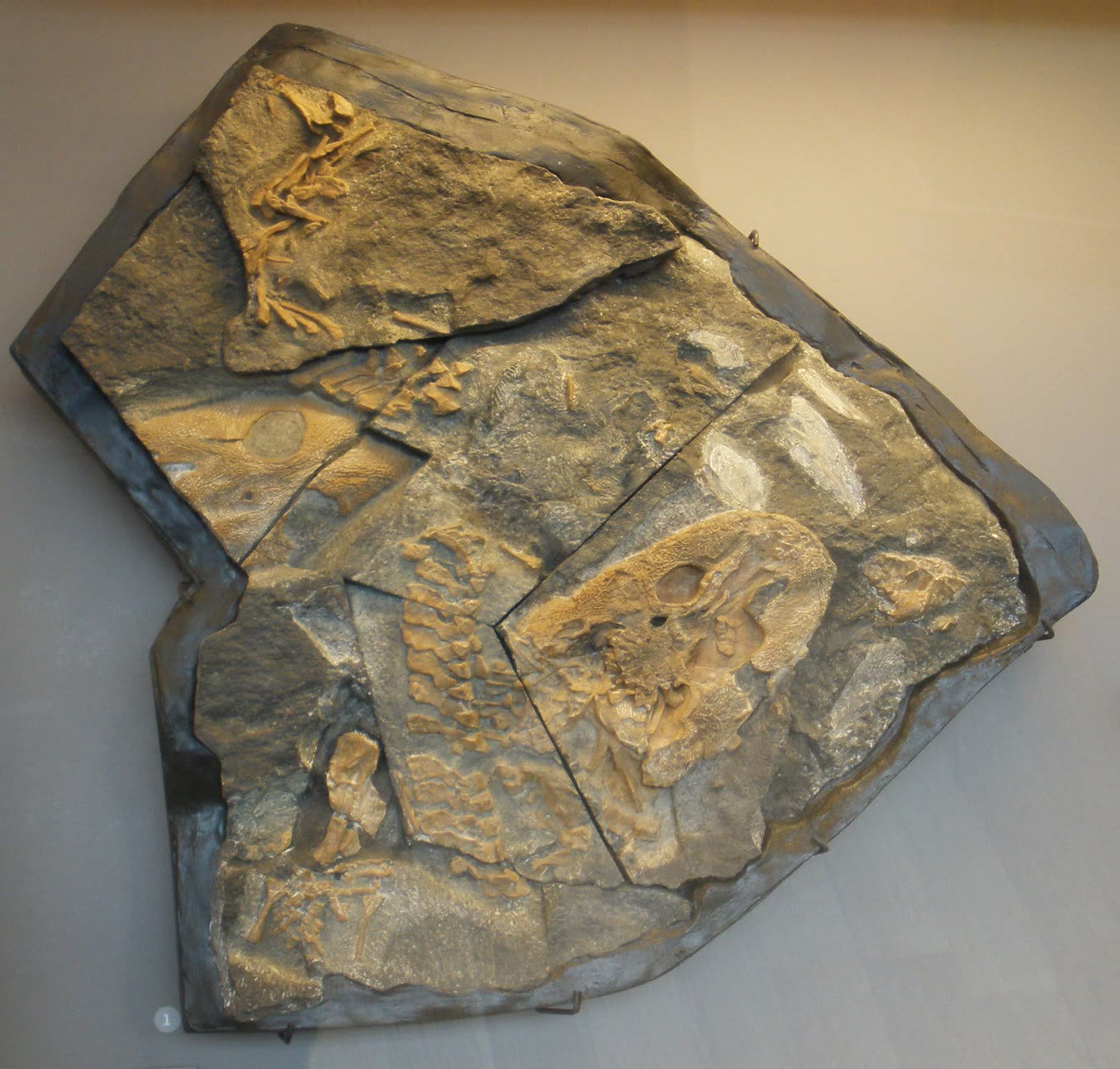
Image context: the lead image is a photographed Acanthostega slab from Wikimedia Commons. It works for this article because it keeps the argument anchored in the fossil itself. You can see a genuine early tetrapod preserved in rock, not a modernized museum reconstruction, which matters because the whole point of the specimen is that the anatomy looks more transitional and more aquatic than the familiar "first walker" legend suggests.[6]
1) Why this fossil changed the argument
The famous 1990 Nature paper by Michael Coates and Jennifer Clack did not merely add one more Devonian oddity to the record. It reported polydactyl limbs in Acanthostega, showing that the earliest known tetrapod limbs did not conform to the later five-digit pattern that became standard in crown tetrapods.[1] In other words, the textbook foot arrived in evolutionary history only after a stranger, broader experimental phase.
That matters because the usual public story had implied a neat package deal: limbs, five toes, walking, land. Acanthostega broke that bundle apart.[1][2] It showed that digits could appear before the familiar pentadactyl template and, more importantly, before the animal using those digits as a fully terrestrial support system. The fossil therefore changed the question from "when did vertebrates first get feet?" to "what were the earliest feet actually for?"[1][2]
Jennifer Clack's later review of the fish-tetrapod transition remains useful here because it frames Acanthostega as part of a broader Devonian reorganization, not as a mascot for one triumphant step ashore.[2] In that framing, the key transition is not a single threshold crossing. It is an interval in which fins become limbs, digits appear, skulls and shoulders change, and ecological habits remain mixed.
2) Digits are not the same thing as a walking foot
The most durable lesson from a close reading of Acanthostega is that a digit-bearing limb is not yet the same structure as a modern land foot. Coates and Clack's paper made that visible at the level of anatomy.[1] Clack's review then made the ecological point plain: Acanthostega is best read as an animal still heavily committed to water, even though the limbs already ended in digits.[2]
That distinction sounds simple, but it changes the entire transition story. If a Devonian tetrapod already has digits while still living in a primarily aquatic regime, then digits did not evolve as a final reward for conquering dry ground. They emerged inside a different problem set: shallow-water support, maneuvering through vegetation or bottom contact, body control in marginal environments, and only later the stronger demands of sustained terrestrial locomotion.[1][2]
This is also why the old ladder image misleads. A fin does not simply turn into a foot on the day an ancestor walks ashore. Acanthostega shows a stage in which the limb has crossed one important anatomical boundary, but the whole animal has not yet crossed the ecological one most people have in mind.[1][2][4]
3) The Greenland deposit rewrote the animal's life history
The 2016 Nature paper by Sophie Sanchez and colleagues added another decisive layer by looking at humeral histology from the Acanthostega mass-death deposit at Stensiö Bjerg in East Greenland.[3] Their result cut against a quiet assumption in much earlier writing: the biggest known Devonian tetrapod bones are not automatically adults. In this deposit, even the largest individuals sampled were juveniles.[3]
That matters because the limb story is not only evolutionary. It is developmental. Sanchez and colleagues found a long early juvenile stage with unossified limb bones, followed by a late juvenile stage with ossified limbs that could last at least six years in some individuals.[3] Their interpretation is direct: the late onset of limb ossification suggests that juveniles were exclusively aquatic.[3]
This does not mean adults never used land-adjacent settings. It means the life cycle itself was telling a water-first story. The animal that popular culture loves to picture as an emblem of walking tetrapods spent its early growth in an unmistakably aquatic developmental regime.[3] That is a much stronger challenge to the legend than any one limb diagram.
4) The head keeps the animal in water too
The postcranial anatomy is not the only evidence. Tom Stubbs, Andrew Neenan, and colleagues analyzed feeding biomechanics across the fish-tetrapod transition and found that Acanthostega sits closer to an aquatic feeding pattern than to a terrestrial biting one.[4] Their conclusion is especially useful because it comes from functional comparison rather than from narrative instinct: the lower jaw mechanics support fast mouth opening and a feeding style more compatible with suction-based capture in water than with snapping prey on land.[4]
That makes the skull part of the same argument as the limbs. The body does not read like an animal halfway to a salamander in every respect. It reads like a stem tetrapod assembling some tetrapod-grade structures while still operating inside an aquatic environment. The head and the limbs therefore reinforce each other instead of pulling in opposite directions.[2][4]
Porro, Rayfield, and Clack's CT study of the skull helps on another level.[5] It reminds us that Acanthostega is not important because it resembles a simplified modern amphibian. It is important because detailed reconstruction of the skull, endocast, and associated spaces keeps revealing a head built for a transitional world, one that still has to be interpreted on its own terms rather than squeezed into a living analogue.[5]
5) What this close reading actually supports
High confidence first. Acanthostega strongly supports the claim that digits are older than fully effective terrestrial walking.[1][2][3] It also supports a second claim that matters just as much: the five-digit limb is not the primitive starting point of tetrapod history but a later standardization after an earlier phase of anatomical experimentation.[1][2]
The fossil also supports a better way to tell the water-to-land story. Limbs, digits, and tetrapod-style anatomy did not arrive all at once as a clean terrestrial package. They were assembled in animals still operating across ecological boundaries.[2][3][4][5] That is a stronger and more interesting account than the old tale of one heroic first walker.
The boundaries matter too. Acanthostega is not every early tetrapod, and it should not be forced to stand in for the entire transition.[2] It does not tell us one single route by which all later tetrapods became effective on land. It tells us something narrower and more secure: when digits first appear clearly in the fossil record, they do so in an animal whose anatomy and development still keep one foot, so to speak, in the water.[1][2][3][4]
6) Why Acanthostega still matters
Some fossils remain famous because they are easy to summarize. Acanthostega remains important because summary fails it. The closer you read it, the less it behaves like a slogan. Its limbs say one thing, its life history says another, its skull says a third, and together those signals force a more careful timeline.[1][2][3][4][5]
That is the real value of the Greenland material. It did not merely show that tetrapods were emerging in the Devonian. It showed that one of the signature features of tetrapod life, the digit-bearing limb, became real before the fully terrestrial animal of popular imagination existed. In paleontology, that kind of sequence correction is often more important than finding a first. Acanthostega is one of the fossils that proves it.
Sources
- Michael I. Coates and Jennifer A. Clack (1990), Nature: "Polydactyly in the earliest known tetrapod limbs."
- Jennifer A. Clack (2009), Evolution: Education and Outreach: "The fish-tetrapod transition: new fossils and interpretations."
- Sophie Sanchez, Paul Tafforeau, Jennifer A. Clack, and colleagues (2016), Nature: "Life history of the stem tetrapod Acanthostega revealed by synchrotron microtomography."
- Andrew J. Neenan, Tom Stubbs, Emily J. Rayfield, and colleagues (2014), Proceedings of the Royal Society B: "Feeding biomechanics in Acanthostega and across the fish-tetrapod transition."
- Laura B. Porro, Emily J. Rayfield, and Jennifer A. Clack (2015), PLOS ONE: "Computed tomography, cranial endocast, and paranasal sinuses of the early tetrapod Acanthostega gunnari Jarvik, 1952."
- Wikimedia Commons file page for the photographed Acanthostega slab used as the lead image.