Most famous dinosaur-age birds are remembered from the stem side of avian history, not from the lineage that leads directly to living birds. That is why Asteriornis maastrichtensis matters so much.[1][3] It comes from the latest Cretaceous, only a geological breath before the end-Cretaceous extinction, and it preserves one of the clearest crown-bird signals yet found in rocks that old.[1][3] The value of the fossil is not that it gives us a neat "first chicken" headline. Its value is that it sharply narrows what the survivor-side of bird evolution already looked like before the asteroid impact.[1][2][3]
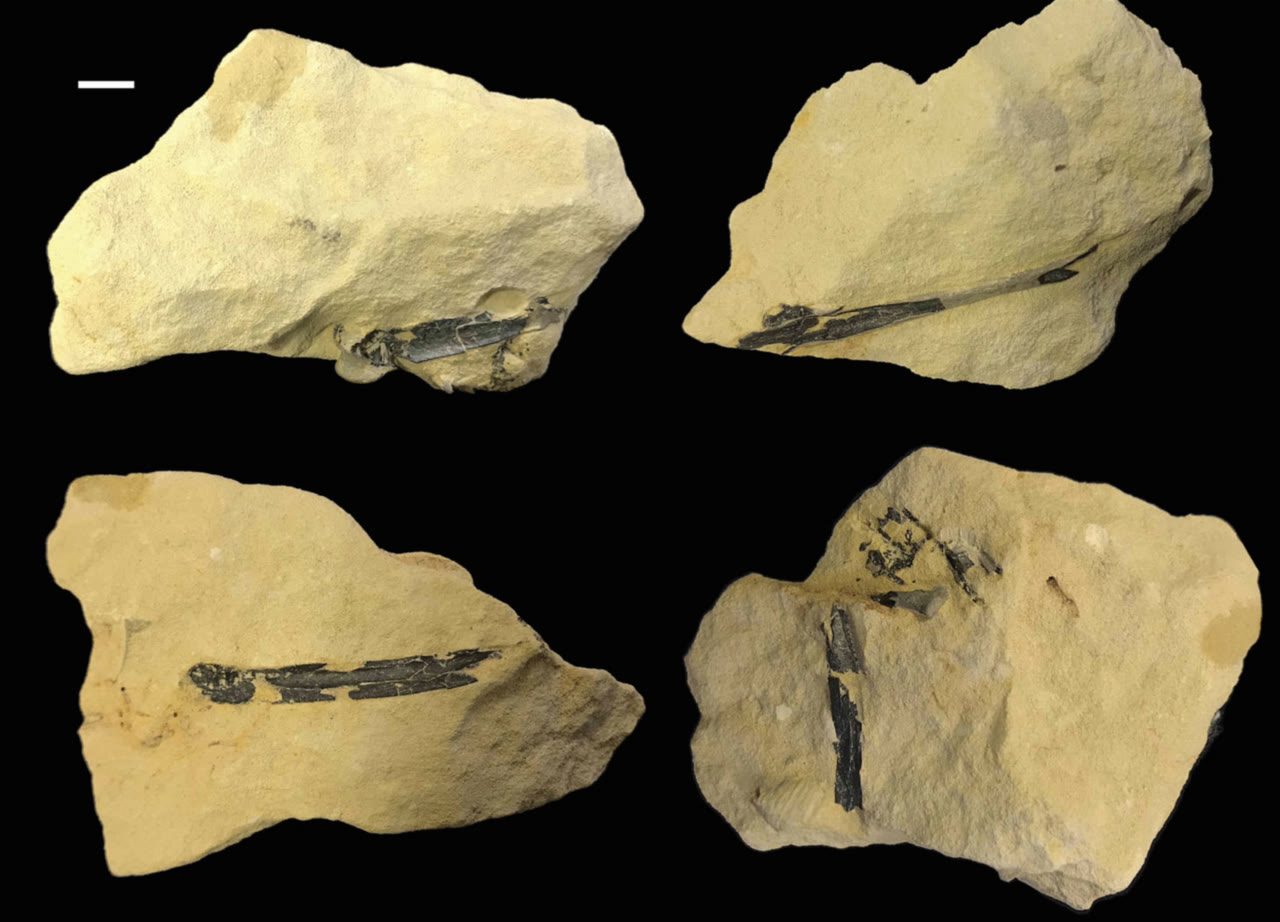
That narrowing only works if the fossil is read with discipline. Asteriornis is not a complete mounted skeleton, and it does not hand over every answer at once.[1][3] The holotype, NHMM 2013 008, consists of four associated matrix blocks preserving most of a skull together with scattered leg-bone fragments and a radius from the Valkenburg Member of the Maastricht Formation at Eben Emael in north-east Belgium.[1][3] Read that package lazily and the fossil becomes a nickname, the so-called Wonderchicken. Read it closely and a better picture appears: a small-bodied latest Maastrichtian bird with a modern-looking skull, long legs, and a coastal setting that all sit uncomfortably close to the extinction boundary.[1][2][3]
That combination is why this fossil find deserves a close reading in 2026. The skull anchors phylogeny. The leg material and sedimentary setting discipline ecology. The later mandibular reassessment shows that even a high-profile fossil can keep changing in detail without losing its core importance.[1][3][4] Asteriornis is strongest not as a mascot for "the first modern bird," but as a constraint on what crown birds had already become before most Mesozoic bird lineages disappeared.
Image context: the cover uses a real photograph of the four matrix blocks comprising the holotype of Asteriornis maastrichtensis from Wikimedia Commons, sourced from the 2024 Netherlands Journal of Geosciences review.[3][5] It belongs here because the article turns on scale and association rather than on a dramatic full skeleton. The fossil's force lies in how much evolutionary signal is compressed into a small set of blocks that would be easy to underrate at first glance.
1) The timing is the first reason the fossil matters
The original 2020 Nature paper made the central point immediately: the fossil record of crown birds in the Mesozoic is extraordinarily sparse, so any secure neornithine from the latest Cretaceous has unusual leverage.[1] In plain terms, Asteriornis sits close to the moment when every bird lineage outside the crown group vanished.[1][3] That alone does not explain why crown birds survived. It does something narrower and more useful. It tells us that at least one bird very near the ancestry of living forms was already present in Europe at roughly 66.7 million years ago, before the extinction horizon closed over the rest of the system.[1][3]
That date matters because it keeps the fossil from being read as a post-impact rebound animal. Asteriornis is not evidence for what birds improvised after disaster. It is evidence for what one branch of the avian tree already had in hand before the disaster arrived.[1][3] The 2024 review from the Maastrichtian type area frames this well: fossils such as Asteriornis and Janavis illuminate both sides of the stem-crown divide, which is exactly the interval that researchers have wanted to see more clearly for decades.[3]
The temptation, of course, is to turn that into ancestor language. The Cambridge announcement encouraged the memorable "mash-up of a chicken and a duck" line, and as public shorthand that works.[2] Scientifically, it needs trimming. The fossil is close to the base of Galloanserae or to early branches near that crown-bird split, not a certified direct ancestor of today's poultry aisle.[1][3][4] Its importance is positional, not genealogically personal. It improves the search image for the sort of bird body plan that made it to the far side of the boundary.
2) The skull did the heavy lifting
The reason Asteriornis became instantly consequential was not a giant specimen or a visually complete mount. It was the skull, discovered through CT work beneath material that did not initially advertise how important it was.[1][2] Cambridge's account is blunt about that moment: the team did not understand the fossil's full significance until scanning revealed the hidden skull.[2] That is a good reminder that modern paleontology often advances by extraction of structure rather than by dramatic field exposure alone.
Once the skull came into focus, the phylogenetic signal sharpened quickly.[1][3] The 2020 description emphasized a toothless beak, a proportionally large premaxilla, and cranial features consistent with crown-bird relationships, especially near Galloanserae.[1] The fossil did not look like a generalized Mesozoic bird grade lingering indefinitely. It looked recognizably modern in the head before the rest of the skeleton had a chance to become charismatic.[1][2][3]
That asymmetry is part of what makes the find so valuable. Paleontology often rewards complete skeletons because they are easy to display and easy to narrate. Asteriornis argues for a different hierarchy. A small amount of the right anatomy, preserved three-dimensionally and scanned well, can matter more than a far larger but less diagnostic body.[1][2][3] In this case, the skull supplied exactly the kind of character information that the late Cretaceous crown-bird record had been withholding.
3) The long legs and shoreline setting stop the fossil from becoming a skull-only story
The head explains why Asteriornis belongs near living birds. The rest of the specimen prevents the article from collapsing into pure phylogeny. The 2024 review notes that the hindlimbs are longer than initially reconstructed, strengthening the interpretation that Asteriornis was a long-legged bird with a possible wading ecology.[3] That claim should be handled carefully. Long legs are fossil evidence. A shoreline or wading lifestyle is comparative ecological inference built from those legs plus locality context, not direct behavioral footage.[2][3]
Handled at that boundary, the ecology becomes interesting rather than overstated. The Cambridge report described Asteriornis as a fairly small-bodied, ground-dwelling bird living near the seashore.[2] That image fits the broader Maastrichtian setting better than a fantasy of a lake-diving duck or a fully terrestrial forest specialist. It also matters because a coastal, shore-adjacent ecology has long been discussed as part of the survival problem for crown birds around the K-Pg event, even if no single fossil can settle that debate by itself.[1][2][3]
This is where the specimen's modesty is actually useful. Asteriornis does not pretend to answer the whole question of why modern birds survived. It simply removes some bad options. By the latest Cretaceous, the crown side of bird evolution already included small-bodied forms with modern cranial architecture and leg proportions compatible with life along open shore-adjacent environments.[1][2][3] That is a much tighter statement than saying the fossil "proves shorebirds survived because they were shorebirds." The fossil constrains morphology and habitat signal. It does not hand us a monocausal extinction theory.
4) The 2025 mandible revision improved the fossil by making it less slogan-friendly
One reason Asteriornis has stayed useful is that later work refined the picture instead of flattening it into a museum slogan. The 2025 mandibular study by Crane and colleagues revisited the lower jaw and argued that one of the famously anseriform-like features from the original description had been overread.[4] What had been interpreted as large hooked retroarticular processes was better read as a displaced medial mandibular process, which weakened the easy "wonderduck" side of the old public framing.[4]
That revision did not demote the fossil into irrelevance. It did the opposite. It showed that the lower jaw of Asteriornis may be more strongly galliform-like than the first wave of headlines suggested, while still keeping the bird close to the galloanseran base and keeping a crown-bird placement highly informative.[4] This is the kind of correction good fossils deserve. The central signal remains. The coarse analogy gets sharper edges.
There is a broader lesson here about how to read unstable details. If one catchy feature changes, the right response is not to conclude that the whole fossil has collapsed. The right response is to ask which parts of the evidence stack were doing the most work all along.[1][3][4] In Asteriornis, the answer is clear: latest Maastrichtian timing, a modern-looking skull, and associated postcranial material that keeps ecology in the picture. The mandible debate matters because it changes how bird-like and duck-like traits are weighted near the base of crown birds. It does not erase the fossil's boundary-setting role.
What survives after that trimming is the strongest version of the article's claim. Asteriornis matters because it is one of the best late Cretaceous constraints on the form of early crown birds before the end-Cretaceous extinction.[1][3][4] The fossil does not give us the first chicken, the whole feather coat, or a full explanation for avian survival. It gives us something better for science: a small, stubborn specimen that reduces the number of stories we are still allowed to tell about how modern birds began.
Sources
- Daniel J. Field, Juan Benito, Albert Chen, John W. M. Jagt, and Daniel T. Ksepka, "Late Cretaceous neornithine from Europe illuminates the origins of crown birds." Nature (2020).
- University of Cambridge, "'Wonderchicken' fossil from the age of dinosaurs reveals origin of modern birds" (2020).
- Daniel J. Field, Juan Benito, Sarah Werning, Albert Chen, Pei-Chen Kuo, Abi Crane, Klara E. Widrig, Daniel T. Ksepka, and John W. M. Jagt, "Remarkable insights into modern bird origins from the Maastrichtian type area (north-east Belgium, south-east Netherlands)." Netherlands Journal of Geosciences (2024).
- Abi Crane, Daniel J. Field, and colleagues, "Mandibular morphology clarifies phylogenetic relationships near the origin of crown birds." BMC Ecology and Evolution (2025).
- Wikimedia Commons, "File:Asteriornis holotype NHMM 2013 008 in matrix.png" — photographic image source used for the lead figure.