A flatfish makes an ordinary fish head look negotiable. As a young sole or halibut develops, one eye moves toward the top of the skull and across to the other side. The adult can settle sideways against the seabed while keeping both eyes directed into the water. Its face has been reorganized around its posture.[1]
The evolutionary difficulty lay between those familiar endpoints. What could an animal do with an eye that had shifted only partway? For generations, the apparent absence of such fish made the transition seem unusually hard to explain. Then museum specimens supplied something more useful than an imagined halfway stage: animals that had actually lived with one.[2]
Their evidence survives in Eocene limestone, roughly 50 million years old. It establishes that partial asymmetry was a workable anatomy. Establishing exactly where that anatomy belongs on the fish family tree remains a different task.
The intermediate was already in the drawer
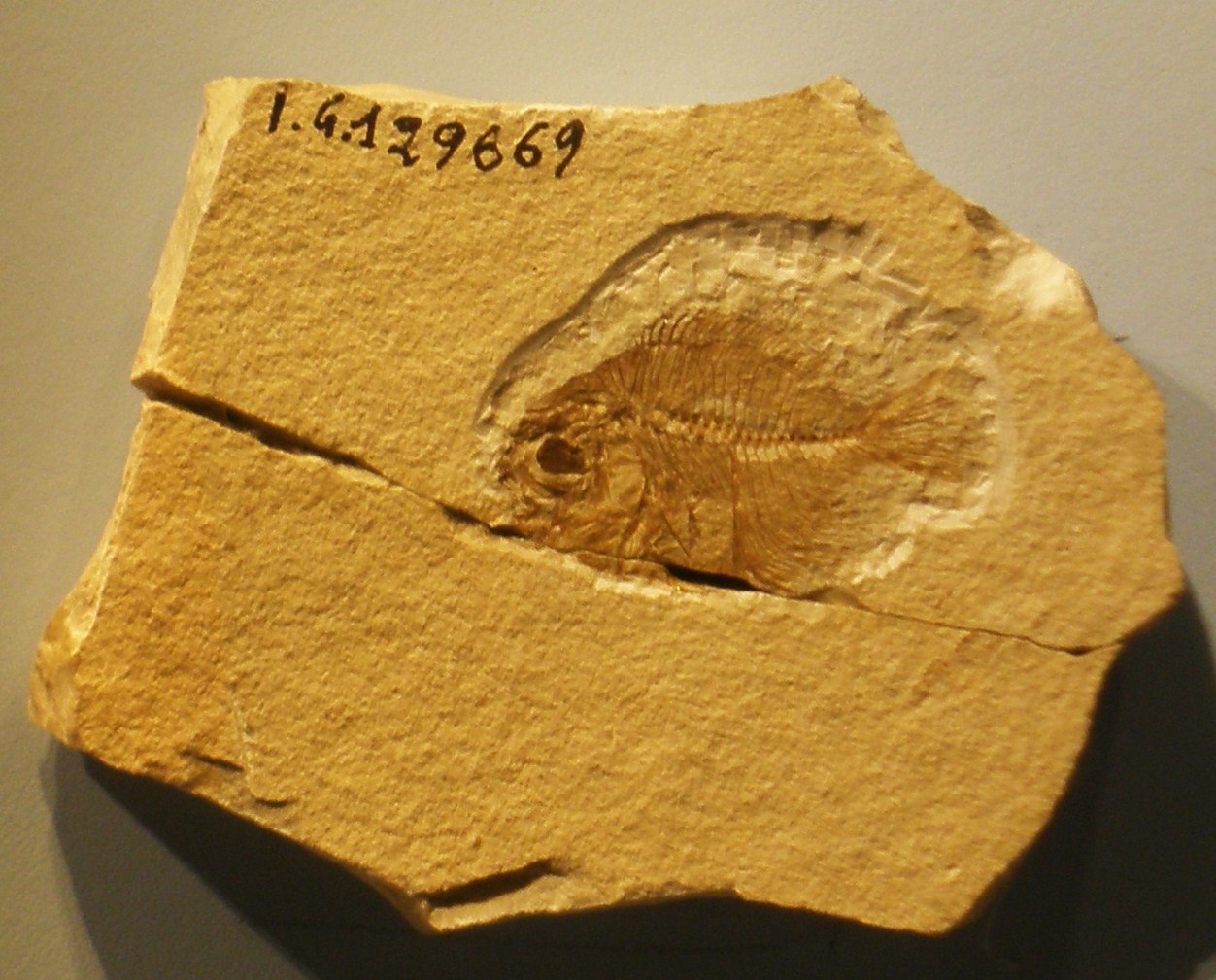
In 2008, Matt Friedman described the significance of two fossil genera, Amphistium and the newly named Heteronectes. The material came from European museum collections, including fossils from northern Italy and the Paris region. Some specimens had been available to researchers for more than a century. Recognition required a fresh anatomical question and, for Amphistium, CT scanning that exposed the skull's asymmetry.[2]
In both genera, one eye socket had moved upward, but the eyes remained on opposite sides of the head. Crucially, these were individuals that had already passed through metamorphosis. They were not ordinary modern flatfish caught briefly in the middle of juvenile development. Their incomplete orbital migration belonged to a lasting body plan.[1]
That distinction gives the fossils their force. A developing animal shows what its own species does during growth. An adult fossil with a different arrangement shows that evolution once produced another viable outcome. The resemblance between those two sequences is informative, but they are not interchangeable records.
A family tree needs more than a crooked face
An asymmetric head alone cannot settle every relationship. Paleontologists compare the rest of the skeleton as well. A 2013 study discussing the fossil evidence noted that Amphistium combined its unusual eye arrangement with other flatfish features, including forward-curving spines on abdominal vertebrae and a dorsal fin extending far toward the head. Some relevant characters could not be evaluated in Heteronectes, illustrating how preservation limits the comparison.[3]
These combinations matter because an intermediate is a mixture of character states. One part of the body can acquire a distinctive configuration while others retain older arrangements. A lineage does not have to remodel every feature at the same pace.
Nor must the fossil be a direct ancestor. Amphistium and Heteronectes occur in strata that also contain fishes with complete cranial asymmetry. The less transformed condition therefore persisted alongside the more familiar one.[3]
The implication is easy to miss in a row of evolutionary pictures. An anatomical sequence can reveal how a body plan was assembled without showing a literal procession of parent species giving way to descendants. These fossils document a possible stage in that assembly; their coexistence with fully asymmetric fishes makes a simple replacement story inadequate.
One origin, or more than one?
Modern DNA introduces a second question. Did all living flatfish inherit their extraordinary arrangement from a common asymmetric ancestor, or did separate branches evolve it independently?
The position of Psettodes, the spiny turbots, is pivotal. Placing this lineage beside all other flatfish supports a single origin. Placing it among symmetric relatives instead can imply separate origins. The disagreement concerns the branching pattern, even when researchers agree about what the animals look like.[4]
In 2024, Emanuell Duarte-Ribeiro and colleagues reanalyzed three genome-scale datasets and recovered support for a single origin. They argued that earlier support for separate origins arose from inadequate treatment of differences in DNA base composition among lineages. In plain terms, the proportions of DNA's letters can vary in ways that mislead a model about relatedness.[4]
The opposing researchers did not simply withdraw their interpretation. In a published reply, Zhenming Lü and colleagues reported analyses that continued to favor separate origins.[5] That exchange is a reason to examine the assumptions behind a tree, rather than treating the quantity of sequence data as an automatic guarantee of its shape.
A May 2026 preprint by Julian Gallego-Garcia and colleagues added another kind of comparison: the order of genes along genomes. Across 17 species, nucleotide analyses and local gene-order patterns supported a single origin, while changes at the larger chromosome scale gave a less decisive signal. The authors interpreted that difference in light of rapid early branching: rarer chromosome rearrangements may leave too few informative changes between closely spaced splits. The version cited here was posted before peer review.[6]
What the limestone settles
Taken together, the fossils and genomic studies constrain different parts of the explanation. The fossils establish that partial eye migration occurred in animals beyond metamorphosis. The genomic work tests how living lineages connect, which determines where particular changes should be placed in their ancestry.[1][4][6]
Neither an eye socket nor a DNA tree is a recording of the ancient animal feeding. The precise advantage of its particular posture still requires functional inference. But the fossils remove a substantial obstacle: we no longer have to invent an intermediate anatomy and wonder whether it could exist.
In the limestone, it already does. The eye has moved; it has not crossed. Around that modest displacement, an entire fish completed its life.
Sources
- Matt Friedman, “The evolutionary origin of flatfish asymmetry,” Nature 454, 209–212 (2008)—incomplete orbital migration in post-metamorphic Amphistium and Heteronectes.
- University of Chicago, “Flatfish fossils fill in a missing link” (9 July 2008)—museum collections, European localities, CT examination and the historical problem of intermediate anatomy.
- Matthew A. Campbell, Wei-Jen Chen and J. Andrés López, “Are Flatfishes (Pleuronectiformes) Monophyletic?” Molecular Phylogenetics and Evolution 69, 664–673 (2013), section 4.2—comparative fossil anatomy, preservation limits and coexistence with fully asymmetric forms.
- Emanuell Duarte-Ribeiro and colleagues, “Phylogenomic and comparative genomic analyses support a single evolutionary origin of flatfish asymmetry,” Nature Genetics 56, 1069–1072 (2024)—genomic reanalysis and the effect of lineage-specific base composition.
- Zhenming Lü and colleagues, “Reply to: Phylogenomic and comparative genomic analyses support a single evolutionary origin of flatfish asymmetry,” Nature Genetics 56, 1073–1074 (2024)—the competing interpretation and additional analyses supporting separate origins.
- Julian Gallego-Garcia and colleagues, “Whole-genome phylogenomics and synteny resolve a single origin of body-plan asymmetry in flatfishes,” bioRxiv, version 1 (26 May 2026)—preprint comparing nucleotide sequences, local gene order and chromosome-scale rearrangements.
- Ghedoghedo, “Amphistium paradoxum.JPG,” Wikimedia Commons (2011)—original photograph taken at the Museo dei Fossili di Bolca; CC BY-SA 3.0.