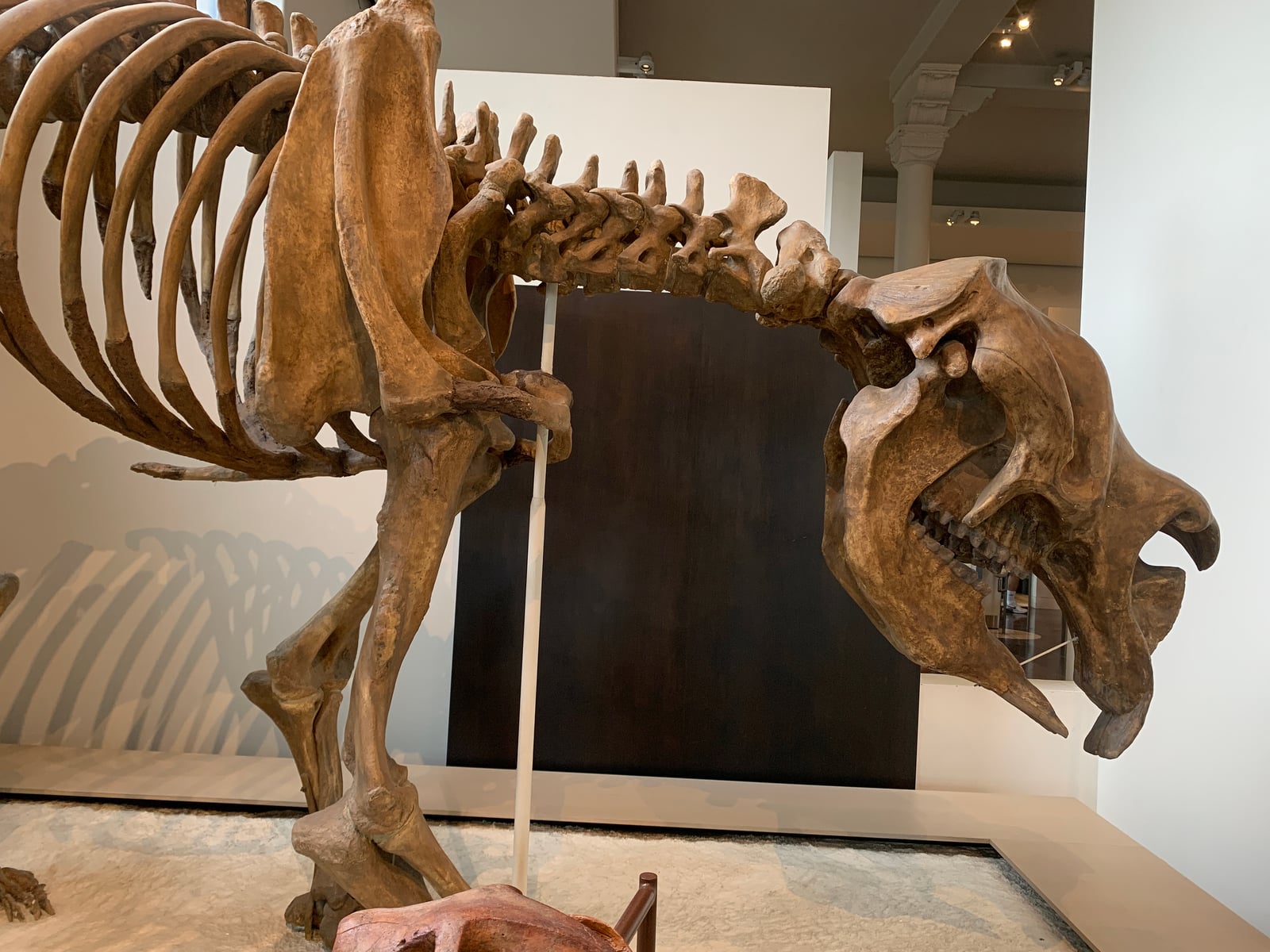
The front teeth arrive before the rest of the animal. Beneath the skull of a mounted Diprotodon, two lower incisors project toward whatever vegetation once stood in its path. Behind them comes an enormous rib cage, carried on stout legs. The Australian Museum puts the largest individuals at roughly 2.7 tonnes: this was the biggest marsupial known to science.[1]
Size makes a memorable introduction. Teeth make a more revealing biography. Their shapes helped researchers decide how many species Diprotodon contained; their arrangement helped recover its way of chewing; their chemistry preserved evidence of movement through a vanished landscape. A skeleton can look settled on its museum platform. The animal it represents had a living to make.
One species in more than one size
Diprotodon optatum inhabited Australia during the Pleistocene. Its fossils occur across widely separated localities, including Queensland’s Darling Downs, Victoria’s Bacchus Marsh and South Australia’s Lake Callabonna. Its sturdy limbs and large body belong to a herbivore known from plains and woodland environments.[1]
That geographical spread once encouraged a proliferation of names. Fragmentary specimens and conspicuous size differences made it tempting to divide the material into separate species. In his 2008 reassessment, Gilbert Price compared specimens across museum collections and concluded that the variation fitted a single species. The two prominent size classes were interpreted as sexual dimorphism, with the larger animals probably male.[3]
The distinction matters whenever we picture the animal. A small adult beside a much larger one need not represent another species or a juvenile. Conversely, size alone does not let a curator assign every isolated bone confidently to a sex. The explanation comes from the pattern across specimens, rather than a label preserved on any one skeleton.[3]
Price also proposed a breeding system in which males mated with several females, drawing comparisons with living mammals. That is a behavioral hypothesis built on the size pattern. It belongs a step beyond the measurable difference between the fossils.[3]
A mouth for sustained work
The incisor tips are only the exposed ends of teeth that continued growing during life. Farther back, the cheek teeth supplied surfaces for processing vegetation. Recovering how those parts worked together requires the missing muscles as well as the surviving bones.[4]
In 2014, Alana Sharp reconstructed the jaw muscles digitally from CT scans of a well-preserved skull from Bacchus Marsh. Bone attachment areas and comparisons with living marsupials constrained the reconstruction. The result suggested that the main chewing movement was vertical, producing a powerful crushing action at the molars, with a smaller sideways component. Its mechanics resembled those of kangaroos more than the strongly transverse chewing stroke of wombats.[4]
That comparison complicates the familiar giant-wombat image. Relatives can share aspects of their skeletons while using their mouths differently. Sharp’s interpretation favored a mixed plant diet rather than obligate grazing, but a muscle reconstruction cannot identify each meal. It establishes plausible movements and feeding capabilities; the actual sequence of muscle activation remains unrecoverable.[4]
The landscape inside an incisor
One tooth offered a different kind of evidence. Price and colleagues’ 2017 study examined an upper incisor, Queensland Museum specimen QMF3452, from the Darling Downs. Uranium–thorium dating placed it at approximately 300,000 years old.[5]
Sampling along its growth recorded changing isotope ratios. Strontium reflected differences in the geological sources of food and water; carbon and oxygen supplied information about diet and water intake. The recurring patterns supported movement between regions followed by returns. Read as annual cycles, they implied seasonal journeys potentially totaling as much as 200 kilometres per round trip.[5]
The qualifications belong inside that picture. This was one tooth from one animal. Annual timing was an interpretation, and the proposed route depended on the regional geological pattern. The evidence supports repeated movement by this individual without establishing that every Diprotodon population followed the same schedule.[5]
Even within those limits, the finding changes the scene. A tooth becomes a record of places encountered in sequence, rather than merely a tool for cropping plants. The animal’s history extends beyond the patch of ground where its remains were recovered.
A large appetite across a changing world
The Australian Museum records saltbush remains in the abdominal region of a Lake Callabonna skeleton. That is a particularly intimate clue: a plant associated with an individual body. It complements the broader capabilities inferred from jaw anatomy without supplying a menu for the entire species.[1]
When the migration study appeared, Price emphasized the ecological consequences of losing such a large plant eater. An animal consuming vegetation and moving between feeding areas participates in the landscape at more than one location; its disappearance could affect plants and the animals connected to it.[6]
That is a useful way to imagine Diprotodon: with obligations imposed by its size. It needed vegetation it could gather and process, and at least one individual left evidence of repeatedly changing where it obtained those resources. The projecting incisors, the crushing teeth behind them and the chemical record within them bring different parts of that life into focus. The museum mount supplies the outline. The teeth begin to put it in motion.
Sources
- Anne Musser, “Diprotodon optatum,” Australian Museum—body size, anatomy, fossil localities, habitat and the Lake Callabonna plant remains.
- Bloopityboop, “Diprotodon optatum skeleton,” Wikimedia Commons (photographed 22 June 2024)—photograph of the AMNH skeletal cast, specimen label and image attribution; CC BY-SA 4.0.
- University of Queensland, “Uncovering the truth behind the largest marsupial to walk the earth” (10 June 2008)—Gilbert Price’s account of his taxonomic reassessment and interpretation of size variation.
- Alana C. Sharp, “Three dimensional digital reconstruction of the jaw adductor musculature of the extinct marsupial giant Diprotodon optatum,” PeerJ 2:e514 (2014)—published paper hosted by Monash University; skull anatomy, muscle reconstruction and feeding interpretation.
- Gilbert J. Price and colleagues, “Seasonal migration of marsupial megafauna in Pleistocene Sahul (Australia–New Guinea),” Proceedings of the Royal Society B (2017)—incisor dating, sequential isotope analysis and inferred seasonal movement; open-access full text.
- University of Queensland, “Giant Australian marsupials were like no other” (27 September 2017)—researcher commentary on migration and the ecological consequences of losing a giant herbivore.