Whale evolution is often taught as a neat sequence of creatures that slowly look more marine. The science became stronger only when separate trait systems started lining up on the same timeline.
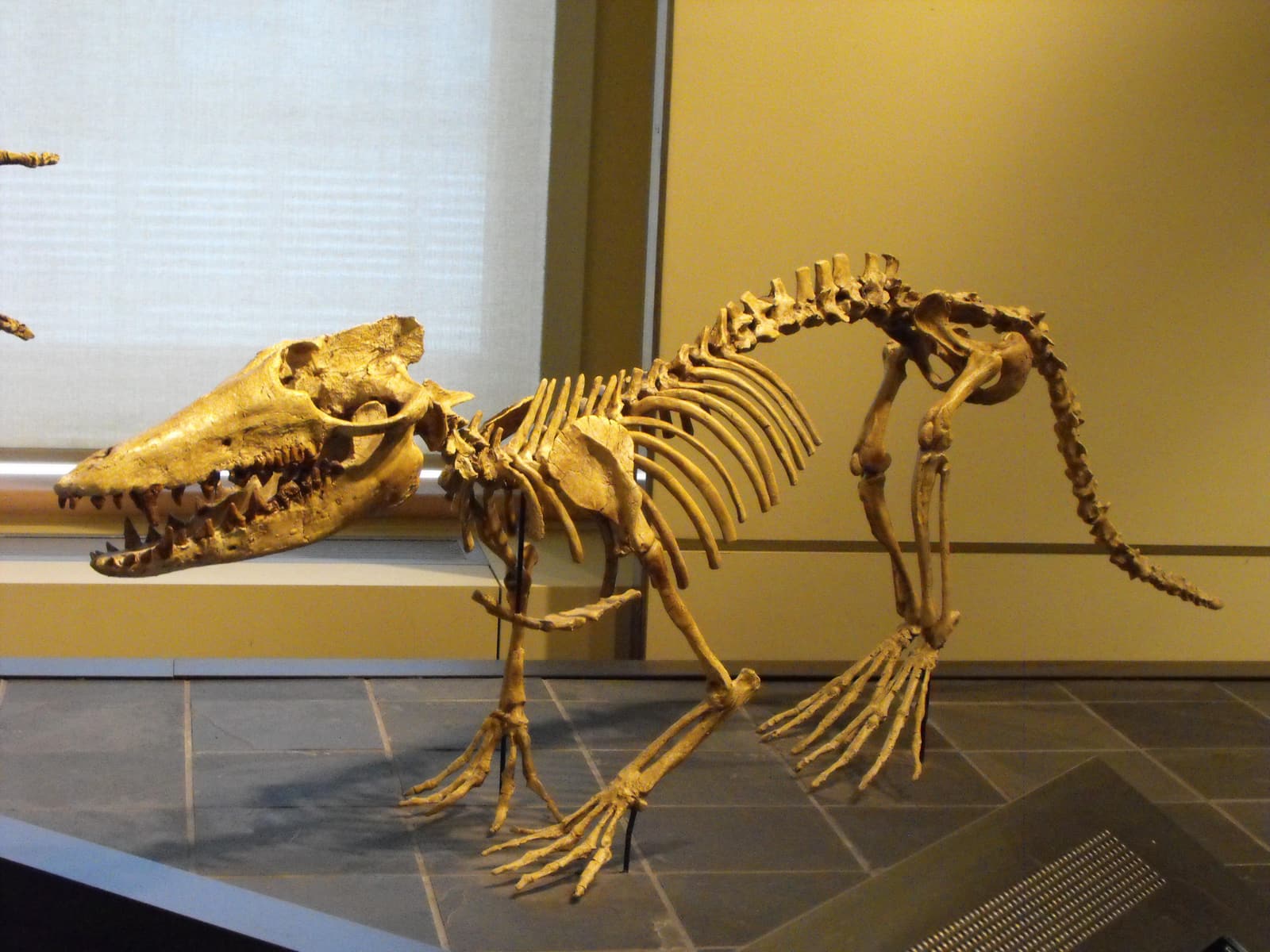
Image context: the cover image shows a Pakicetus cast in museum display context, used here as a lineage anchor for the near-shore early phase rather than as a full-body ecological reconstruction by itself.
The highest-value way to read this lineage is to track four evidence channels at once: hearing, locomotion, breathing geometry, and reproduction/life history. Once those channels are placed across the Eocene window (roughly 56–34 million years ago), the transition from land-capable mammals to obligate marine cetaceans stops looking like a narrative leap and starts looking like an evidence-constrained map.
Why ankles mattered as much as skulls
For decades, whale origins were argued through partial skulls and tooth comparisons, which left room for competing placement hypotheses. The breakthrough came when fossils preserved lower-limb and ankle anatomy in forms close to early whales.
In the early 2000s, work on Eocene material from Pakistan showed that early cetaceans carried artiodactyl-linked ankle architecture while also retaining whale-defining ear traits.[1][2] That two-system combination mattered more than either trait alone.
- The ear region (especially cetacean-type auditory specializations) anchored these animals inside the whale stem.
- The ankle and hindlimb features linked that stem to even-toed ungulate relatives rather than to older mesonychian-centered models.
This did not instantly solve every branch order, but it collapsed a major uncertainty range. A lineage hypothesis became a much tighter phylogenetic corridor.
A compressed Eocene sequence, with trait transitions rather than mascot species
The familiar names are useful only if each taxon is tied to a concrete trait shift.
1) Near-shore terrestrial-to-amphibious phase (~50–48 Ma)
Pakicetus and related early forms from the Indian subcontinent sit near riverine/coastal settings in the early Eocene.[1][6] They still read as land-capable mammals in gross body plan, but their cranial/ear evidence places them on the cetacean stem.
What changed in this phase was not “fully aquatic life,” but the first tight overlap between terrestrial locomotor capacity and whale-line sensory specializations.
2) Amphibious propulsion experiments (~48–47 Ma)
Ambulocetus is often summarized as the “walking whale,” but the deeper point is mechanical: mixed locomotor capability under estuarine and shallow-water constraints.[6]
Here we see a body still leg-driven on land, while aquatic propulsion and trunk/tail contribution become more central in water. The transition is not binary; it is a changing budget of where force is generated.
3) Coastal-to-marine commitment (~47–41 Ma)
Protocetid-grade whales (including forms such as Rodhocetus in broader lineage syntheses) document stronger marine engagement while retaining some terrestrial legacy features.[2][5]
In this interval, several transitions stack together:
- Hindlimb function trends downward for effective terrestrial movement.
- Axial and tail-driven swimming roles increase.
- Cranial geometry and feeding setup continue drifting toward later fully aquatic conditions.
This is the part of the lineage where simplistic “half on land, half at sea” language fails; different anatomical systems shift at different rates.
4) Fully aquatic archaeocete world (~41–34 Ma)
By the late Eocene, basilosaurids such as Basilosaurus and Dorudon are clearly marine mammals in ecology and body organization.[5][7]
They still keep some primitive signatures (for example, small external hindlimb remnants in some forms), but those are no longer indicators of land competence. They are evolutionary leftovers inside an already marine life strategy.
Blowholes did not appear overnight: breathing geometry as a moving target
One of the easiest myths to avoid is the “sudden blowhole” story. Across stem and early crownward transitions, nostril position migrates gradually along the skull, tracking changing surfacing mechanics and head posture in water.
In lineage context, this matters because it pairs with locomotor change:
- As propulsion shifts away from weight-bearing limbs,
- and as body orientation in water becomes more stable,
- breathing access geometry is progressively re-optimized for aquatic surfacing.
No single fossil “invents” the modern blowhole condition. The record shows staged cranial reconfiguration over millions of years.
Hearing is the hidden backbone of the whale-transition argument
Public retellings often over-index on limbs because they are visually intuitive. But the ear region is arguably the stronger continuity marker linking early stem forms to later cetaceans.[1][2]
Why this matters in practice: locomotion can converge under similar environmental pressures, while detailed auditory structures are less likely to produce misleading lookalikes at broad scale. The strongest lineage inference comes from cross-checking both systems instead of privileging one.
Geography and tempo: why the Tethyan margin matters
A recurring pattern in core fossils is concentration around Eocene deposits on the former Tethyan margins, especially in what is now Pakistan and India for early phases, then broader marine distributions in later archaeocetes.[2][5][6]
This spatial arc supports a shoreline-to-open-marine transition model with a fast macroevolutionary tempo by mammalian standards. A shift from near-shore stem forms to fully aquatic archaeocetes unfolds across roughly 10–15 million years—long on a human timescale, but relatively compressed in deep-time lineage turnover.
What remains open (and why that does not weaken the core lineage)
Modern debate is not about whether whales evolved from land-capable ancestors; that backbone is robust. Open questions sit at finer resolution:
- Exact branching order among some early stem groups when different character matrices are weighted differently.
- Ecological partitioning within contemporaneous archaeocete assemblages.
- Functional interpretation boundaries when soft tissue, behavior, and seasonality must be inferred from hard-part evidence.
These are normal high-resolution problems in vertebrate paleontology. They refine the map; they do not erase the map.
Reading rule for future discoveries
When a new “missing link” headline appears, test it against the same four channels used here:
- Does it clarify hearing evolution?
- Does it change locomotor mechanics inference?
- Does it shift cranial/breathing geometry?
- Does it add reproductive or life-history constraints?
If a find moves only one channel, treat it as an important tile. If it moves several channels together, it can redraw lineage confidence.
That is how whale evolution became one of the clearest macroevolutionary transitions in the fossil record: not through one iconic specimen, but through repeated cross-system convergence of evidence across Eocene time.
Sources
- Thewissen et al. (2001), Nature: “Skeletons of terrestrial cetaceans and the relationship of whales to artiodactyls.”
- Gingerich et al. (2001), Science: “Origin of whales from early artiodactyls: hands and feet of Eocene Protocetidae from Pakistan.”
- Thewissen et al. (2007), Nature: “Whales originated from aquatic artiodactyls in the Eocene epoch of India.”
- Uhen (2010), Annual Review of Earth and Planetary Sciences: “The Origin(s) of Whales.”
- Fordyce & Marx (2018), overview on cetacean evolution (Encyclopaedia Britannica)
- Natural History Museum (UK): “When whales walked on four legs.”
- UCMP Berkeley, Cetacea overview and fossil context
- Wikimedia Commons source image (Pakicetus cast photo)