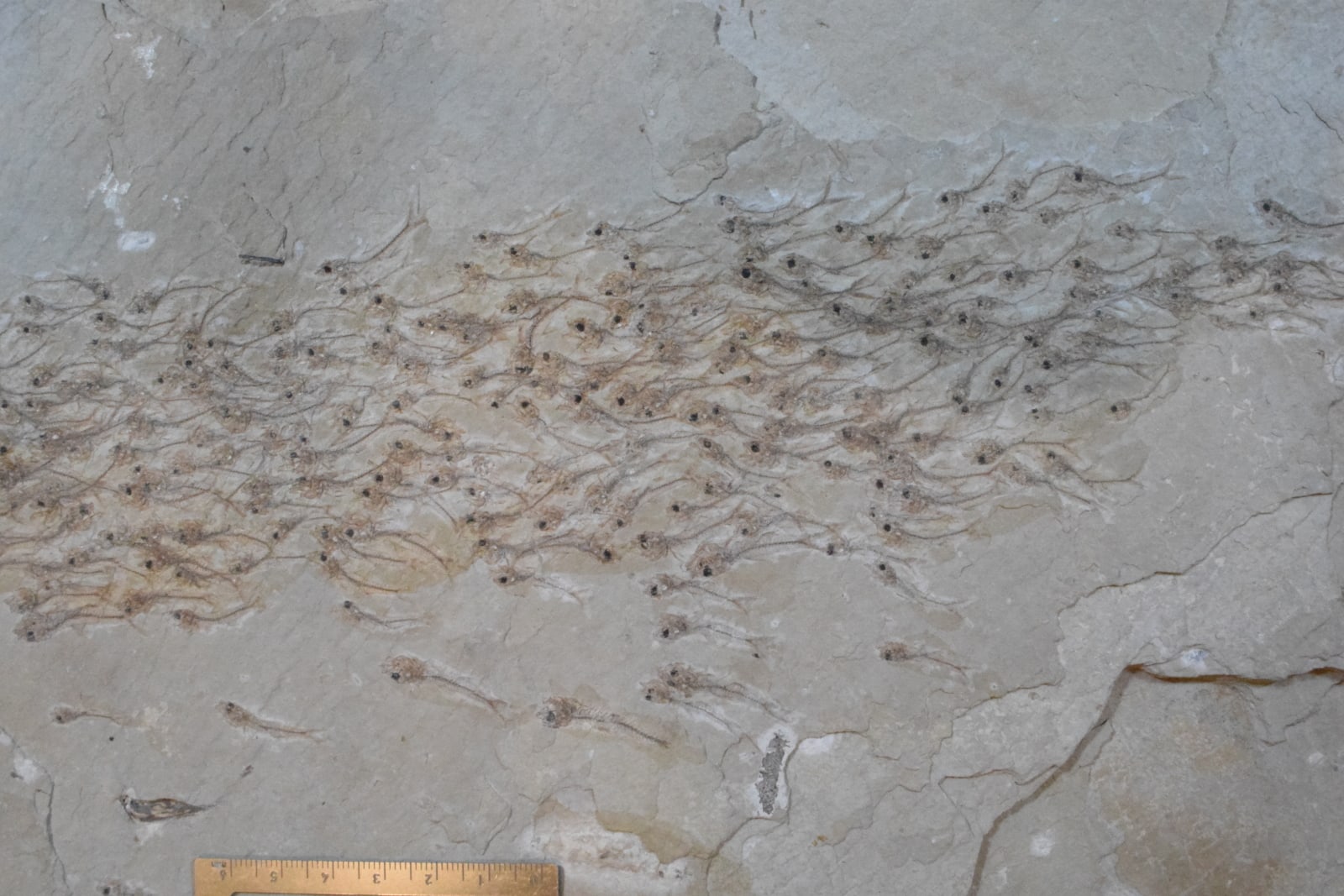
The fish seem to have somewhere to go. Across a pale slab, small dark bodies gather into an elongated crowd, most pointing the same way. The photograph invites the eye to supply the missing water and movement. These are 259 young Erismatopterus levatus, an extinct fish associated with Eocene lakes roughly 50 million years ago.[2]
For biologist Nobuaki Mizumoto, the more revealing detail was the space between them. A 2019 study with Shinya Miyata and Stephen C. Pratt asked whether those gaps retained evidence of fish responding to their neighbors. Reading the slab meant finding a way to investigate movement with only one frame.[4]
A crowd with an incomplete address
Specimen FPDM-V8206 belongs to Japan's Fukui Prefectural Dinosaur Museum. Its stone rectangle measures 57 by 37.5 centimeters. The analysis used 257 fish, excluding two outside the central group; their bodies measured roughly 11–24 millimeters long.[1]
Its label records an American origin and an Eocene age. The researchers inferred the Green River Formation from the matrix and the species, known from deposits of Lakes Gosiute and Uinta. The paper provides no exact quarry location.[1]
The formation preserves several vanished lakes across what is now Wyoming, Utah and Colorado. The National Park Service distinguishes Gosiute and Uinta from Fossil Lake, the smaller basin protected in part at Fossil Butte National Monument. There, lake sediments record changing water levels and chemistry, with different beds preserving different concentrations and sizes of fish.[3]
That regional context helps explain why a slab can be rich in fossils while still being short of information. A museum specimen preserves a piece of a deposit. Identifying the formation does not restore the layers that originally lay above and below it. Nor should the familiar story of one Green River lake automatically become the burial history of a fish from another.
Advance the picture by one imagined moment
Mizumoto approached the photograph as a set of positions and directions. In the analysis described by Arizona State University, each fish was moved a small distance along the direction its body pointed. The researchers then examined whether neighboring fish would become closer together or farther apart.[4]
This was a projected movement. No fossil supplied a swimming speed or a second observation. The useful question was geometric: given the arrangement preserved here, what would happen to the gaps if the fish continued forward?
Fish already near a neighbor tended to open a little more space. Those farther away tended to close the gap. That combination resembles two requirements of group travel: maintaining room to move and keeping contact with the group.[4]
Imagine walking through a station concourse with a companion. Your orientation becomes more informative when someone also knows where your companion stands. A single body points somewhere; a pair of bodies can suggest a relationship. The fossil analysis applies that distinction across a crowd.
Josai University's account describes an additional comparison: artificial arrangements with a shared directional preference did not reproduce the same relationship between spacing and projected movement. Simply pointing together was insufficient to explain the pattern. This strengthened the interpretation of social interaction beyond the photograph's immediate resemblance to a school.[2]
What living fish let researchers measure
The comparison has an experimental foundation. In 2011, James Herbert-Read and colleagues studied living mosquitofish, tracking individuals through successive video frames. They found responses consistent with moving away from very close neighbors and approaching more distant ones. Changes in speed helped fish avoid collisions.[5]
Their study also found that an aligned group need not arise from each fish explicitly copying a neighbor's orientation. Following, attraction and avoidance can contribute to the collective pattern. That distinction matters whenever a fossil presents bodies pointing in similar directions: the visible outcome does not uniquely reveal the rule that produced it.[5]
The fossil researchers likewise could not directly test an alignment rule from their single snapshot. They included alignment in their broader simulation, which tested whether plausible interaction rules could produce a comparable group shape.[1]
A model that resembles the slab establishes a possibility. Reconstructing the particular sequence that made this slab requires another kind of evidence.
The missing burial scene
The thin specimen lacks the surrounding sedimentary record needed to establish rapid burial. The authors suggested a collapsing sand dune as one possibility but found no evidence for that event. They also could not fully exclude a short accumulation of dead fish.[1]
That uncertainty concerns the central premise: whether the positions preserve a living group's arrangement closely enough to read its behavior. A convincing account must explain both how the animals moved and how those movements stopped being rearranged.
Mizumoto's laboratory has pursued this problem in a different material. Its work on paired termites in amber compared fossil postures with living termites caught on sticky surfaces. Struggling during entrapment could turn a following pair into two insects lying side by side. The final arrangement contained information about both the original behavior and the process that preserved it.[6]
The implication for the fish is methodological, rather than a claim that amber and lake mud behave alike. Burial belongs inside the behavioral reconstruction. More slabs with documented geological context would let researchers compare patterns and test which arrangements recur under particular preservation conditions.
For now, this crowded rectangle rewards a slower look. Follow one fish, then find its nearest neighbor, then inspect the gap between them. The compelling possibility is that the stone preserves something of how an ancient animal made room for another.
Sources
- Nobuaki Mizumoto, Shinya Miyata and Stephen C. Pratt, “Inferring collective behaviour from a fossilized fish shoal,” Proceedings of the Royal Society B 286 (2019)—specimen, provenance, methods and preservation limitations.
- Josai University Oishi Fossils Gallery, “Discovery of behavioral rules governing an ancient fish school” (2019; Japanese-language research announcement)—group structure and the comparison with artificial directional patterns.
- National Park Service, “Geology,” Fossil Butte National Monument (updated April 29, 2025)—the three Green River lake basins and the differing deposits of Fossil Lake.
- Melinda Weaver, “ASU researcher finds first fossilized evidence of collective behavior,” Arizona State University (May 30, 2019)—researcher account of projected movement; source of the specimen photograph.
- James E. Herbert-Read et al., “Inferring the rules of interaction of shoaling fish,” PNAS 108 (2011)—observed interactions, speed changes and alignment in living mosquitofish.
- Mizumoto Lab, “Research topics—fossil behavior”—experiments testing how entrapment changes the arrangement of termite pairs, alongside the fossil-fish research.