The popular version of Eretmorhipis carrolldongi arrives fully assembled: a small marine reptile with a platypus-like bill, tiny eyes, broad paddles, an armored back, and a body so peculiar that it seems designed to exhaust comparisons. The fossil story is more revealing because that complete image did not arrive all at once. The specimen used to name the animal had no head. The skull that inspired the platypus comparison appeared in later material, and the soft sensory equipment that would make the comparison functional has never been preserved.[1][2]
That sequence changes the profile. Eretmorhipis is not best understood as an ancient platypus impersonator. It is a latest Early Triassic hupehsuchian from Hubei Province, China, whose separate specimens preserve different parts of an unusual aquatic design. Bones establish the paddles, stiff trunk, small orbits, divided snout, and spaces once occupied by cartilage. A tactile style of feeding is a careful comparative inference built on those structures, not something fossilized beside them.[1][2]
The animal was named from everything behind the skull
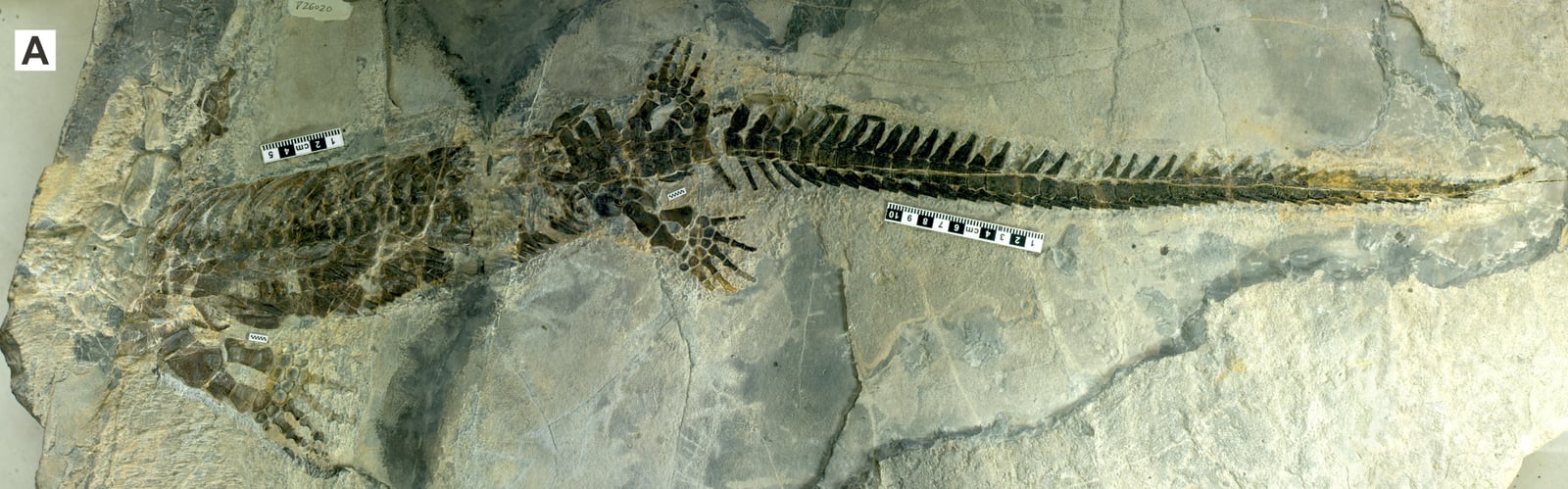
Robert Carroll and Zhiming Dong recognized a distinct hupehsuchian body in 1991 but declined to name it from the poorly defined specimen then available. Much of that fossil, IVPP V4070, survived as impressions rather than clean bone. A second specimen, WGSC V26020, had been collected in Yuan'an County and donated to the Wuhan Centre of China Geological Survey in the 1970s, but it was prepared much later. Its clearer anatomy finally supported the name Eretmorhipis carrolldongi in 2015.[1]
The cover photograph shows that holotype. It is almost complete from the rear of the neck to the tail tip, but the skull is absent.[1][5] That absence is useful to keep in view. The name itself—combining Greek roots for “oar” and “fan”—did not come from the famous face. It came from hands and feet whose digits radiate outward, making the ends of the limbs almost as broad as they are long. The forelimbs are especially robust, while the hind limbs are smaller. This was a paddle-first diagnosis.[1]
The torso added a second defining feature. Thick ribs overlap, closely packed belly ribs brace the underside, and layered dermal bones reinforce the back. Near the chest, some ribs articulate in a way that creates a short, stiff “body tube,” a less extensive version of the enclosure described in the related Parahupehsuchus.[1][3] The 2015 authors proposed that such a rigid chest could have provided a stable platform for rowing with large forelimbs, while acknowledging that the evolutionary direction remains uncertain: the short tube could be an early stage or a reduced descendant of a longer one.[1]
Even before anyone could describe the head, the animal therefore had a coherent mechanical profile. It was not a flexible, tail-driven swimmer in the familiar fish-shaped mold. Its chest was braced, its tail was constrained by long overlapping elements, and its limbs carried much of the propulsion and steering load.[1][2]
Later fossils supplied a head, not a living sense organ
Two specimens reported in 2019 changed the public silhouette. YAGM V 1401 preserves nearly the whole animal, including a skull seen from above; WGSC V 1601 preserves the front of another individual, including the skull from below. Researchers referred both to Eretmorhipis using the distinctive postcranial package already known from the named specimens: radiating paddle digits, characteristic ribs, and the arrangement of dermal armor.[2]
The skull is genuinely strange. Its orbits are extremely small relative to the trunk. In a comparison with similarly sized Hupehsuchus, the latter's orbit was about twice as large. In front, the bones of the snout divide into two slender branches around an oval central space. An isolated bone lies inside that space, its unfinished surface indicating that cartilage surrounded at least part of it. Grooves along the jaw margins also point to a cartilaginous extension beyond the preserved bone.[2]
Those are observations. The next step is inference. Eyes this small would have offered limited image resolution, so the authors argued that another sense probably contributed strongly to finding prey. Because soft tissue is absent, they could not directly identify that sense. They considered touch the strongest candidate and did not rule out electroreception, but no living or fossilized receptor field survives to decide the matter.[2]
This boundary matters because “platypus-like” can sound more complete than the evidence is. A living platypus detects mechanical and electrical signals with specialized structures in a soft bill. Eretmorhipis shares a broad resemblance in snout construction and reduced reliance on vision, yet its nostrils occupy a different position, the central bone cannot be assigned the same role, and the relevant nerves and receptors are unknown. Even the 2019 study warns that similar-looking skull structures do not by themselves prove identical function.[2]
A resemblance is most useful where it breaks
The platypus comparison earns its place when treated as a question generator. It asks why an aquatic amniote would combine poor visual equipment with an expanded, cartilage-edged snout. It suggests a way to test the bones against living animals that forage without depending on sight. It also makes the missing evidence obvious: cartilage shape, nerve distribution, receptor anatomy, prey remains, and direct traces of feeding behavior.[2]
Diet is especially open. The Nanzhang-Yuan'an deposits have produced abundant marine reptiles but almost no ordinary record of their food web; the 2019 paper notes the absence even of fish scales from attempts to recover microfossils. Small tubular fossils interpreted as the fecal pellets of shrimp-like arthropods show that suitable invertebrates were present. Their size and the animal's broad feeding apparatus make such prey plausible for Eretmorhipis, but a plausible menu is not a gut content. No shrimp is preserved inside the animal.[2]
The same caution applies to lighting. Reduced vision and possible touch-assisted foraging could have let Eretmorhipis feed when light was poor, helping several hupehsuchian species share one lagoon at different times or in different microhabitats. That does not establish strict nocturnality. Murky water, twilight, shaded bottom habitat, or flexible day-and-night activity could produce a similar selective problem.[2]
The whole body keeps the face honest
Once the bill became famous, it was easy for the rest of the animal to become supporting scenery. In fact, the body limits what the head could do. The later complete specimen confirms a shallow torso with triangular dermal elements projecting above the back. Thick ribs and belly bones leave little room for trunk flexion, while long hemal spines stiffen much of the tail. The neck and hip region retained more movement, but the animal as a whole was built around stability rather than undulation.[2]
That architecture makes a slow, maneuverable limb-powered swimmer more credible than a fast pursuit predator. Broad forelimb paddles could produce thrust and fine control while the stiff trunk resisted twisting. A curved, reinforced lower jaw does not resemble the slender, potentially expanding jaw proposed for lunge-feeding Hupehsuchus. The pieces point toward close-range prey detection and capture, although the precise stroke, speed, and feeding motion remain unobserved.[1][2]
Placed in deep time, this degree of specialization is the larger surprise. Eretmorhipis lived in the late Spathian, near the end of the Early Triassic and only several million years after the end-Permian mass extinction. Broad studies of marine-reptile form show that the Triassic was not a slow rehearsal for later ichthyosaurs and plesiosaurs; early marine invasions rapidly explored very different skulls, body sizes, and feeding roles.[2][4] The Hubei hupehsuchians compress that experimentation into one regional record: related animals with different body depths, limb proportions, trunk reinforcement, jaw shapes, and likely ways of acquiring food.[1][2][3]
The durable portrait of Eretmorhipis is therefore assembled but not imaginary. One group of fossils gives it fan paddles and a braced torso. Later fossils give it a minute-eyed, cartilage-edged bill. Comparisons suggest touch-assisted foraging in dim conditions, while the missing soft tissues and direct prey evidence keep that behavior provisional. The platypus resemblance is memorable; the specimen-by-specimen boundary around it is what makes the animal scientifically interesting.
Sources
- Xiao-hong Chen, Ryosuke Motani, Long Cheng, Da-yong Jiang, and Olivier Rieppel, “A New Specimen of Carroll's Mystery Hupehsuchian from the Lower Triassic of China,” PLOS ONE 10 (2015)—the naming paper and primary account of the postcranial skeleton, fan-shaped paddles, and short body tube.
- Long Cheng, Ryosuke Motani, Da-yong Jiang, et al., “Early Triassic marine reptile representing the oldest record of unusually small eyes in reptiles indicating non-visual prey detection,” Scientific Reports 9 (2019)—the primary description of the skull-bearing specimens and the bounded sensory and ecological inferences.
- Xiao-hong Chen, Ryosuke Motani, Long Cheng, Da-yong Jiang, and Olivier Rieppel, “A Carapace-Like Bony ‘Body Tube’ in an Early Triassic Marine Reptile and the Onset of Marine Tetrapod Predation,” PLOS ONE 9 (2014)—comparative anatomy of the more extensive trunk enclosure in Parahupehsuchus.
- Thomas L. Stubbs and Michael J. Benton, “Ecomorphological diversifications of Mesozoic marine reptiles: the roles of ecological opportunity and extinction,” Paleobiology 42 (2016)—comparative context for the early expansion of marine-reptile body forms and feeding roles.
- Wikimedia Commons, “File:Eretmorhipis.png”—source page for the published photograph of holotype WGSC V26020, credited to Chen, Motani, Cheng, Jiang, and Rieppel (2015).