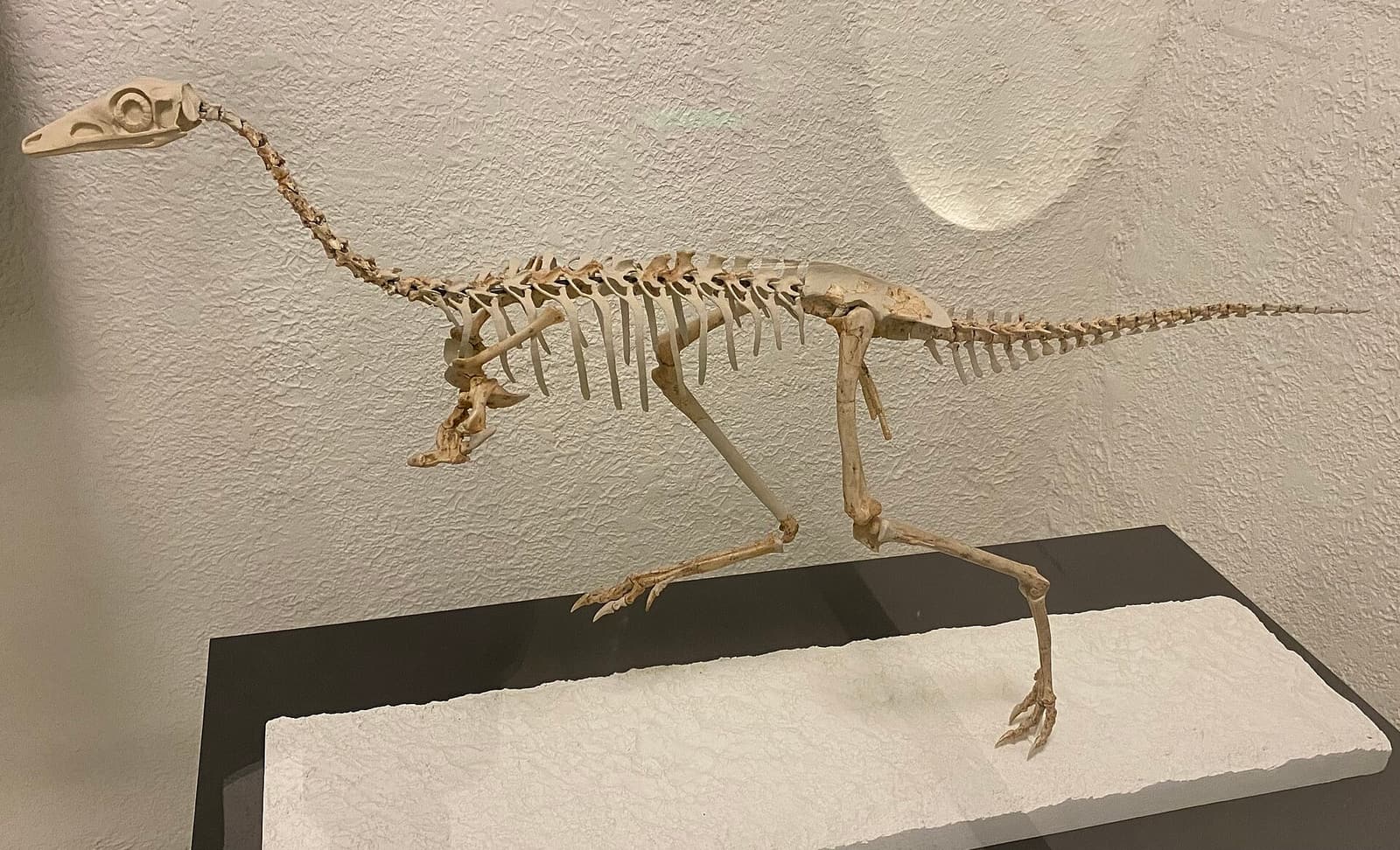
At first glance, Mononykus olecranus seems to have reached the end point of an evolutionary joke. Its hind limbs are long and light, its tail extends the body into a runner's balance beam, and under the chest hang two arms that appear to have been stopped almost as soon as they began. Each ends in one dominant claw. The whole forelimb looks too small to seize prey, brace a fall, or dig a conventional burrow.
That first impression gets the anatomy exactly backward. The arm was not fading away. It was being rebuilt around a narrower job. Mononykus sacrificed reach and versatility while enlarging the bony levers that let muscles retract, rotate, and extend the limb with force. A 2026 biomechanical study strengthens the long-standing case that this was a tool for breaking into resistant material—but it also shows why “dinosaur anteater” remains a hypothesis, not a meal preserved in stone.[2][3][4]
Image context: the cover is a real photograph of a skeletal mount at the American Museum of Natural History. It accurately conveys the animal's extraordinary proportions, but a mount combines fossil evidence with reconstructed elements and pose. The functional argument below rests on described and scanned specimens, not on the display silhouette alone.[1][4][7]
A small arm built from large levers
The holotype came from predominantly red sandstones of the Maastrichtian-aged Nemegt Formation at Bügiin Tsav, Mongolia, near the end of the Cretaceous. It was an associated partial skeleton with articulated forelimbs, hind limbs, and vertebrae, but only fragments of the skull and no complete tail. The detailed 1994 description already recognized the central paradox: the rest of the body was gracile and cursorial, while the short, robust forelimb resembled the force-producing apparatus of digging tetrapods.[1]
That paper's title placed Mononykus within Avialae, and the first report presented it as an unusually primitive flightless bird. Later discoveries changed the comparison set. The current consensus treats alvarezsauroids as non-avian maniraptoran theropods, with Early Cretaceous forms preserving stages between a more conventional theropod arm and the extreme limb of Mononykus.[1][5] The reclassification matters functionally: a keeled sternum and compact, birdlike-looking limb cannot be read as a flight apparatus when the rest of the lineage reveals an independent transformation toward force production.
The one claw is only the most visible part of that apparatus. The upper-arm bone is short and stout, with a prominent deltopectoral crest for muscles acting across the shoulder. The ulna carries an enlarged olecranon—the projection behind the elbow that increases the leverage of the triceps. In Mononykus, the radius and ulna are sutured into a tightly integrated forearm, the wrist and hand are consolidated, and one enlarged digit carries the principal claw. A keeled sternum provided still more area for powerful chest musculature.[1][4]
None of those features creates reach. They do the opposite: they concentrate motion into a compact chain. A long limb can move its tip through a broad arc, but it also places the load farther from the muscles driving it. Shortening the forearm while enlarging the olecranon increases the triceps' mechanical advantage. Fusing elements can reduce independent motion while helping the limb transmit force as a unit. The resulting hand was poor at grasping and the arm was far too short for sustained subterranean excavation. It made more sense as a pick than as a shovel.[2][4]
This distinction matters because “reduced” and “vestigial” are not synonyms. Reduction describes size or number; vestigiality implies diminished function. Mononykus reduced the length of the arm and the number of working fingers while exaggerating muscle attachments, joint congruence, and a single load-bearing digit. The anatomy points to specialization, not abandonment.
How do bones test a movement?
Fossils do not preserve a replay button. To move a dead joint, researchers must decide how its bones articulated, how much cartilage separated them, where muscles attached, and which poses would have forced one surface through another. Every answer adds an assumption. The strength of a functional claim depends on making those assumptions visible and testing whether different methods converge.
In 2005, Philip Senter manually articulated casts of the Mononykus forelimb. He found that the palms could face downward and that the hand could move through a restricted, forceful path suited to scratching or a hook-and-pull action. The reconstruction ruled out ordinary prey-grasping and burrow excavation while supporting the idea that the animal opened hard insect nests in a manner broadly comparable to anteaters or pangolins.[2]
Senter revisited the shoulder in 2023 because the earlier manipulation did not follow the standardized range-of-motion procedure developed in later studies. The restudy gave the humerus more freedom than the first reconstruction had allowed: the arms could tuck toward the body as well as sprawl outward to turn the palm down, making surfaces at more orientations accessible. That did not transform the limb into a general-purpose arm. It refined the envelope inside which a specialized action was possible.[3]
The 2026 study by Sidney Leedham and colleagues moved the test into three dimensions. The team used surface scans of Mononykus specimen AMNH FARB 28508, digitally repaired preservational gaps, and articulated a complete left forelimb. An algorithm then searched shoulder and elbow pose space across three rotations and three translations. Separate simulations treated bones as closely opposed or added conservative estimates for cartilage between their ends.[4]
The second half of the method asked not only where the bones could go, but where the muscles could push effectively. The researchers reconstructed muscle attachment sites using living birds and crocodilians as an anatomical bracket, calculated moment arms for major motions, and compared the resulting leverage with an unspecialized theropod and with living mammals that do or do not dig. This is a stronger test than matching one odd-looking claw to an anteater. It makes two independent predictions: a digging limb should permit the necessary path, and its muscle geometry should favor force along that path.[4]
It is still a model. Cartilage thickness in a non-avian dinosaur cannot be measured directly; one set of modern-bird values produced biologically implausible mobility at the unusual Mononykus elbow and had to be rejected. Muscle lines are reconstructed rather than preserved. A collision-free pose is not proof that the animal habitually used it. The useful result is therefore an envelope of feasible motion and leverage, not a frame-by-frame resurrection.[4]
Less room to move, more force where it counted
The simulations recovered a more restricted shoulder and elbow in Mononykus than in the earlier-branching alvarezsauroid Bannykus. The important motions were coupled rather than free: retracting the upper arm worked with rotation along its long axis, while the elbow behaved mainly as a stable flexion-and-extension joint. Its tightly matching surfaces limited wandering motion but could transmit load through the hand.[4]
The leverage results were even more revealing. Except for elbow adduction, the maximum moment arms in Mononykus exceeded those of the comparison theropod, Bannykus, and most mammals in the dataset. Its elbow extensors and shoulder rotators surpassed almost all of the sampled digging mammals. In the combined analysis, Mononykus fell firmly among diggers, near moles and golden moles—though not as a mechanical copy of either.[4]
That is the trade. The arm could not sweep widely, grasp flexibly, or reach far in front of the body. But within its narrow operating range, an enlarged shoulder crest, a keeled sternum, a long olecranon lever, a compact forearm, and a reinforced hand could direct substantial force into one claw. The small arm was powerful partly because it had given up other ways of moving.
The comparison with Bannykus turns that anatomy into an evolutionary sequence. Fossils described in 2018 preserve intermediate stages between the longer, three-fingered forelimbs of early alvarezsauroids and the short, functionally one-fingered limbs of Late Cretaceous forms. The transformation was mosaic: shortening, joint modification, digit reduction, and force specialization did not appear in one leap.[5] Bannykus retained a broader range of motion; Mononykus sat farther along the path toward a dedicated tool.[4][5]
Digging is not the same claim as eating termites
Here the evidence boundary becomes essential. In this literature, “digging” includes breaking resistant material above ground, such as a dead log or the wall of an insect nest. It does not require Mononykus to excavate a tunnel. Its arms were too short for that, and the rest of its skeleton was built around bipedal movement rather than the four-limbed body plan of a mole.[4]
Biomechanics makes substrate-breaking plausible. Reduced teeth and slender jaws in derived alvarezsauroids make small prey plausible. The Cretaceous diversification of social insects supplies an ecological opportunity. Together, those lines support insectivory and perhaps myrmecophagy—specialization on ants or termites—as the leading interpretation.[4] They do not preserve a termite in a Mononykus gut, a claw mark on a nest, or a particular foraging sequence.
The warning is not pedantic. In 2025, researchers reported bone-derived material in the intestinal contents of Bannykus, direct evidence that this earlier, less specialized alvarezsauroid had eaten animal tissue. The result suggests that forelimb transformation and dietary change were not locked to the same clock.[6] It does not refute later insect specialization in Mononykus. It shows why the exact meal cannot be read from arm geometry alone.
Even the modern analogies have limits. Anteaters, pangolins, echidnas, and moles are quadrupedal mammals whose forelimbs also carry their bodies. Mononykus was a bipedal theropod free to combine long running legs with arms unlike those of any living digger. Similar moment arms reveal convergence in the problem of applying force; they do not make the animals behaviorally interchangeable.[4]
The one claw is the end of the argument, not the beginning
Popular reconstruction tends to start with the claw and work outward: one big digit looks like a tool, so the animal must have opened termite nests. The stronger reconstruction runs in the other direction. It begins with the preserved shoulder, sternum, upper arm, elbow, forearm, wrist, and hand; tests how their surfaces can move; reconstructs muscle leverage; compares an earlier-branching relative; and only then asks which behaviors fit the whole package.
On that route, the digging hypothesis survives—and becomes more interesting. Mononykus was not powerful despite having a tiny arm. Its force came from the same transformation that made the arm look inadequate: reach was surrendered, joints were constrained, levers were enlarged, and three-fingered versatility collapsed toward one reinforced point of contact.
The AMNH mount catches that paradox in a glance. The arms almost disappear beneath the ribs, while the hind limbs dominate the silhouette.[7] But size alone is the wrong measurement. The scientific story lies in what the short arm could do per unit of muscle effort, which movements its joints refused, and how carefully anatomy can narrow a behavioral inference without pretending to witness it. Mononykus leaves us with a strong case for a specialized breaker of hard substrates—and an appropriately unfinished case for what, exactly, waited inside.
Sources
- Altangerel Perle et al., Skeletal Morphology of Mononykus olecranus (Theropoda, Avialae) from the Late Cretaceous of Mongolia, American Museum Novitates 3105 (1994)—Biodiversity Heritage Library record and digitized volume.
- Philip Senter, “Function in the stunted forelimbs of Mononykus olecranus (Theropoda), a dinosaurian anteater,” Paleobiology 31 (2005), 373–381.
- Philip J. Senter, “Restudy of shoulder motion in the theropod dinosaur Mononykus olecranus (Alvarezsauridae),” PeerJ 11 (2023), e16605—PubMed record with full-text links.
- Sidney Leedham et al., “Range of motion and myology support a digging function for the forelimbs of alvarezsauroid dinosaurs,” Proceedings of the Royal Society B 293 (2026), 20260565—University of Bristol publication record.
- Xing Xu et al., “Two Early Cretaceous Fossils Document Transitional Stages in Alvarezsaurian Dinosaur Evolution,” Current Biology 28 (2018), 2853–2860.e3.
- Shuo Wang et al., “Direct evidence of carnivory in the early-diverging Alvarezsaurian Bannykus,” The Innovation Geoscience 3 (2025), 100143.
- Wikimedia Commons, “File:Mononykus at AMNH.jpg”—Ryan Schwark's 2024 photograph of the museum skeletal mount and the source record for the article image.