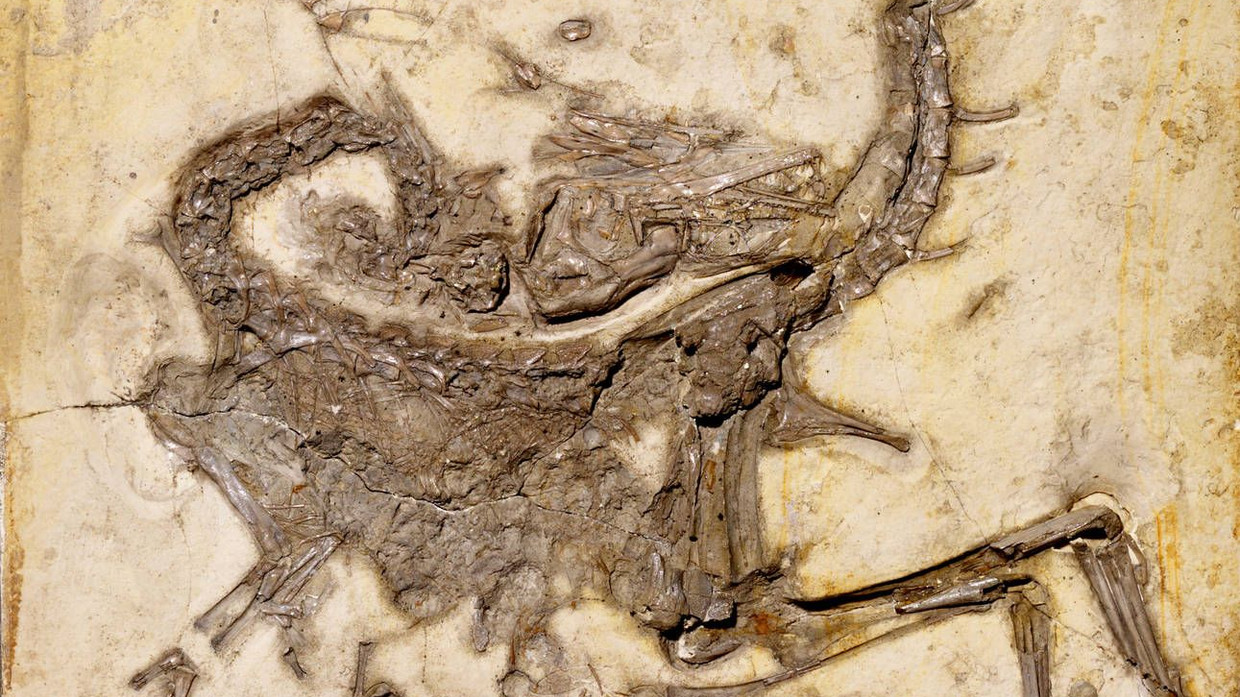
The little dinosaur seems to have died in an act of impossible recoil. Its jaws gape. The neck bends backward until the skull approaches the spine, while the tail answers with a long curve toward the body. Against pale limestone, the articulated bones look less scattered than clenched.
That shape has a clinical name: opisthotonic posture, an extreme backward arching of the vertebral column. It also has an irresistible nickname, the “death pose.” The first term describes geometry. The second quietly invites a story. Once the skeleton looks agonized, drowning, poisoning, suffocation or a final muscular spasm can feel visible in the rock.
The cover photograph shows the German specimen of Compsognathus longipes, a small theropod preserved in Upper Jurassic limestone from the Solnhofen region.[2][6] It is real fossil evidence, not a restoration. Yet its drama is exactly why restraint matters. An arched skeleton preserves the end of a physical sequence; it does not automatically preserve the cause of death. Perimortem spasm, postmortem ligament action, buoyancy, decay and the permitted motion of the joints can converge on a similar final curve.[1][2][3][4]
The useful question is therefore not “What does this pose mean?” It is “Which sequence could have made this pose in this animal, in this sediment, without contradicting the joints?”
The posture is an observation; “death throes” is a hypothesis
In 2007, Cynthia Marshall Faux and Kevin Padian made the strongest modern case for a perimortem reading. They examined articulated vertebrate fossils with skull and neck recurved over the back, tail extended, jaws open and limbs contracted. After considering rigor mortis, drying, salinity and ligament contraction, they argued that those familiar postmortem mechanisms could not account for the most extreme examples. Their alternative was neurological: damage to the central nervous system could produce muscle spasms before death, as opisthotonus does in living animals affected by asphyxia, toxins, infection or other severe stress.[1]
The argument was valuable because it refused a vague explanation. “The tendons shrank” was not enough; the proposed tissue had to exert enough force, in the available time, through the preserved joints. Faux and Padian also distinguished ordinary current-bent carcasses from the more organized posture they were trying to explain.[1] They turned a museum silhouette into a testable causal claim.
But the same precision exposed the claim to a stronger countertest. A neurological syndrome can produce arching in a dying animal. That does not mean every fossil arch is a frozen syndrome. The skeleton reached the slab through decay, transport, settling, joint relaxation, compression and burial. Any diagnosis that jumps from the last geometry to the first cause has silently removed that interval.
Water gives ligaments room to act
Achim Reisdorf and Michael Wuttke reopened that interval in a 2012 taphonomic study centered on Compsognathus and Juravenator from the Solnhofen Archipelago. Their reconstruction treated the carcass as a changing mechanical system. Muscles decay at a different rate from tougher connective tissues. Joints lose active control. In water, buoyancy reduces the load that would otherwise pin a neck and tail against the ground. Elastic structures can then pull a relaxing vertebral column toward a characteristic resting configuration.[2]
They concluded that the opisthotonic shape in Compsognathus was postmortem, not a spasm captured at death. Just as importantly, they used Juravenator, which lacks the classic arch, as a comparison. Orientation and contact with the bottom can constrain which way a carcass is able to move. Two related animals in broadly similar lithographic-limestone settings need not finish in the same pose because “the environment” is not a single condition: depth, salinity, arrival orientation, decay stage and burial rate still differ from basin to basin and body to body.[2]
This does not make ligament recoil a universal answer. It makes sequence visible. A postmortem model has to explain why the skeleton remained articulated, when the body entered water, which tissues still connected the vertebrae, how the carcass rested and what stopped further movement. The curve alone cannot supply those conditions.
Experiments separate permission from trigger
Living analogues sharpen that boundary because they let researchers watch bones and soft tissue move rather than infer every step from a compressed slab.
Anthony Russell and Andrew Bentley used radiographs to follow the domestic chicken neck through its full sagittal range. The vertebrae did not behave as one evenly flexible chain. They formed three functional regions, with the greatest excursions concentrated at the boundaries between them and at the skull-neck joint. The combined geometry made backward displacement mechanically easy, while equivalent forward displacement became restricted. Their conclusion was deliberately plural: the chicken neck is predisposed to the “dead bird” posture, but the circumstances that trigger it are likely varied.[3]
That distinction is central. Anatomy can permit a pose without identifying the event that caused it. A mobile skull joint, an S-shaped resting neck and uneven flexibility explain why different carcasses may converge on the same outline. They do not choose between neurological spasm, immersion, decomposition or a mixture of processes.
Theagarten Lingham-Soliar supplied a second kind of test in 2016 by allowing three ostrich carcasses to decompose in a natural setting: two on land and one in shallow water. The land carcasses developed strong neck arching but stopped short of the classic posture. The immersed carcass reached the full opisthotonic configuration as decay progressed. The experiment demonstrated that a recognizable “death pose” can arise after death under observable conditions, without requiring the animal to hold that form during its last moments.[4]
One small experiment does not reproduce a Jurassic lagoon, and an ostrich is not Compsognathus. Its value is narrower and stronger: it establishes possibility. Once a postmortem route has been observed, a fossil diagnosis must show why that route fails in the specimen at hand before treating the pose as evidence of a specific fatal syndrome.
Read the joints before reading the drama
The skeleton itself can preserve limits that the overall silhouette hides. A living neck moves while articular surfaces retain functional contact and soft tissues resist dislocation. A fossil neck bent so far that its zygapophyses—the paired vertebral processes that guide and limit motion—have slipped past one another records a range that was not a sustainable life posture. The curve may be genuine while the implied behavior is impossible.
Kent Stevens showed how easily that distinction can escape from a quarry into reconstruction. The juvenile Camarasaurus lentus specimen CM 11338 was preserved with its neck strongly recurved and many cervical joints displaced. A 1925 skeletal drawing kept the fossil's dramatic curve but redrew the vertebrae as neatly aligned. The result converted taphonomic distortion into apparent anatomy and helped naturalize a swan-necked Camarasaurus in later imagery.[5]
This is the second danger of the death pose. It can be mistaken not only for a cause of death but for a capability in life. Resetting each joint toward a defensible neutral articulation removes information about the carcass's final movement, but that is exactly the point: life reconstruction and taphonomic reconstruction ask different questions. One restores a working column. The other explains how the working column came apart.
The slab preserves a sequence, not a final photograph
Return to Compsognathus. The photograph gives several observations at once: a largely articulated skeleton, an open jaw, strong recurvature, fine-grained host rock and enough continuity along the spine to make the pose look coordinated.[2][6] Those features narrow the possibilities. They do not reveal whether the animal's nervous system failed before death, whether the carcass floated, how long decay proceeded, or which tissues were still bearing tension when the body settled.
A strong reading therefore moves in order. First map articulation and disarticulation. Then establish the slab's original orientation, depositional setting and evidence for transport. Compare decay resistance along the body, ask where gravity or buoyancy could act, and test whether the joints could reach the preserved angles in life. Only after that work should pathology or cause of death enter the story.[1][2][3][4]
Restraint here is not refusal to interpret. It is the method that keeps several real kinds of evidence from impersonating one another. The arched fossil is not mute: it records anatomy, tissue failure, movement and burial. But it is not a photograph of an animal's last conscious second. The “death pose” becomes scientifically useful when it stops being treated as the answer and starts being read as the final state a complete causal sequence must explain.
Sources
- Cynthia Marshall Faux and Kevin Padian, “The opisthotonic posture of vertebrate skeletons: postmortem contraction or death throes?” Paleobiology 33 (2007)—the perimortem neurological-spasm hypothesis and its tests against rigor, desiccation and ligament contraction.
- Achim G. Reisdorf and Michael Wuttke, “Re-evaluating Moodie's Opisthotonic-Posture Hypothesis in Fossil Vertebrates, Part I,” Palaeobiodiversity and Palaeoenvironments 92 (2012)—taphonomic reconstructions of Compsognathus and Juravenator, decay sequence, water, orientation and postmortem biomechanics.
- Anthony P. Russell and Andrew D. Bentley, “Opisthotonic head displacement in the domestic chicken and its bearing on the ‘dead bird’ posture of non-avialan dinosaurs,” Journal of Zoology 298 (2016)—radiographic analysis of regional neck motion and the conclusion that triggers are likely varied.
- Theagarten Lingham-Soliar, “Experiments on ostrich decomposition and opisthotonus with implications for theropod dinosaurs,” Journal of Zoology 300 (2016)—natural-setting carcass experiments comparing decomposition on land and in shallow water.
- Kent A. Stevens, “The Articulation of Sauropod Necks: Methodology and Mythology,” PLOS ONE 8 (2013)—joint-based reconstruction and the case of a Camarasaurus death curve carried into life posture.
- Reinhard Wandtner, “Krümmung ohne Krampf,” Frankfurter Allgemeine Zeitung (2012)—publication page and credit for the photographic cover image of the German Compsognathus specimen.