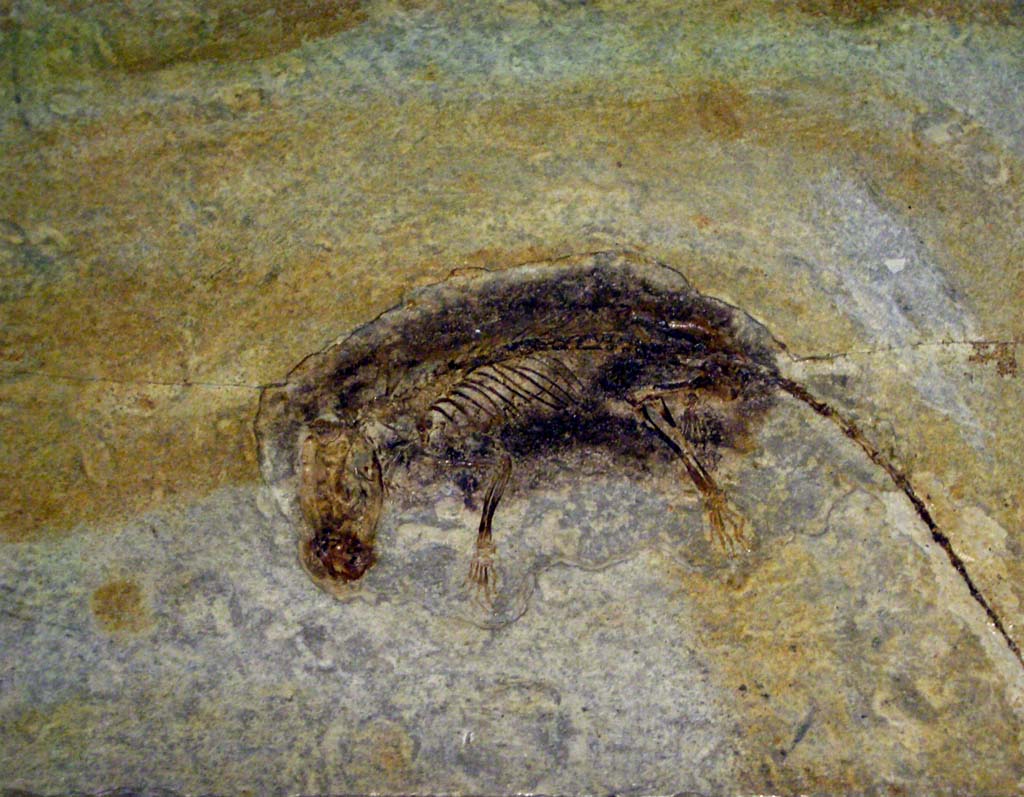
Eomaia scansoria is most interesting when it is allowed to stay small. The fossil came from the Lower Cretaceous Yixian Formation of northeastern China and was described in 2002 as a roughly 125-million-year-old skeleton near the root of Eutheria, the broader mammal group on the placental side of the marsupial-placental split.[1] That made it famous immediately. It also made it easy to oversimplify.
The tempting headline is "first placental mammal." The better reading is stricter: Eomaia is a threshold fossil. It sits close enough to the eutherian side to make the early history of placental relatives visible, but it should not be treated as a direct portrait of the last common ancestor of living placentals. Later work on placental origins has kept crown Placentalia, the group made of living placentals and their closest fossil relatives, separate from older stem eutherians and has argued for a major post-K-Pg radiation of living placental lineages.[2][6] Eomaia therefore matters less as a trophy ancestor than as a fossil that shows what the pre-placental neighborhood looked like.
That distinction is not pedantry. It changes how the slab should be read. The animal preserves a body with hair, small teeth, delicate limb bones, and feet interpreted as suited to climbing or tree life.[1] Those are concrete anatomical signals, not a full biography. The fossil does not let us watch a Cretaceous mammal scamper through branches. It gives a set of constraints: a tiny body, scansorial limb proportions, and a place in the early diversification of eutherian-grade mammals before modern placental orders existed.
The slab is a body, not a mascot
The original Nature paper described Eomaia from a skeleton with skull and postcranial material, enough of the body to compare teeth, wrist, ankle, and limb proportions together.[1] That completeness is the first reason the fossil still works. Many early mammal stories turn on isolated teeth, because mammalian dental anatomy is richly diagnostic. Teeth can be powerful, but they can also make the animal disappear behind classification. Eomaia keeps the animal partly visible.
The visible body matters because early mammal evolution was not only a sequence of jaw and tooth changes. It was also an ecological expansion into different body sizes, postures, and movement styles. The 2002 description argued that Eomaia had limb and foot features known in scansorial or arboreal living mammals, contrasting that signal with more terrestrial or cursorial features in some other Cretaceous eutherians.[1] The species name, scansoria, points to that climbing interpretation.
The image belongs for the same reason. A museum photograph of the fossil is quieter than a life reconstruction, but it is more honest for this argument. The flattened specimen does not show a furry branch runner in motion. It shows the evidentiary surface: a small mammal compressed into a slab, with enough anatomy preserved to raise locomotor and phylogenetic questions.[5]
Hair is evidence, but not the whole story
One of the instantly appealing details of Eomaia is the preservation of hair traces.[1] Hair pulls the animal out of the abstract category "Mesozoic mammal" and makes it feel close to living mammals. But that familiarity has to be handled carefully. Hair does not make Eomaia modern, and it does not make it placental in the narrow crown-group sense.
The better use of the hair signal is ecological. A tiny Cretaceous mammal with preserved fur belongs to a world where mammalian physiology, insulation, and nocturnal or small-bodied niches were already sophisticated long before the end-Cretaceous extinction opened later ecological space for placental orders. In other words, Eomaia helps separate two histories that are often blended: the older history of mammalian body construction, and the later history of living placental diversification.[2][6]
That separation protects the fossil from a common story error. If every old eutherian-grade fossil becomes "our ancestor," the actual branching pattern disappears. Deep-time relatives are not automatically direct grandparents. Eomaia is more useful as a side-lit body near a major split: close enough to show early eutherian possibilities, distant enough that it should not be forced into a straight human-centered line.
Feet make the animal sharper
The climbing signal is where the fossil becomes more than a date point. The original description emphasized limb and foot features associated with scansorial and arboreal mammals.[1] That does not prove a whole day-in-the-life scene, but it does push against the old flattening of Mesozoic mammals into generic ground-level insectivores hiding under dinosaurs.
The Yixian and broader Jehol record repeatedly made small-bodied vertebrates more ecologically vivid by preserving fine detail. Other Early Cretaceous eutherian finds from the Jehol biota, such as Acristatherium, also show that eutherian-grade mammals were diversifying in the region rather than appearing as one isolated form.[3] Acristatherium is known from much more limited material, but its description matters beside Eomaia because it reinforces the point that Early Cretaceous eutherian history was not a single fossil event.[3]
Read that way, Eomaia is not important only because it is old. It is important because it is old and ecologically legible. A 125-million-year-old mammal with climbing-adapted proportions says that eutherian-grade mammals were already testing different ways of moving through the Cretaceous landscape. The animal's small size is not a weakness in the story. It is part of the story: early mammalian success often happened in small bodies whose ecological differences are easy to miss unless the limbs, feet, and preservation are taken seriously.
The placental boundary should stay visible
The strongest version of the article is also the most restrained. Eomaia should not be used as a finished placental ancestor. O'Leary and colleagues' 2013 study reconstructed the ancestor of living placental mammals and argued that crown placental diversification occurred after the K-Pg boundary, using a large combined dataset of anatomical and genetic traits.[2] A public summary of that work makes the same implication plain: the common ancestor of living placentals is modeled as a post-dinosaur-extinction animal, not as a named Yixian fossil from the Early Cretaceous.[6]
That does not demote Eomaia. It clarifies the category. The fossil is still a major eutherian-grade mammal from the Cretaceous; it still extends the skeletal record close to the placental side of therian evolution; and it still preserves a rare combination of skull, body, hair, and locomotor evidence.[1] What changes is the claim we ask it to carry. Instead of saying "here is the first placental," the sharper claim is "here is an early eutherian body close enough to show what the placental side was assembling before crown placentals radiated."
There is also a posture lesson in the wider early-mammal literature. Kielan-Jaworowska and Hurum used taphonomic patterns from lacustrine fossil settings, including Jehol mammals, to discuss how skeletons of different early mammal groups were compressed and what that might imply about sprawling versus more parasagittal limb posture.[4] Their argument is broader than Eomaia, but it shows why preservation mode matters. A flattened mammal slab is not just a picture; it is a record shaped by anatomy, posture, burial, and compression.[4]
What Eomaia can carry
The secure claim is strong enough. Eomaia scansoria is a small Early Cretaceous mammal from the Yixian Formation, described from a comparatively informative skeleton with hair traces and limb features that support a scansorial or arboreal interpretation.[1] It belongs near the early eutherian story, and it helps show that the Cretaceous relatives of placentals were anatomically and ecologically more varied than a simple "small mammals underfoot" stereotype allows.[1][3]
The boundary is just as important. Eomaia is not a clean modern placental in miniature. It is not a direct ancestor certificate for humans, bats, whales, or shrews. It is a fossil from the stemward side of a larger story, valuable precisely because it preserves a body before later placental diversity made the outcome look inevitable.[2][6]
That is why the slab still deserves attention. It turns the origin story down to a readable scale: a small hairy mammal, pressed into Cretaceous rock, carrying enough anatomy to show climbing ability, early eutherian placement, and the danger of confusing a threshold fossil with a finished ancestor.
Sources
- Qiang Ji, Zhe-Xi Luo, Chong-Xi Yuan, John R. Wible, Jian-Ping Zhang, and Justin A. Georgi, "The earliest known eutherian mammal," Nature 416 (2002) - original description of Eomaia scansoria.
- Maureen A. O'Leary et al., "The Placental Mammal Ancestor and the Post-K-Pg Radiation of Placentals," Science 339 (2013), PubMed record - crown placental timing and reconstruction context.
- Yaoming Hu, Jin Meng, Chuankui Li, and Yuanqing Wang, "New basal eutherian mammal from the Early Cretaceous Jehol biota, Liaoning, China," Proceedings of the Royal Society B 277 (2010), PubMed record - Jehol eutherian diversity context.
- Zofia Kielan-Jaworowska and Jorn H. Hurum, "Limb posture in early mammals: Sprawling or parasagittal," Acta Palaeontologica Polonica 51 (2006) - early mammal posture and taphonomic comparison.
- Wikimedia Commons, "File:Eomaia scansoria.JPG," museum photograph of an Eomaia scansoria fossil displayed in the Hong Kong Science Museum, used as the article image.
- ScienceDaily, "Most comprehensive tree of life shows placental mammal diversity exploded after age of dinosaurs" (2013) - public summary of the post-K-Pg placental ancestor study.